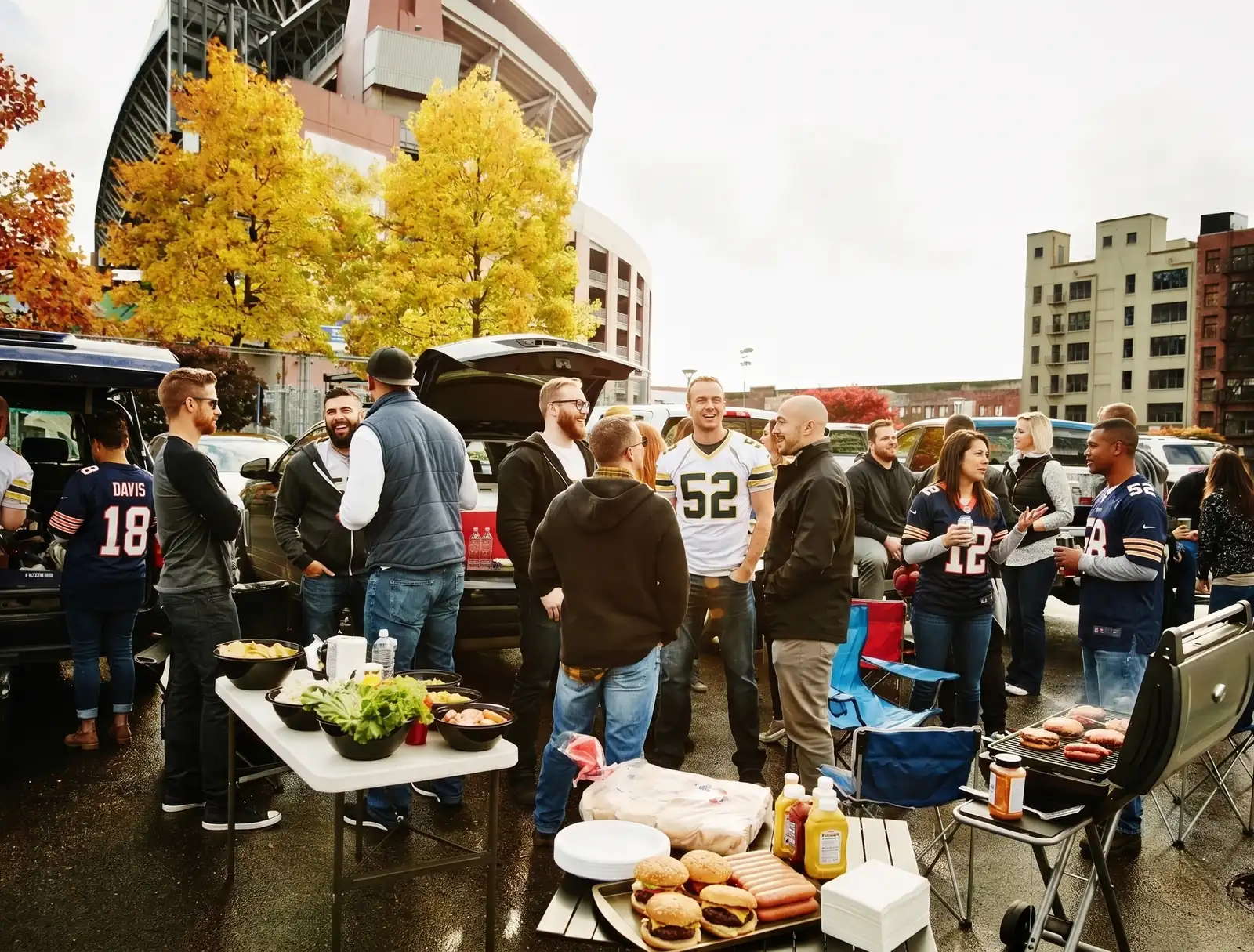
The smell of hot dogs on a grill. The sounds of bean bags hitting a cornhole board. The sight of hundreds of people wearing their favorite player’s jersey. These are just a few of the classic signs of a football tailgate. Between grilling, playing cornhole, and even passing the time with a quick game of Sudoku, fans have plenty of ways to enjoy the hours before kickoff. This tradition, which carries from city to city, is a popular pregame ritual that many fans take very seriously—and for some, it can even rival attending the game itself.
As we enter another football season, we set out to learn which NFL cities offer the best conditions for tailgaters. To do this, we collected weather, parking, local store, and attendance data to create an overall tailgating score on a scale of 0 to 100, with 100 representing the best spot for tailgating. Read on to learn more about our findings and which week is the best to schedule a tailgate for your favorite team.
Key Takeaways
- Los Angeles is the best city for tailgating as the Chargers and Rams top the ranking.
- The Los Angeles Chargers and Los Angeles Rams have the best gameday weather this season.
- Raiders fans have the best odds of a dry tailgate in the NFL, with just a 7% average chance of rain across their home schedule.
- 18 of 32 teams see their best tailgating weather in the first two weeks of the season.
- The Buffalo Bills' Week 15 matchup against the Chicago Bears is the most likely game to see snow this season.
The Best and Worst Teams for Tailgating This Season
A great tailgate needs a few things to go right at once. You want weather you can stand around in, enough open pavement to set up, stores close by to stock the cooler, and enough fans turning out to make the lot feel like a party. We scored all 32 teams on those four factors, but we weighted gameday weather the heaviest at 50% because conditions often decide whether fans show up to the lot at all.
Los Angeles came out on top, and it did it twice. The Chargers lead the league with a tailgating score of 87.5 out of 100, and the Rams sit right behind them at 87.2. Both teams play at SoFi Stadium, so they share the same lots and the same nearby stores. What separates them is the calendar because each team is scored on its own home schedule.
The Chargers drew two September home dates to the Rams' one, while the Rams pick up an extra game in late December, and that trade is enough to move the numbers. Across their scored home games, the Chargers average 64.2 degrees with a 9% chance of rain, while the Rams land at 63.6 degrees with a 10% chance.
The Houston Texans take third with a score of 83.8, powered by the biggest parking footprint in the NFL. The Arizona Cardinals follow in fourth at 83.5, then the New York Giants (81.9) in fifth and the Philadelphia Eagles (81.2) in sixth.
The New York Jets round out the top seven at 80.0, which means the two shared stadiums placed both of their teams in the top 10 as SoFi landed first and second and MetLife claimed fifth and seventh. The Washington Commanders and San Francisco 49ers tie for eighth at 79.0, and the Miami Dolphins close out the top 10 at 78.6.
Further down the list, the story is less about what a city lacks and more about what its fans are willing to put up with. The Green Bay Packers (52.0), Minnesota Vikings (53.0), and Seattle Seahawks (53.4) sit at the bottom of the overall ranking, and all three are cold, wet, or cramped in ways a scoring model notices and a diehard fan shrugs off.
Weather is a big part of that. Green Bay's home schedule averages a high of just 46 degrees, the coldest in the league, and the Packers are one of only two teams without a single home date where both the daily high and the daily low fall inside the ideal outdoor range (51°F to 80°F).
Even Lambeau's most comfortable day of the season, hosting Atlanta on September 24th, peaks at 69 degrees before sliding back to 47 after dark. Minnesota's home highs average 47 degrees, the next coldest in the NFL.
Seattle's story is a different one. The Seahawks actually see milder conditions than the teams around them at the bottom of the list, averaging a high of 56 degrees across their home schedule. What holds them back is space: There are roughly 34 acres of surface parking within a mile of Lumen Field, and only 35% of it sits within a half mile of the gates.
Where Fans Get the Best Gameday Weather
Weather carries the most weight in our ranking since conditions often decide whether fans bother to show up early at all. For this portion of the study, we scored every team's scheduled home games on temperature and the chance of measurable rain.
The two Los Angeles teams come out ahead again, as home games at SoFi Stadium average a high near 72 degrees whether the Chargers or the Rams are hosting. Las Vegas, Arizona, and San Francisco round out the top five.
Rain is the biggest separator, however, as Raiders fans have the driest home schedule in football at just a 7% average chance of measurable rain, with the Chargers (9%), Arizona (10%), and the Rams (10%) close behind.
On the other side, Seattle sees a 50% average chance of rain across its home dates, followed by Buffalo (47%) and Cleveland (45%), which is a big reason those tents get so much use in the Pacific Northwest and around the Great Lakes.
Temperature tells a slightly different story though, as Miami has the warmest home schedule in the league at an average of 75 degrees, with Tampa Bay right behind at 74. Arizona lands closest to the middle of that comfortable range at an average of 67 degrees, which is about as easy as a parking lot gets.
The Stadiums Where the Lots Sit Closest to the Gates
Every tailgater has a version of the same setup. You find the best parking spot, set up a tent and chairs, get the grill going, and that patch of pavement becomes home base for the next few hours. What changes from city to city is how far that spot sits from the gates, and that distance decides more than it seems.
A short walk means your tailgate can last a little longer, and after the game is over, you have an easy trip back to your car. To measure this, we mapped the parking lots within a mile of each stadium, then looked at how much of that space sits within a half mile of the gates.
On sheer space, Houston is in a class of its own with 396 acres of surface parking inside a mile of Reliant Stadium, the largest tailgating footprint in the NFL. Santa Clara comes next with 286 acres around Levi's Stadium, followed by Glendale with 273 acres around State Farm Stadium.
When it comes to the closest tailgating spots, Tampa Bay leads the league with 88% of the parking near Raymond James Stadium sitting within a half mile. SoFi Stadium is second at 86% and Highmark Stadium third at 85%, which is welcome news for Bills fans who spend as much time in that lot as anyone in football.
MetLife Stadium follows at 82%, and Arrowhead Stadium comes in fifth at 77%. In those cities, the trip to the gates is quick enough that the grill can stay on a little longer. A few cities manage both, with plenty of acres and a short walk. Arizona is the clearest example because 74% of those 273 acres around State Farm Stadium falls inside the half mile, giving Cardinals fans one of the biggest tailgating footprints in football and one of the shortest trips to their seats.
Gillette Stadium (73%), Lincoln Financial Field (70%), Soldier Field (68%), and Hard Rock Stadium (67%) round out the top 10, each putting roughly two of every three parking acres within easy reach of the gates.
What's Close By for Tailgaters
Before anyone fires up a grill, somebody has to make the run for food, drinks, and a bag of ice. To account for that, we counted the liquor, beer, wine, grocery, supermarket, and convenience stores within five miles of each stadium along with their average customer rating.
Philadelphia wins this one outright, with 1,941 stores within five miles of Lincoln Financial Field, more than any other NFL city. MetLife Stadium is second with 1,557 and SoFi Stadium third with 1,521.
Quality is where the smaller markets shine. Buffalo has the highest rated stores in the NFL at 4.24 out of 5, and Green Bay ranks second at 4.23 despite having one of the shortest lists of options in the league. Detroit, Minnesota, and New Orleans all average 4.20. Fewer choices isn't much of a drawback when the ones nearby are the places fans keep going back to.
The Best Gameday Forecasts This Season
After scoring the full season, we wanted to find the single best home date on each team's calendar to help fans plan ahead. To do this, we looked at every scheduled home game and picked the one with the most comfortable combination of temperature and rain chance, which gives every fan base one weekend to circle on the calendar.
Overall, we found that early season wins as 18 of the 32 teams get their best tailgating weather in the first two weeks. Week 1 accounts for nine of them. Seattle gets there first, as its best day of the year is the NFL's Wednesday opener on September 9th against New England. The other eight all land on September 13th, when the Bengals, Chargers, Colts, Giants, Eagles, Lions, Steelers, and Vikings each hit their most comfortable home conditions of the season.
Week 2 matches it with another nine. Buffalo goes first on September 17th against Detroit in a Thursday night game. This is followed by a September 20th group that includes the 49ers, Bears, Broncos, Chiefs, Jets, Patriots, and Ravens. The Rams will close out the run on September 21st against the Giants.
From there the calendar thins out and moves into fall. Green Bay's best day arrives September 24th against Atlanta and Cleveland's on September 27th against Carolina, both in Week 3. Carolina's own peak comes October 4th against Detroit, then Dallas on October 8th against the Buccaneers, Tennessee and Washington on October 11th, and Atlanta on October 18th. Las Vegas and Houston share the last October date, with both hosting on the 25th.
Five teams wait until Week 8 or later, and all five are warm weather markets where the best tailgating conditions show up after the summer heat lets go. Jacksonville's day arrives November 1st, New Orleans on November 8th, Arizona on November 15th, and Tampa Bay on November 30th. Miami waits longer than anyone in the league, all the way to January 3rd against Buffalo in Week 17.
Ten teams get the best of both worlds, drawing their most comfortable home date against a division rival. Giants fans get Dallas, and Eagles fans get Washington on that opening September 13th weekend, while Vikings fans host Green Bay the same day and Bears fans return the favor against Minnesota a week later. Later on, Tennessee hosts Houston, Washington hosts the Giants, Jacksonville hosts Indianapolis, Arizona hosts the Rams, Tampa Bay hosts Carolina, and Miami closes out the list against Buffalo.
The Tailgates Most Likely to Get Snowed On
Finally, we looked at the other end of the tailgating experience. Using the same 30-year averages, we found the home games with the highest chance of an inch or more of snow, and a few fan bases should probably plan on it.
Buffalo's Week 15 matchup against Chicago on December 19th tops the list with a 20% chance of an inch or more, which comes as no surprise to anyone who's seen a Bills lot in December. Cleveland's Week 17 game against Indianapolis on January 3rd is second at 17%, and Green Bay appears twice, hosting Houston on January 4th (13%) and Miami on December 20th (12%).
A game many Americans will gather around their TVs to watch is the Buffalo Bills vs. Kansas City Chiefs in the Thanksgiving primetime game on November 26th. With an 11% chance of snow, this Week 12 game rounds out the top five.
Green Bay's Week 17 date is the coldest game on the entire list by a wide margin, with an average high of 26 degrees and a low of 13, roughly ten degrees colder than the Buffalo and Cleveland games on this list. For a lot of fans, that's the whole point. A snowy tailgate is the one people talk about all year, and the parking lots at Lambeau and Highmark tend to be at their best when the forecast is at its worst.
Enjoy a Game Before the Game
Gamedays can be a thrilling experience, but some moments are less exciting than others. Whether boredom creeps in while sitting under your tent for a few minutes to cool off at the tailgate or while waiting in line at the concession stand in the stadium, the team at Sudoku Bliss can help keep the entertainment going.
We offer a variety of puzzles ranging from easy to evil to ensure that Sudoku rookies and veterans alike get the experience they want. Whether you've got five minutes in the parking lot or the whole halftime break, there's a puzzle waiting.
Methodology
In this study, we set out to find the best NFL cities for tailgating. To do this, we scored all 32 NFL teams across four factors: gameday weather, surface parking around the stadium, the density and quality of nearby stores, and gameday attendance using data from the National Centers for Environmental Information, OpenStreetMap, Google Maps, and ESPN in August 2026.
For the weather data, we analyzed 30-year averages for each team's scheduled home games for the 2026-27 season. We then collected the normal high temperature, the normal low temperature, the normal average temperature, normal rainfall, the chance of measurable rain, and the chance of an inch or more of snow for each team. We scored temperature against the 51°F to 80°F range the National Weather Service treats as requiring no wind chill or heat index adjustment, awarding a full score inside that band and deducting three points per degree outside it. The daily high and low were scored separately and averaged, since a cold morning and a hot afternoon can produce the same daily average as a comfortable day, and rain was scored as the inverse of its likelihood, so a 25% chance of measurable rain produces a score of 75.
For the parking data, we measured every mapped parking area within one mile of each stadium to determine the total acreage of available parking nearby and the percentage of share of a city's parking located within a half mile of the stadium. Parking garages and structures were excluded throughout, since tailgating requires open pavement. We then turned our attention to the businesses fans frequent ahead of a tailgate to stock up on their necessities like food, beer, and more. To incorporate this factor, we analyzed Google Maps for the density of liquor, beer, wine, grocery, supermarket, and convenience stores within five miles of each stadium along with their average customer rating. Because there is no external standard for how many acres or stores a city should have, acreage and store counts were ranked across all 30 stadium cities.
Finally, we analyzed attendance data from ESPN's 2025 season figures, divided by each stadium's listed capacity that year. This factor was designed to show which teams have the biggest fan turnout for home games, as a packed parking lot can make for a more entertaining tailgate.
We then combined those four scores with the following weights to calculate the overall tailgating score for each team: weather 50%, parking 25%, nearby stores 15%, and attendance 10%. We decided that weather would carry the most weight as conditions can sometimes determine whether fans turn out to tailgate at all.
Because the New York Giants and New York Jets share MetLife Stadium and the Los Angeles Rams and Los Angeles Chargers share SoFi Stadium, those teams share parking, store, and attendance figures but are scored separately on weather, which follows each team's own schedule. Games played outside the home city were excluded from weather scoring, as were the Week 16 through 18 dates the NFL had not yet scheduled when this data was collected. Attendance figures include international home games, which draw larger crowds than any home stadium holds. Finally, OpenStreetMap also does not capture informal parking, such as the residential driveways, which may understate some teams' true capacity.