How to Play Killer Sudoku
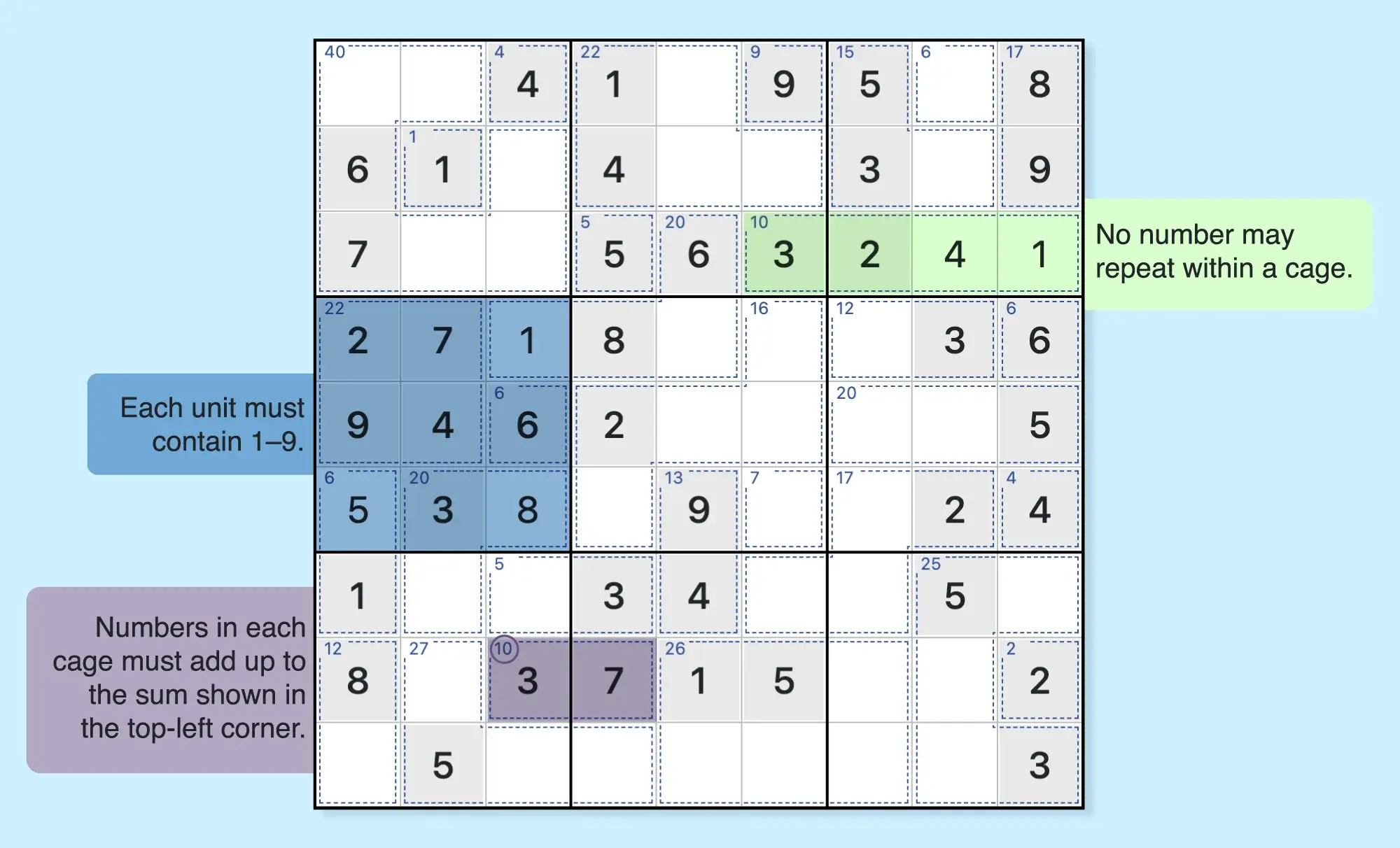
To solve Killer Sudoku, you must fill in the grid following standard Sudoku rules plus additional cage constraints:
- Each unit (row, column, or 3x3 block) must contain the numbers 1–9 without repeats.
- Numbers in each cage (outlined by dotted lines) must add up to the sum shown in the top-left corner.
- No number may repeat within a cage.
Killer Sudoku Strategies
Killer Sudoku, also known as Sumdoku, follows the same rules as regular Sudoku, but with an added layer of cage sums, so familiar solving strategies still apply. However, cage sums also give you the opportunity to use arithmetic-based strategies. These tips will help you solve Killer puzzles more efficiently:
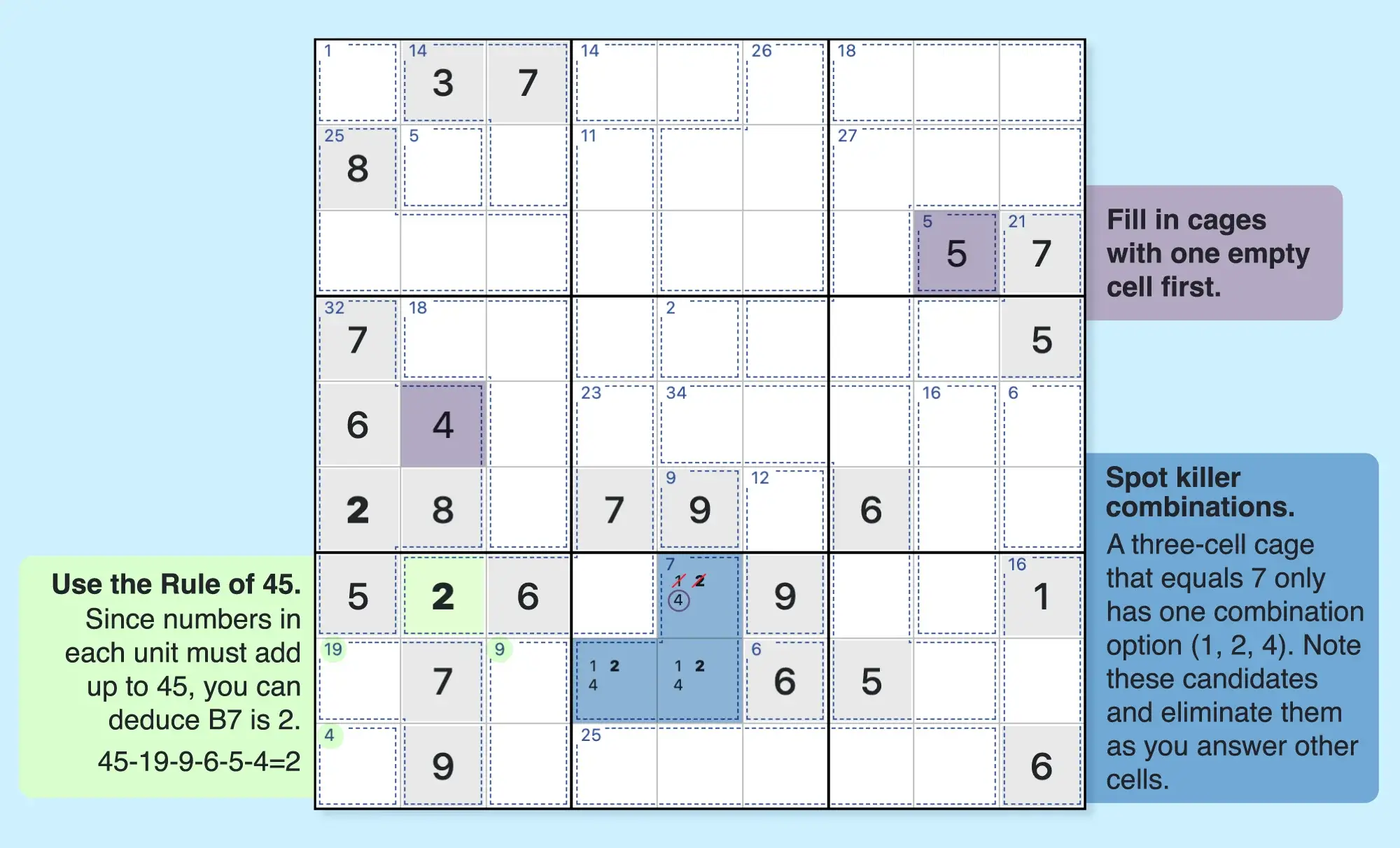
- Start with one-cell cages and cages with only one empty cell. Single-cell cages have a fixed number you can place immediately, and cages with only one empty cell can be solved by subtracting the known numbers from the cage total. Filling these single-digit opportunities early can help you unlock other answers.
- Look for high or low cage sums. Extreme sums limit possibilities. When you see large or small numbers in the upper left corner, there are often only one or two possible number combinations. For example, a two-cell cage equaling 17 can only be 8 + 9, while a sum of 3 can only be 1 + 2. Similarly, the only possible combination for a four-cell cage equal to 30 is 6 + 7 + 8 + 9.
- Use the Rule of 45. Since each unit contains 1–9 exactly once, the sum of each unit is 45. By subtracting the sums of multiple cages from an area, you can calculate the digit needed for the remaining empty cell.
- Use pencil marks (also known as candidate numbers). Write all possible answers in the corners of empty cells and update them as you place numbers. This helps spot patterns, eliminate options, and plan moves. You can add candidate numbers by checking the "This number is a possibility" box.
- Consider killer combinations. A killer combination is the set of all possible number groups that can fit inside a cage and add up to its target sum without repeating digits. For example, a three-cell cage summing to 6 must be 1 + 2 + 3, while a two-cell cage summing to 6 could be 1 + 5 or 2 + 4. Cross-check these possibilities with surrounding candidate numbers to eliminate impossible options.
Difficulty Levels
While Killer Sudoku may sound intimidating, the extra cage constraints can actually make this number puzzle feel easier than Classic Sudoku, since they help you narrow down possible answers more quickly. We offer five different skill levels, for beginners to advanced players, so you can start simple and gradually challenge yourself as your skills improve.
Puzzle Features and Options
To customize your Killer Sudoku puzzles, click "See More Options" below the grid. You can:
- Remove possibilities automatically: Choosing this option automatically removes candidate numbers when you place an answer in a cell, so you don't have to manually adjust them.
- Use Automove: This fills the last empty cell in a unit when only one number is possible.
- Allow incorrect moves: Decide whether the game alerts you to mistakes or lets you solve without hints.
- Customize number input: Choose to place numbers by clicking or typing and whether you want to highlight the active number.
- Adjust visuals and animations: Toggle grid animations and display possibilities, and choose if you want to see the leaderboard.
How to Play Killer Sudoku
A challenging variant that combines Sudoku with mathematical constraints!
- Follow all standard Sudoku rules (1-9 in each row, column, and 3×3 box).
- Numbers in each dotted cage must add up to the small number in the corner.
- No number can repeat within a cage.
- Use logic and arithmetic to solve!