How to Play Hard Killer Sudoku
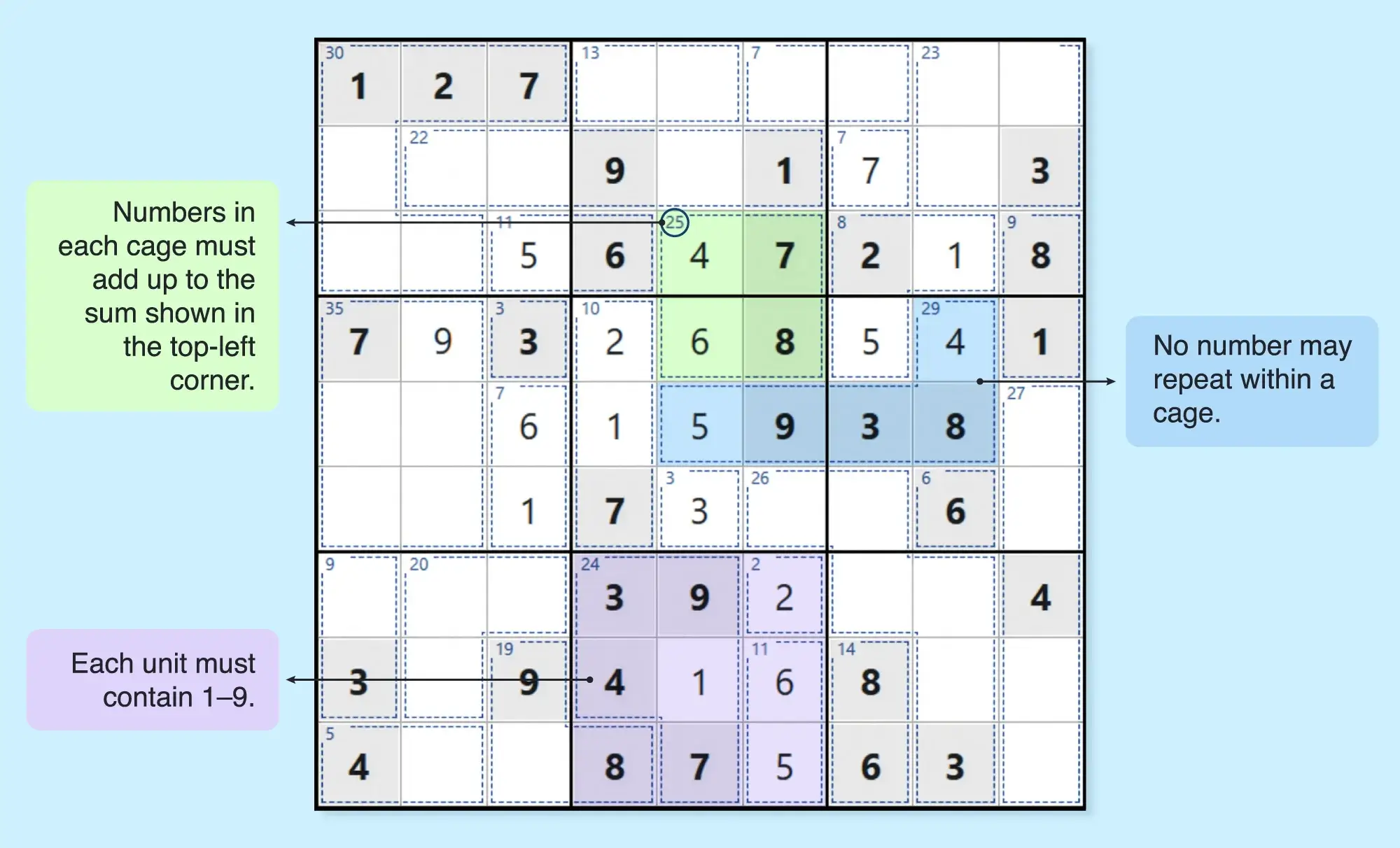
To solve Hard Killer Sudoku, you must fill in the grid following standard Sudoku rules plus additional cage constraints:
- Place numbers 1–9 in each unit (row, column, or 3x3 block) without repeats.
- Cages are outlined by dotted lines, and answers within each cage must add up to the sum shown in the top-left corner.
- Just like a number cannot repeat within a unit, no number may repeat within a cage.
Hard Killer Sudoku Strategies
Cage sums may seem tricky, but having another component to the puzzle actually gives you more room to strategize. Not only can you use regular Sudoku solving strategies with hard Killer Sudoku, but you can also use arithmetic-based strategies. To solve more efficiently, try these techniques:
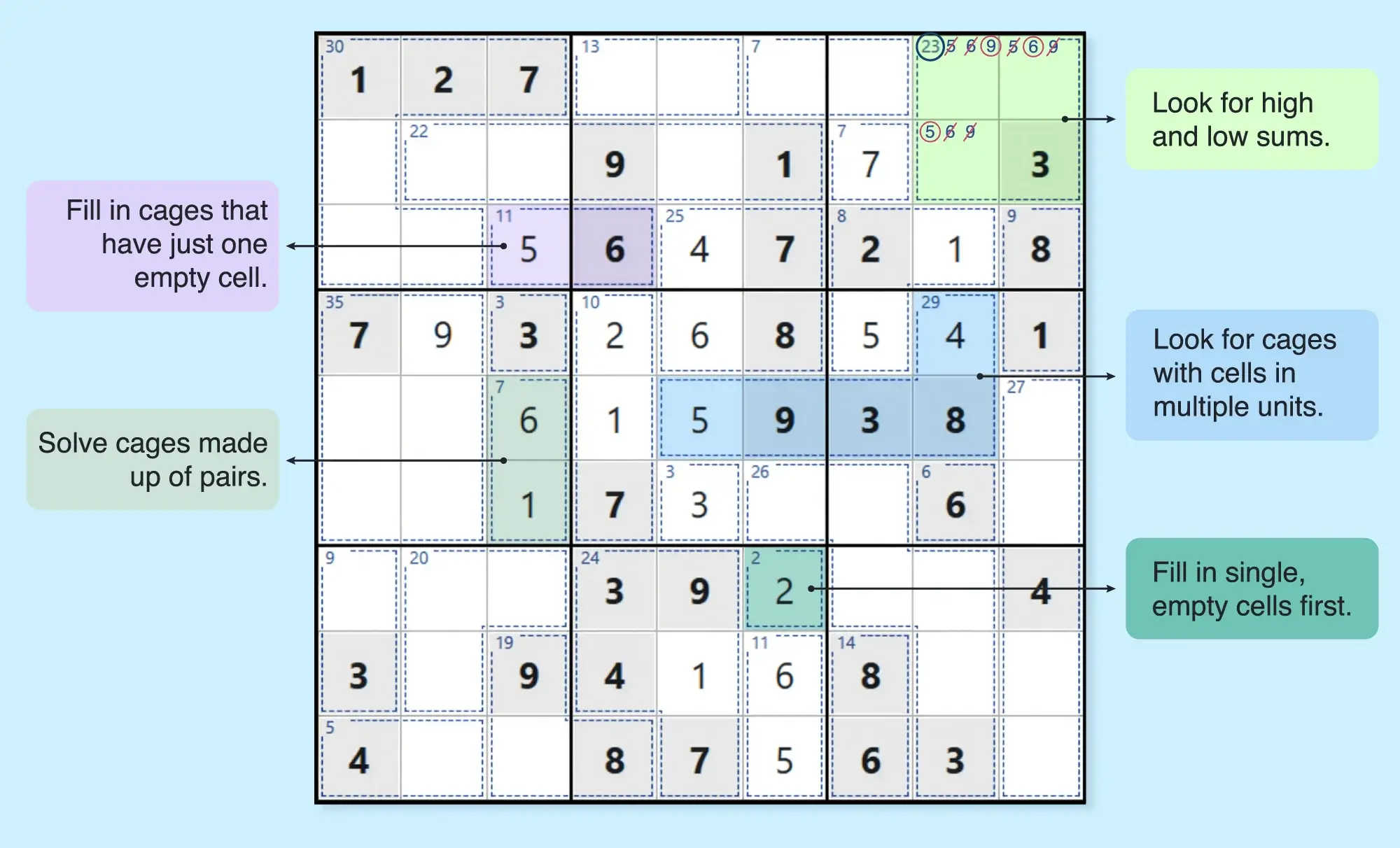
- Prioritize single-cell cages and cages with just one empty cell.
- Single-cell cages are instant placements. The cage sum is the same as the answer for that cell (a sum of 2 in the bottom-middle cage means the answer is 2).
- For cages with only one empty cell, you just need to subtract the sum of known numbers from the cage sum. So for a two-cell cage with the sum of 11, some quick subtraction of the given (6) forces you to place 5 in the remaining cell.
- Evaluate two-cell cages. Two-cell cages have a limited number of answers, making them easier to solve. Just list all pairs of numbers that add up to the cage sum, and then check each pair against overlapping units. For example, a two-cell cage summing to 7 could be 1 + 6, 2 + 5, or 3 + 4. Because a 5 and 3 already appear in the same column as the cage, the only possible pair for the cells is 1 and 6.
- Look for cages with cells in multiple units. Cages that span different rows, columns, or blocks have multiple clues. So identify which numbers are needed to complete the cage sum, then check each unit to see which numbers are already placed. For example, the 29-cage in the middle-right of the puzzle has just two empty cells and spans two blocks. The numbers in those two cells must add up to 9, but the middle block already has all numerals placed except for 4 and 5. That means the two cells left for that cage must be 4 and 5, and because the other block has a 5 already, you can easily place those numbers to complete the cage.
- Look for high or low cage sums. Extreme sums often have very limited combinations and are good starting points. For example, a four-cell cage that totals 23 and includes a 3 can only have the following possible combinations: 3 + 4 + 7 + 9, 3 + 5 + 6 + 9, or 3 + 5 + 7 + 8. Since rows 1 and 7 both contain 7s, 3 + 5 + 6 + 9 is the only combination left. By scanning surrounding cells, you can complete the cage.
Difficulty Levels
If you find Hard Killer Sudoku a bit too difficult or you want to try out new strategies, you can move down to an easier level, like Medium Killer Sudoku or even Easy Killer Sudoku. But as your skills develop, you can challenge yourself further with Expert Killer Sudoku or try the most difficult level: Evil Killer Sudoku.