How to Play Evil Killer Sudoku
To play Evil Killer Sudoku, you must use standard rules to fill in the grid in addition to following cage constraints:
- In each row, column, or 3x3 block, place numbers 1–9 without repeats.
- The numbers placed in each cell must add up to their cage sums, shown in the top-left corner of outlined cages.
- Ensure that no number repeats within a cage.
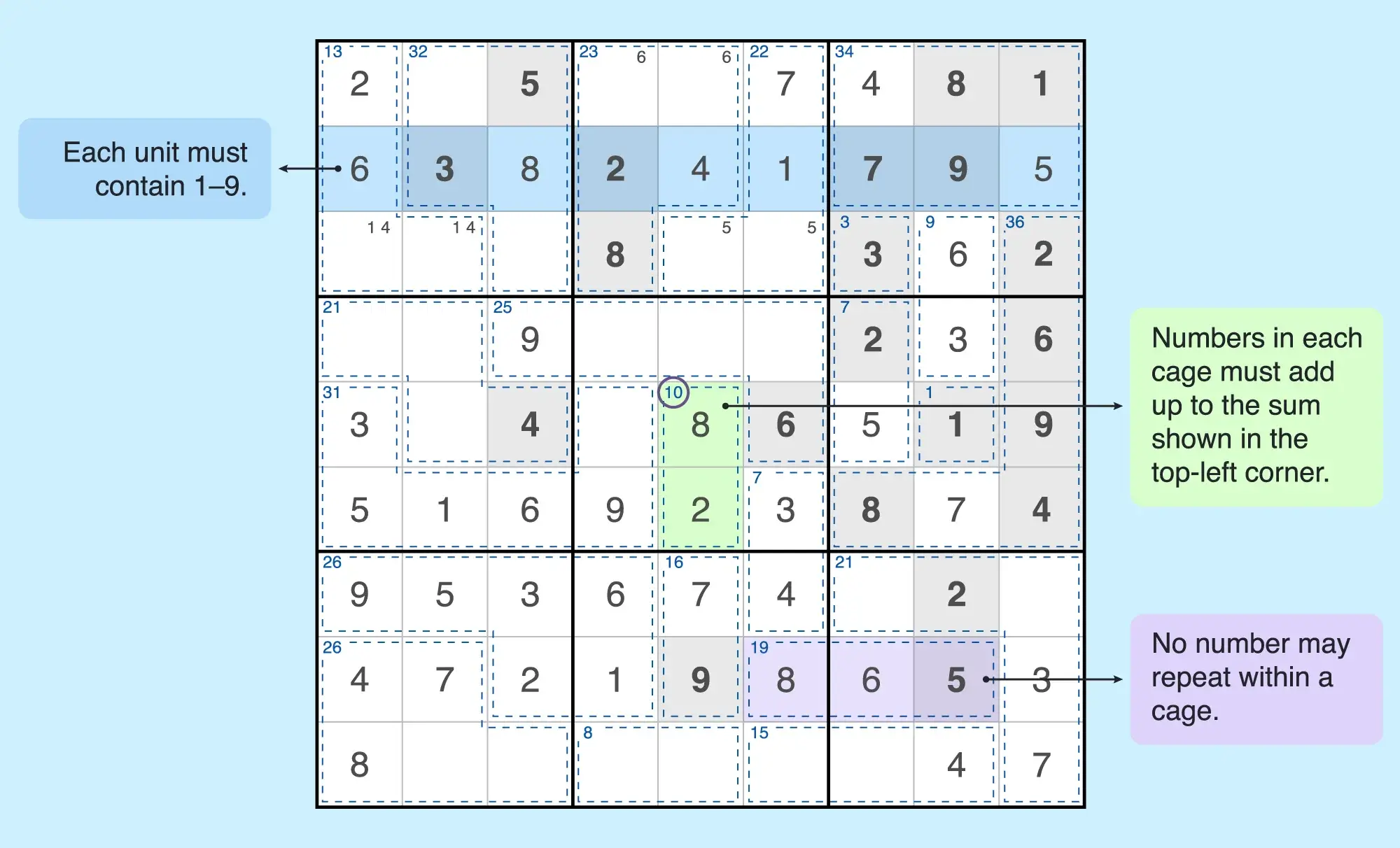
Evil Killer Sudoku Strategies
Evil Killer Sudoku removes most of the direct placements you find in easier levels. Instead of solving cages individually, you must analyze how multiple cages interact across rows, columns, and blocks. Progress often comes from eliminating impossible combinations rather than placing numbers immediately. You can pair these techniques with regular Sudoku solving strategies:
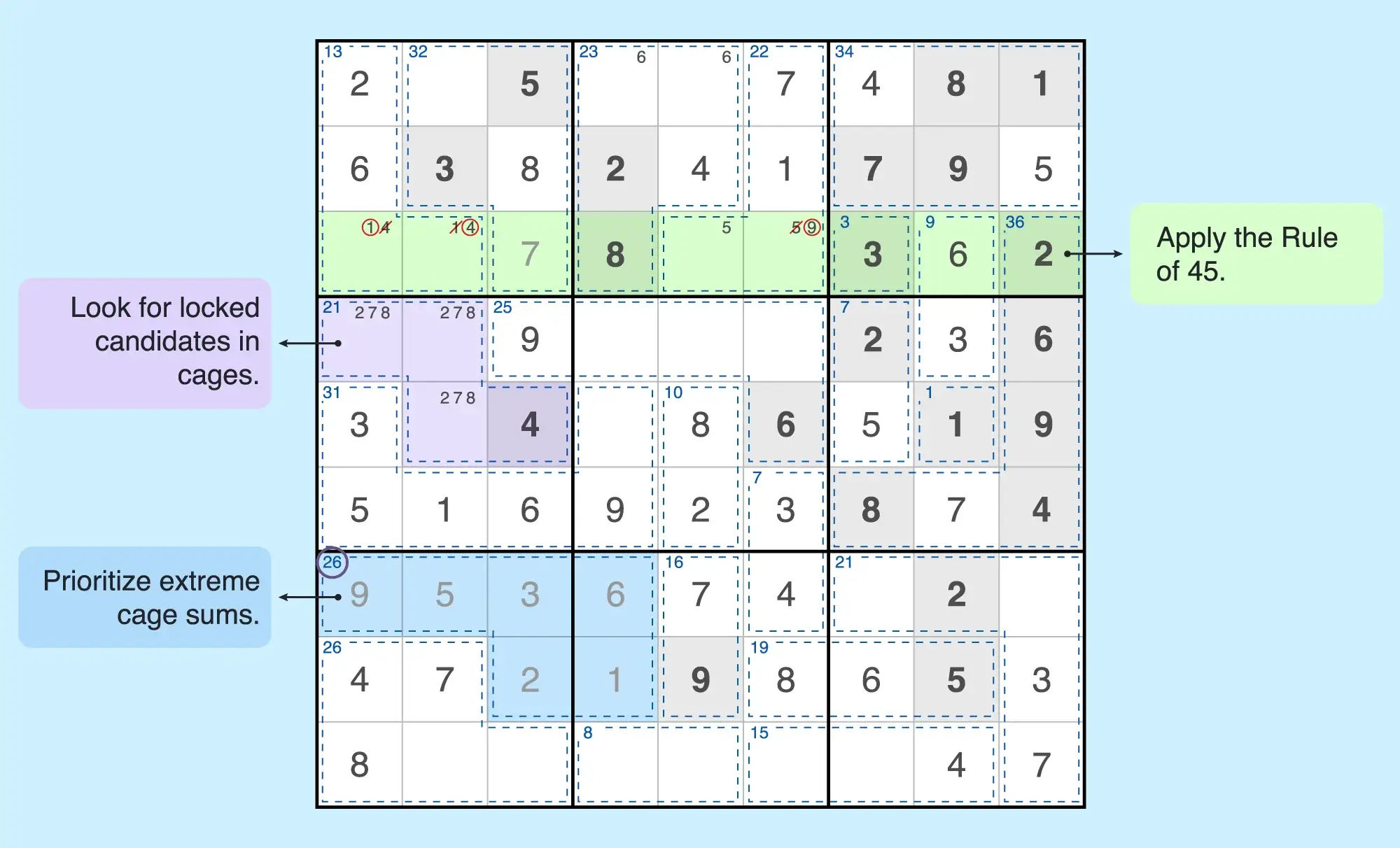
- Look for locked candidates in cages. If a cage is enclosed in a single unit, you can lock in what candidates should belong there, even if you don't know the exact cell placement. For example, the 21 cage in the left-middle block is completely enclosed in the block and has a given (4). So the three empty cells of that cage must add up to 17, and a 1, 5, and 6 are already placed in that block. So 2, 7, and 8 must be placed in the cage. Similar to the locked candidate strategy, you're claiming these three candidates for the cells of that cage, helping you place the 3 and 9 in the blocks remaining cells.
- Apply the Rule of 45. All units (rows, columns, and 3x3 blocks) must add up to 45. So you can overlap that rule with cage sums and Sudoku rules of no repeats in units to narrow down, eliminate, or place candidates. For example, in row 3, givens and placed numbers already add to 19. A3 must be 1 and B3 must be 4 for the cage to equal 13. And 5 must go into either E3 or F3, which makes the new unit total 29. The remaining two cells must add up to 16 (45 - 29), and candidates 7 and 9 are left to be placed. So you can place 9 in F3 to complete the cage sum, forcing 7 in C3.
- Prioritize extreme cage sums. High and low sums often have very limited combinations and are good targets, especially when you consider other constraints like givens and candidate placements. For example, the bottom-left block has a six-cell cage with the sum of 26. Because of candidates already placed in the adjacent units, the only possible digits that can finish this cage are 1+2+3+5+6+9. And these digits are easily forced into place because of candidates in the rows, columns, and blocks overlapping the cage.
Difficulty Levels
If you find Evil Killer Sudoku is a bit too sparse to solve, you can try easier levels, like Hard Killer Sudoku or Expert Killer Sudoku. Use these puzzles to practice techniques and build your skills so you can solve Evil puzzles more efficiently.