Used as a technique for a single digit (x), the turbot fish is a short X-cycle built from four cells that begin and end with strong links (two conjugate pairs). It allows you to eliminate candidate x from cells that see both ends of the pattern.
Many Sudoku players discover turbot fish while learning the logic of advanced techniques like X-wing and other fishy cycles. Whether you're a developing solver or already deep into puzzle solving, this turbot fish technique is a helpful addition to your Sudoku solving toolkit.
How to Find a Turbot Fish in Sudoku
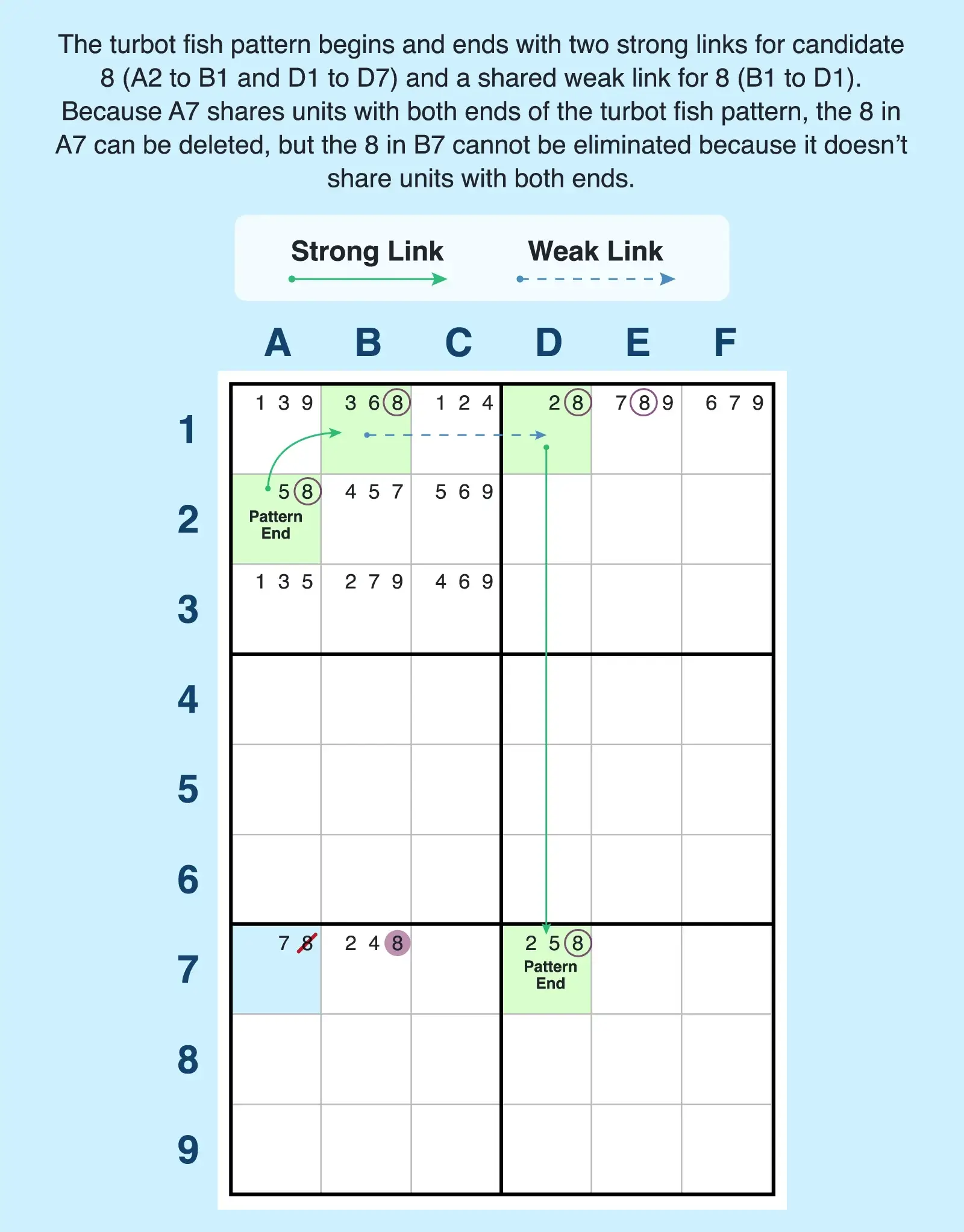
Use these steps to easily find a turbot fish for a single digit (x) in your Sudoku puzzle:
- Find the first strong link (conjugate pair) for candidate (x) to begin the turbot fish. A conjugate pair occurs when candidate x appears only two times in a unit, and because one candidate or the other must be true (the answer), the pair creates a strong link. So find x appearing exactly twice in one unit (row/column/box) to find the first strong link. For example, candidate 8 appears exactly twice in the first block in A2 and B1, creating the first strong link.
- Find the second strong link for candidate (x) that will end the turbot fish. In a different unit (row/column/box), x appears exactly twice to create a second strong link. For example, candidate 8 appears exactly twice in column D (D1 and D7), creating the second strong link that will end the pattern.
- Find a shared link for (x) between the two strong links. The two strong links must connect to another link that contains candidate x. For example, candidate 8 appears three times in row 1, so B1 and D1 create a weak link for the candidate. The turbot fish is a compact alternating inference (AIC) chain, but this advanced technique still works when the middle link is strong. However, like in this example, the shared link is often weak.
- Target candidates for elimination in cells that see both ends of the fish. For example, because A7 sees both ends, also called tips, of the turbot fish pattern (A2 and D7), the 8 in A7 can be deleted. Although candidate 8 in B7 shares a row with D7, it can't see the other endpoint (A2), which means it cannot be eliminated.
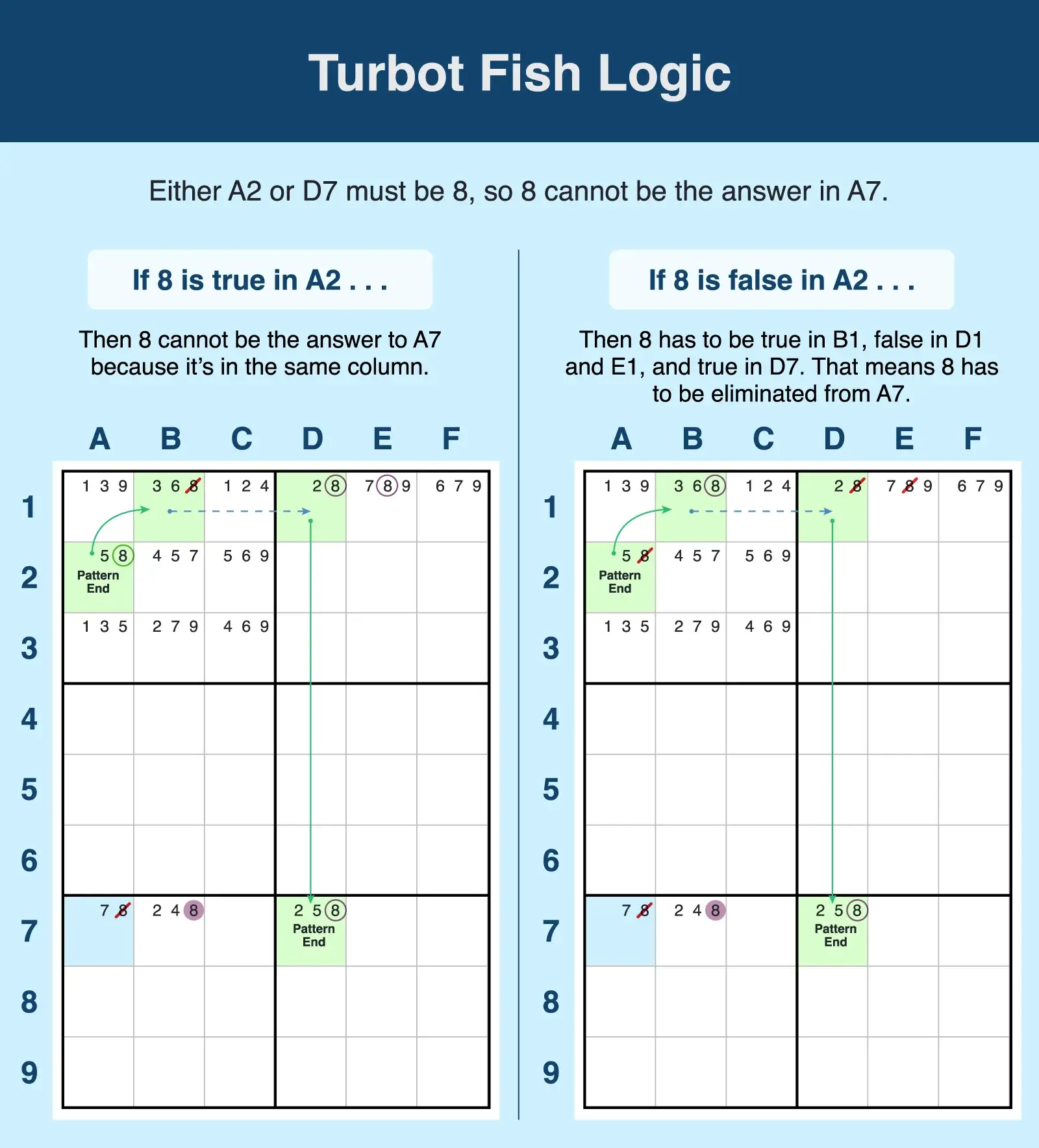
Why this works: If 8 is true (or the answer) in A2, then it can't be the answer in A7, and if 8 is true in D7, then the 8 cannot be the answer in A7. Even with the weak link, you can prove this to be true by following the logic.
- Starting with 8 true in A2: If 8 is true in A2, it automatically eliminates 8 from A7 because it's in the same column. So you don't need to follow the chain through to make the pattern work.
- Starting with 8 false in A2: If 8 is false in A2, then 8 has to be true in B1. If true in B1, then 8 must be false in both D1 and E1. That means 8 must be true in D7, and 8 has to be eliminated from A7.
Either way, an 8 cannot be the answer in that cell because one tip or the other must contain candidate x (in this example, 8).
Standard Turbot Fish Examples
A standard turbot fish is simply a four-cell X-chain (not a fish pattern) that starts and ends with a strong link. One strong link must be diagonal within a block and the second strong link must be found within the same row or column.
Other solving strategies may be considered turbot fish, but they go by their own names and have their own solving strategies. For example, skyscraper and empty rectangle are types of turbot fish, but they don't follow the standard, simple pattern. A two-string kite is also considered a type of turbot fish, but it uses a weak leak on the diagonal in a block.
Turbot Fish in a Row
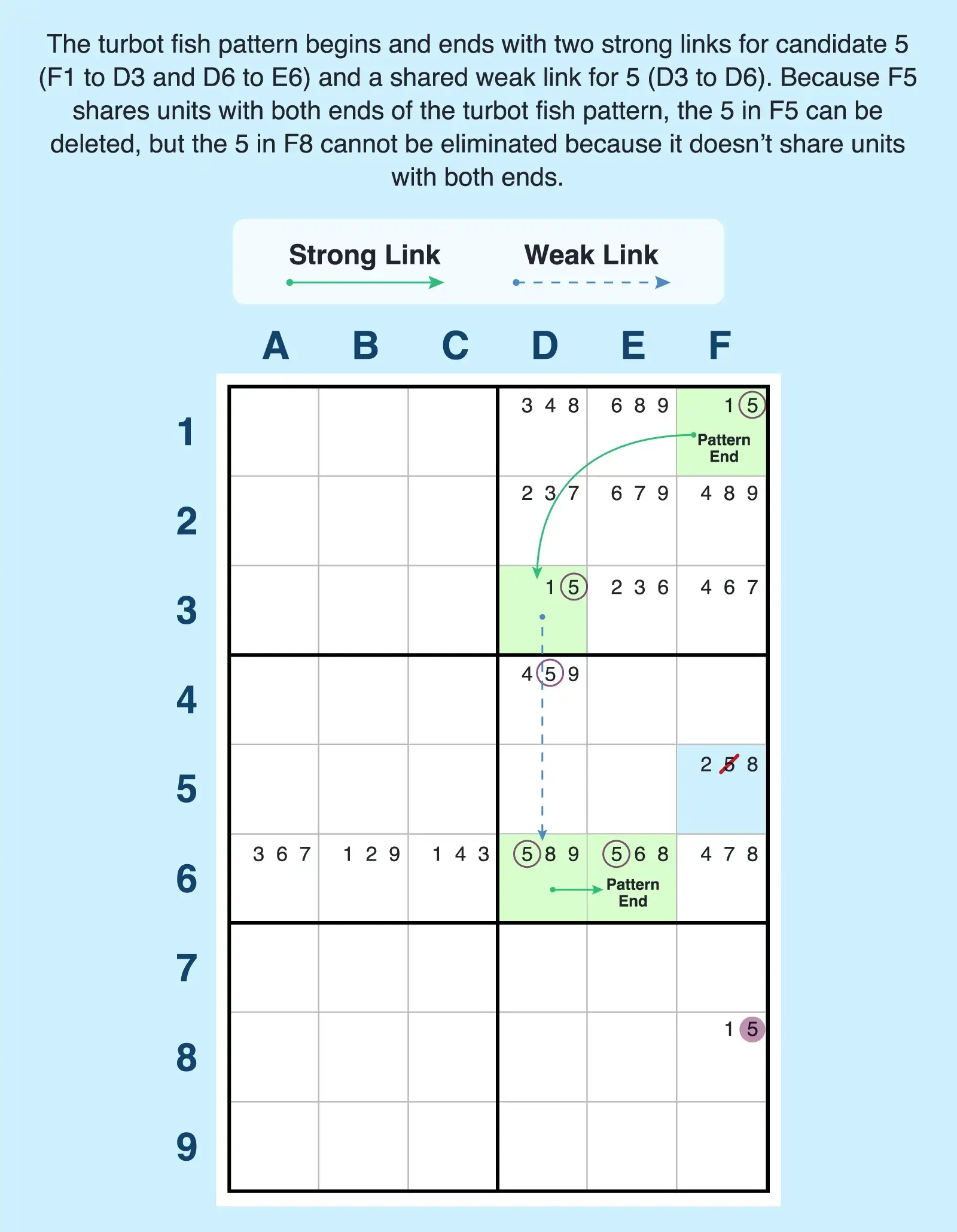
Find a standard turbot fish with a second conjugate pair in a row by following these steps:
- Look for the first strong link between two diagonal cells in a block. F1 and D3 both have a strong link with candidate 5 because candidate 5 appears just twice in that block.
- Find the second strong link for the same candidate in a row. Candidate 5 appears only twice in row 6, creating a strong link between D6 and E6.
- Find the shared link with the same candidate to connect the two strong links. D3 and D6 create a weak link for candidate 5 because it appears three times in that column, and it connects both strong links into a chain.
- Eliminate candidate x (5) from cells that see both endpoints. F5 shares a column with F1 and a block with D6, so the 5 in F5 can be eliminated. Note that the 5 in F8 only sees F1. Because it doesn't see both ends of the chain, candidate 5 cannot be eliminated from that cell.
Turbot Fish in a Column
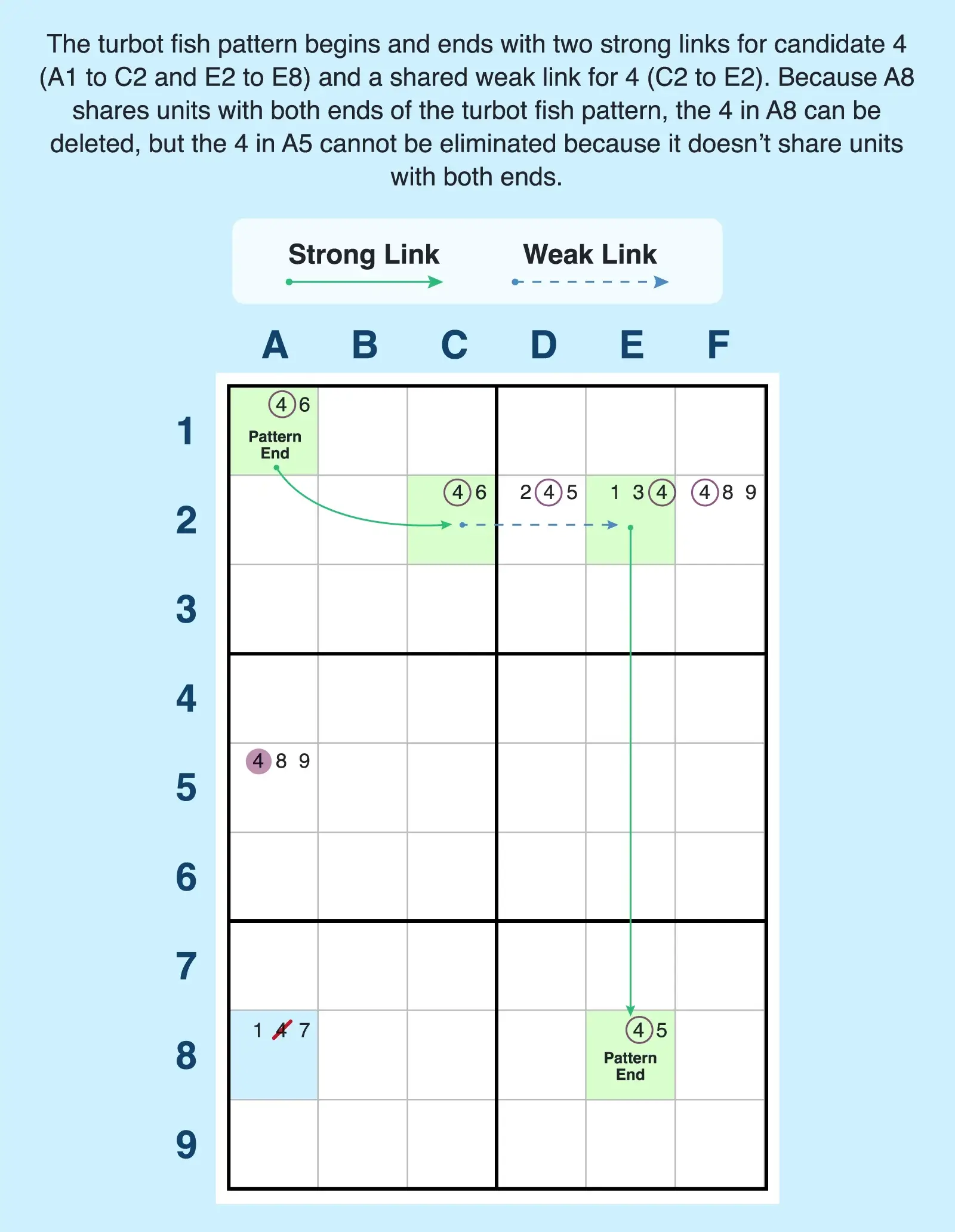
Find a standard turbot fish with a second conjugate pair in a column by following these steps:
- Look for the first strong link between two diagonal cells in a block. Candidate 4 creates a strong link between A1 and C2 because 4 appears just twice in that block.
- Find the second strong link for the same candidate in a column. Candidate 4 appears only twice in column E, creating a strong link between E2 and E8.
- Find the shared link with the same candidate to connect the two strong links. C2 and E2 create a weak link for candidate 4 because it appears four times in that row, and that link connects both strong links into a chain.
- Eliminate candidate x (4) from cells that see both endpoints. A8 shares a column with the first cell in the first strong link (A1), and it shares a row with the last cell of the second strong link (E8). So the 4 in A8 can be eliminated. Note that the 4 in A5 only sees A1. Because it doesn't share a unit with the other endpoint (E8), candidate 4 cannot be eliminated from that cell.
Sometimes you just need one elimination to unlock an expert or evil-level puzzle. So the next time you're playing Sudoku online, try finding a turbot fish when you get stumped and see if it enhances your solving strategy.