A bi-value universal grave (BUG) pattern occurs when almost every unsolved cell in a grid has exactly two candidates (bi-value cells), and each candidate appears exactly twice in every row, column, and block in which it occurs. In this perfectly balanced state, the puzzle would have multiple solutions.
But valid Sudoku puzzles can have only one unique solution. So if the Bi-value cells occur Universally throughout the Sudoku puzzle, it creates a Grave situation—bi-value universal grave—because it creates a deadly pattern with multiple solutions or invalid ones.
Because a true bi-value universal grave (BUG) creates an invalid puzzle, in practice, solvers most often encounter BUG+1 patterns, an advanced Sudoku technique, where one extra candidate breaks the symmetry and allows a forced placement. This post will cover both BUG +1 and the rarer BUG+2 pattern so you can learn how to recognize these situations and make correct placements or eliminations.
How to Find a Bi-value Universal Grave Pattern in Sudoku
To find a breakable BUG pattern:
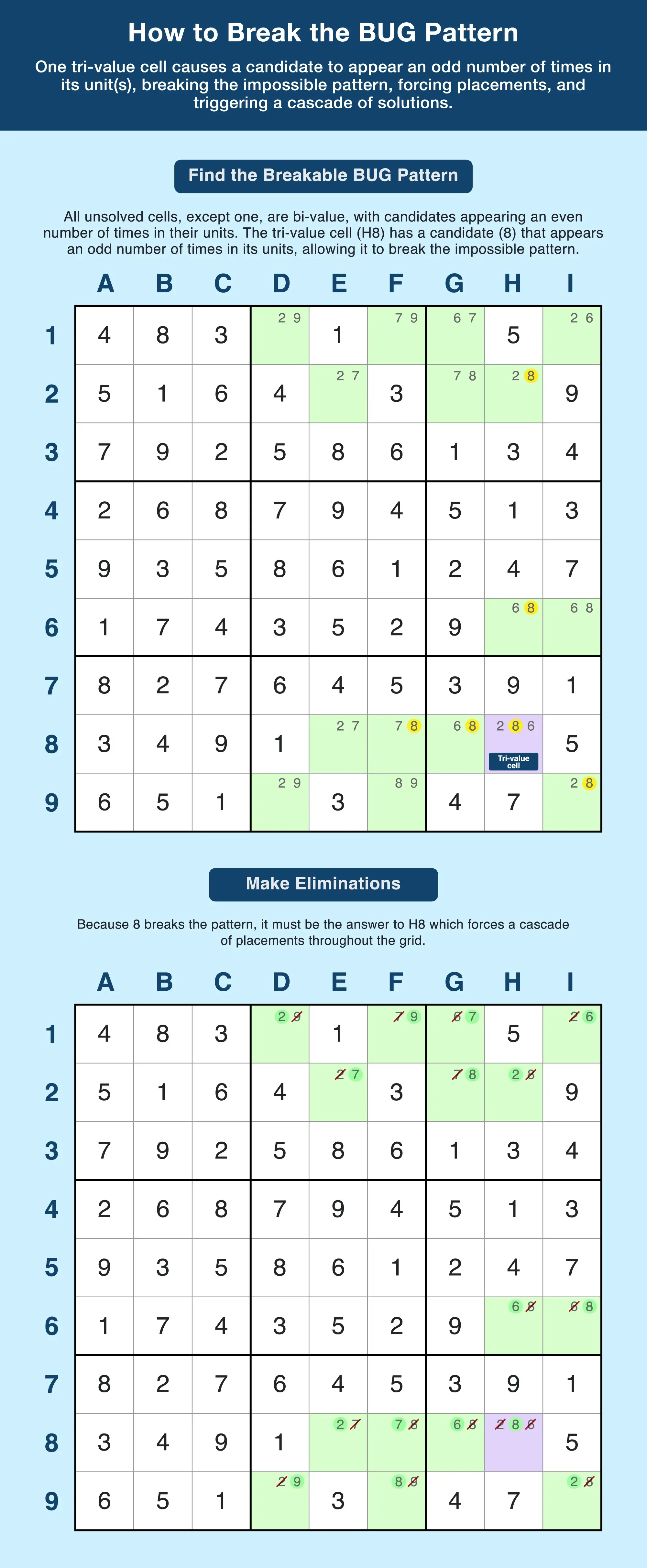
- Confirm that all but one unresolved cell in the grid has just two candidates. For example, all cells are bi-value in this grid except for H8, which has three candidates (tri-value).
- Check that candidates in bi-value cells appear exactly twice in the rows, columns, and blocks in which they appear. This setup creates a perfectly symmetrical state in which the candidates could be swapped in pairs, producing multiple valid solutions. Since standard Sudoku puzzles must have a unique solution, this state cannot be allowed. For example, 2 appears twice in the top middle block and twice in those intersecting rows (1 and 2) and columns (D and E). The same is true for all candidates that only appear in bi-value cells.
- Identify the candidate (BUG candidate) from the tri-value cell (BUG cell) that appears an odd number of times to break the pattern and force a placement. Cell H8 is the tri-value cell, and candidate 8 is found three times in column H, row 8, and the bottom-right block. Because 8 appears an odd number of times, it breaks the impossible pattern and can be placed in H8. You can see the cascade of placements that happens after you place the 8. H6 must be 6, H2 must be 2, and so on as the remaining bi-value cells are answered and the puzzle is solved.
Understanding Sudoku BUG Pattern Logic
In a pure BUG pattern, every remaining cell has two candidates and each candidate appears exactly twice per unit. This means the candidates can be swapped in pairs across the grid, producing two different valid completions of the puzzle. Since valid Sudoku puzzles must have a unique solution, the grid cannot be allowed to reach this state.
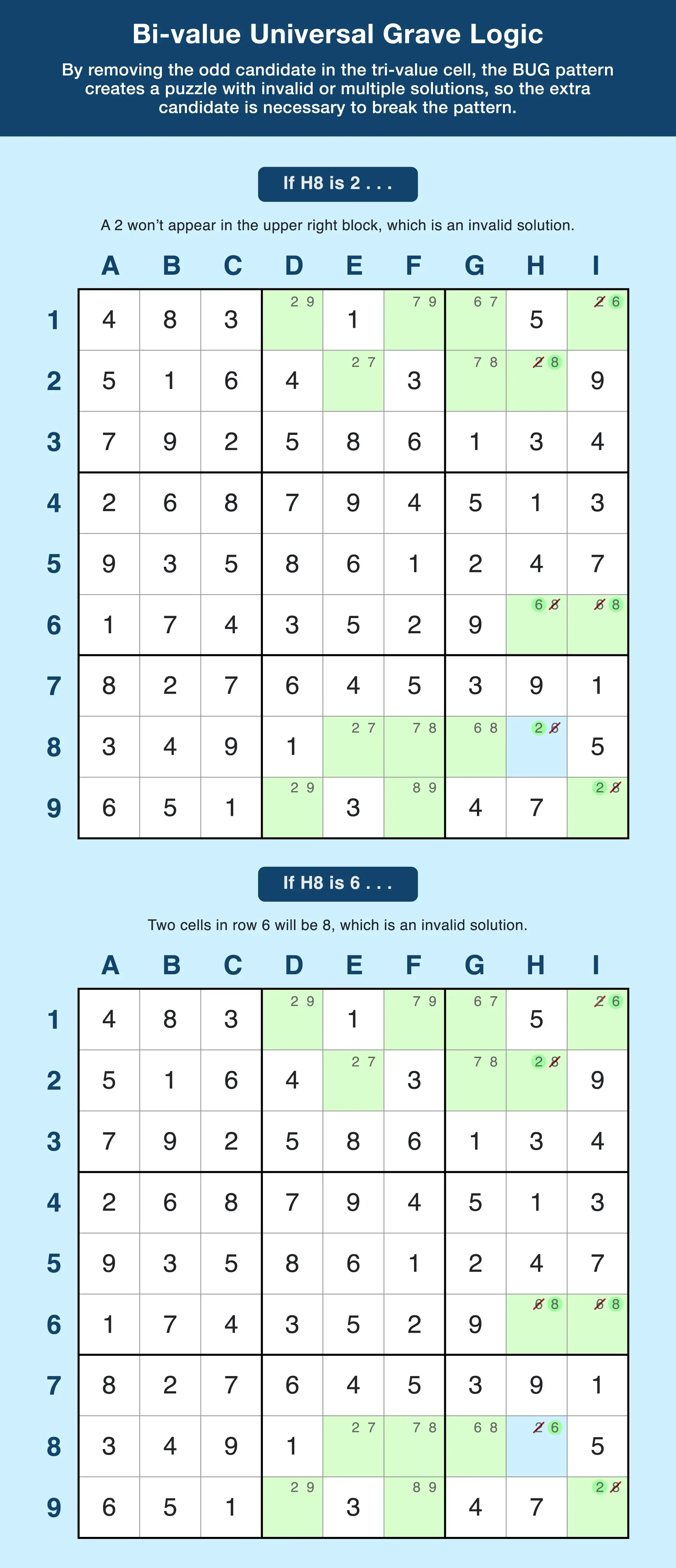
For example, if the 8 is removed from H8, the puzzle used as the example above becomes a pure BUG pattern. Using if-then logic in column H, you get two possible results:
- If H8 is 2, then H2 is 8, and H6 is 6. That means I6 has to be 8, I9 is 2, and I1 is 6. But that means no 2 can be placed in the upper-right block, and that requires 2 to be the answer to two cells (H8 and I9) in the bottom-right block, both of which makes the puzzle invalid.
- If H8 is 6, then H2 is 2 because H6 is 8. If placements continue, I6 has to be 6, I9 is 8, and I1 is 2. But that means 2 is placed in two cells in the upper-right block, which makes the puzzle invalid.
By finding a cell that contains an extra candidate that appears an odd number of times, like a BUG +1 pattern, you can break the pattern, force placements, and create a cascade of answers.
Bi-value Universal Grave Examples
Most often, you’ll encounter a BUG+1 pattern, where one cell has three candidates, allowing you to place the extra candidate and break the pattern easily, but a BUG+2 isn’t as straightforward. It contains two tri-value cells, which means you can’t simply make placements, but you can make some eliminations that lead to placements elsewhere in the puzzle.
BUG+1 Example
The BUG+1 pattern is easy to spot because all but one unsolved cell in the puzzle is bi-value—one cell is three candidates. You can find it with the following steps:
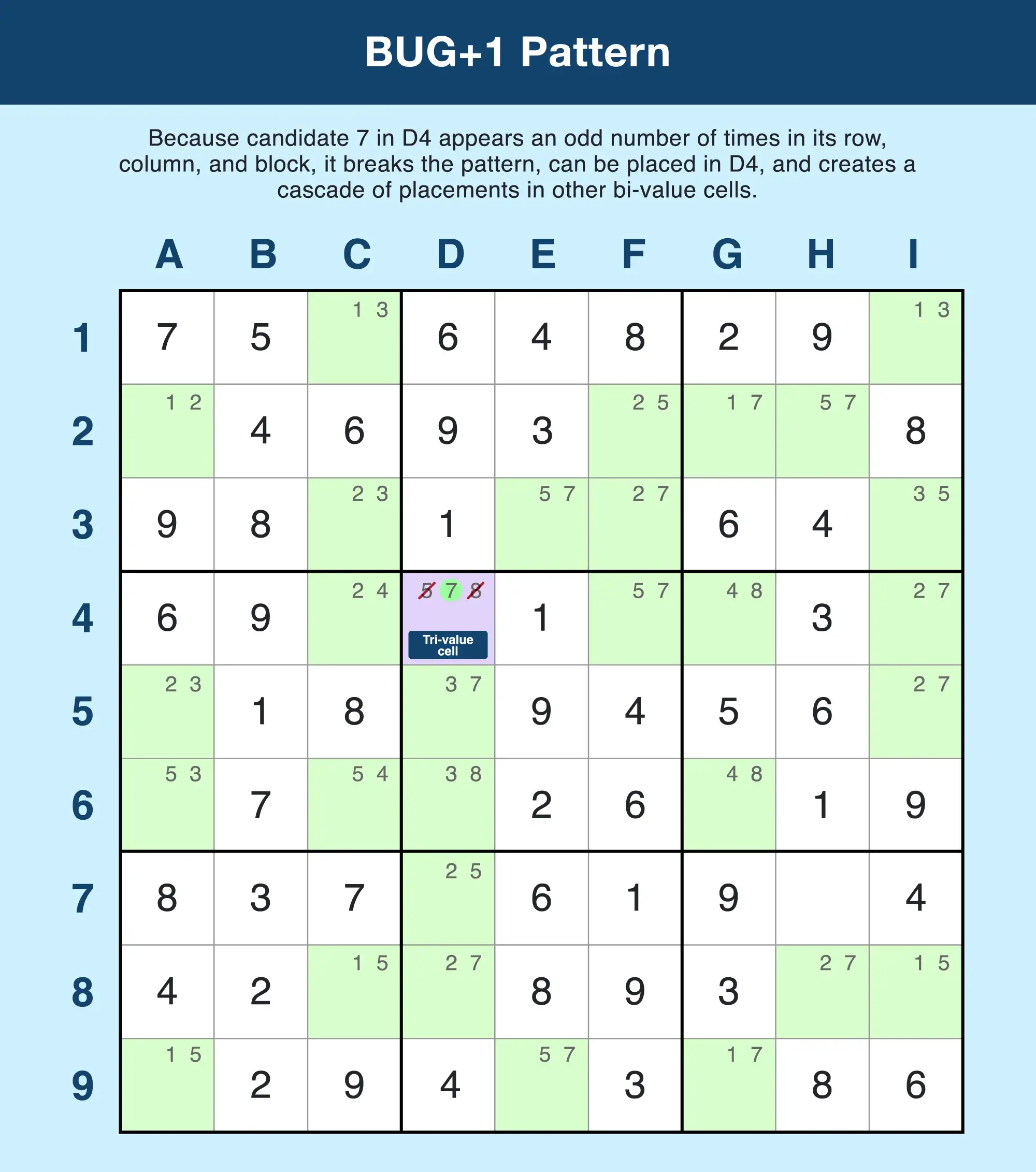
- Confirm that all but one unresolved cell in the grid has just two candidates. For example, all cells are bi-value in this grid except for D4, which has three candidates.
- Check that candidates in bi-value cells appear twice in each unit (row, column, and block) in which they appear. For example, 1 appears twice in the top-left block and twice in those intersecting rows (1 and 2) and columns (A and C). The same is true for all candidates that only appear in bi-value cells.
- Identify the candidate from the tri-value cell that appears an odd number of times to break the pattern and force a placement. Cell D4 is the tri-value cell, and candidate 7 is found three times in column D, row 4, and the middle block. Because 7 appears an odd number of times in each unit, it breaks the pattern and can be placed in D4, unraveling the puzzle with a cascade of placements in other bi-value cells.
BUG+2 Example
The extra tri-value cell in this pattern complicates the outcome because, unlike the BUG+1, you could end up with three possible situations, which may not offer elimination or placement possibilities:
- Only the extra candidate from one tri-value cell could be true.
- Only the extra candidate from the other tri-value cell could be true.
- Both extra candidates could be true.
Remember: You may not be able to make placements or eliminations, but you can try based on the relationship of the tri-value cells and the logic that, regardless of the three possibilities, at least one of the extra candidates must be true to avoid a pure BUG state with multiple solutions.
So find a BUG+2 and see if you can make eliminations using the following steps:
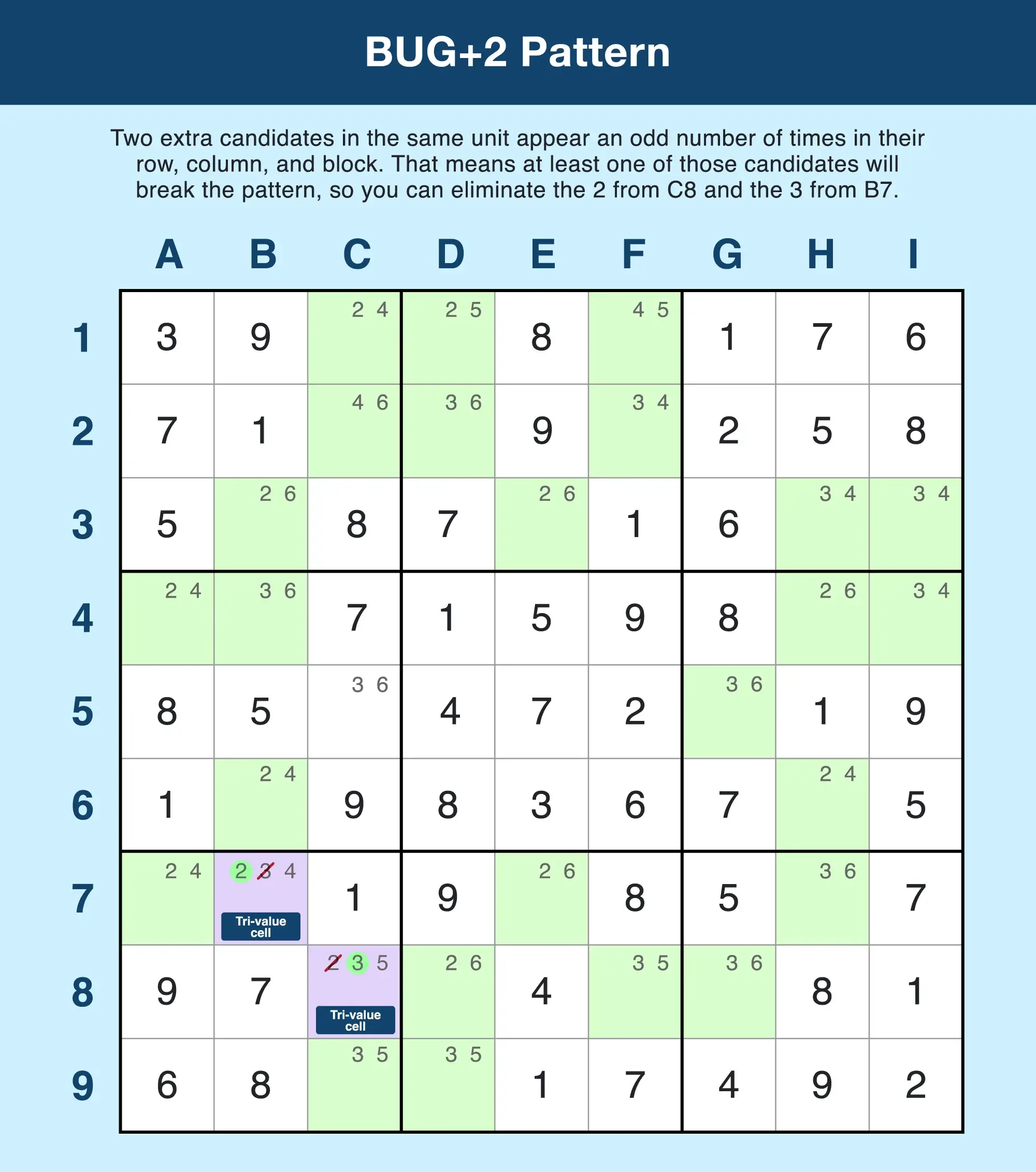
- Confirm that all but two unresolved cells in the grid have just two candidates. For example, all cells are bi-value in this grid except for B7 and C8, each of which has three candidates.
- Check that candidates in bi-value cells appear twice in each unit (row, column, and block) in which they appear. For example, 2 appears twice in the top-left block and twice in those intersecting rows (1 and 3) and columns (B and C), which creates multiple placements for that candidate. The same is true for all candidates that only appear in bi-value cells.
- Identify the candidates from the tri-value cells that appear an odd number of times. Sometimes, as in this example, the cells share similar candidates, so it’s important to identify which candidate is “extra” in each cell by checking which candidate appears three times in all three intersecting units. For example, cells B7 and C8 are the tri-value cells, so one candidate in each is an “extra” candidate.
- Candidate 2 is the extra candidate in B7 because it is found three times in column B, row 7, and the bottom-left block, but the other two (3 and 4) are only found twice in all of those same units.
- Candidate 3 is the extra candidate in C8 because it is found three times in column C, row 8, and the bottom-left block, but the other two (2 and 5) are only found twice in all of those same units.
- Make eliminations based on the three possible outcomes and the relationship of the tri-value cells, if possible. You know from the BUG+1 that having an extra candidate breaks the pattern, but having two extra candidates means that at least one must be true for the pattern to be broken. Because these cells share a block and at least one must be true, you can eliminate the 2 from C8 and the 3 from B7. Here’s why:
- If B7 is 2, it can be eliminated from C8.
- If B7 isn’t 2, then C8 must be 3, which eliminates 2 from that cell.
- If C8 is 3, it can be eliminated from B7.
- If C8 isn’t 3, then B7 must be 2, which eliminates 3 from that cell.
The concept behind bi-value universal grave patterns is pretty simple, but you typically don’t encounter them until you’ve used other solving techniques that leave you with a grid full of bi-value cells. So the next time you get this close to solving a puzzle when playing Sudoku online, try finding a BUG pattern to unravel the puzzle.