The Sue de Coq is an advanced Sudoku technique, named after its creator, that enables eliminations when a group of candidates is constrained between a block and an intersecting row or column in hard Sudoku puzzles.
In a basic Sue de Coq pattern, a group of base cells at the block–line (row or column) intersection contains N cells and N+2 candidates. Each base cell has an intersecting bi-value cell — one in the block and one in the row or column — containing unique subsets of these candidates. This constrains the placement of candidates, allowing eliminations outside the pattern in the block and the intersecting line.
This advanced solving technique doesn’t directly place a number, but it can open up hard puzzles once basic Sudoku strategies have been applied.
How to Find a Sue de Coq in Sudoku
To find a Sue de Coq, follow these steps:
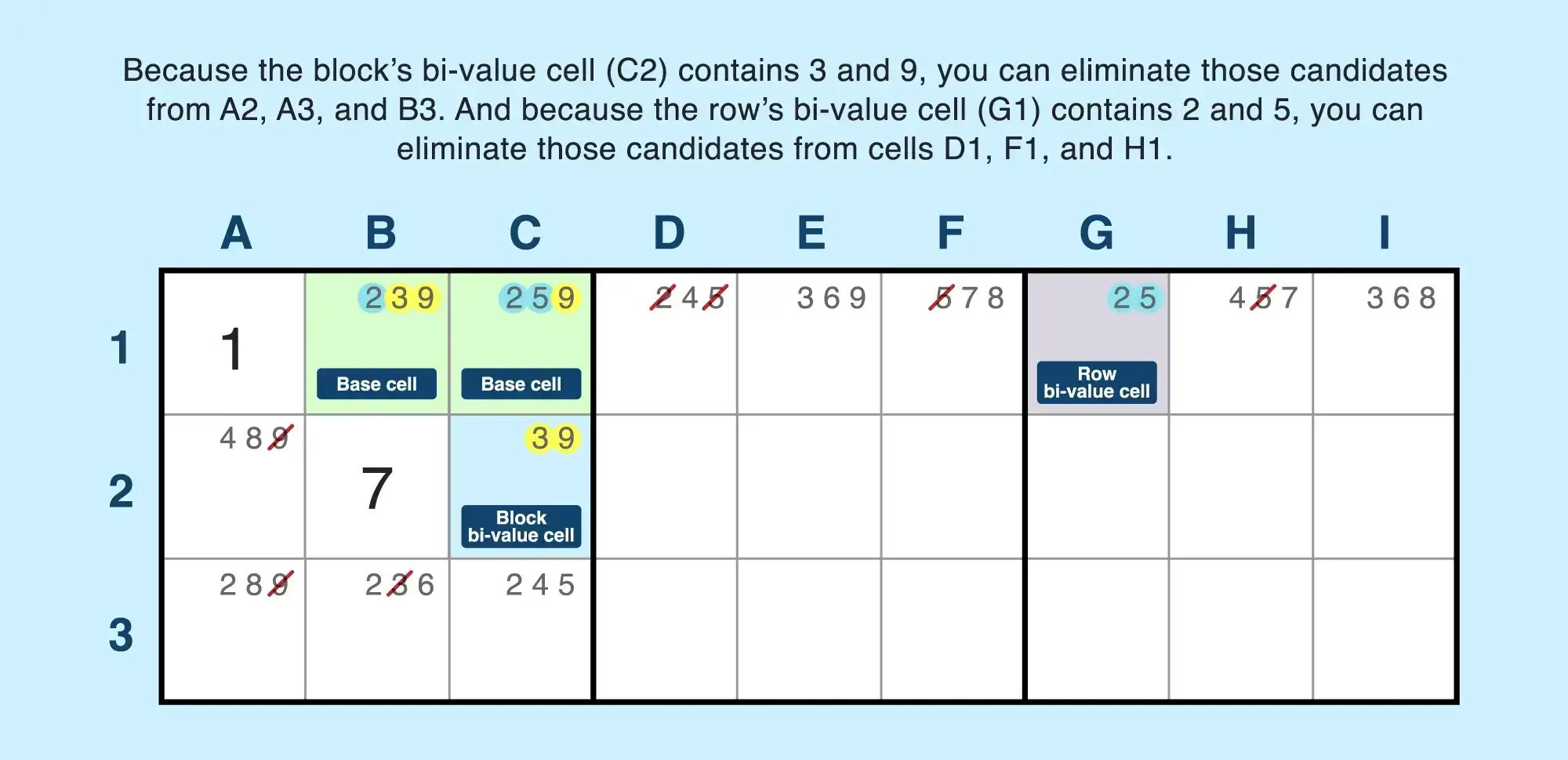
- Find the base cells—two cells in one block and one unit (row or column) that contain exactly four candidates. These base cells form the foundation of the pattern. The four candidates can appear in other cells in the block, but only this set of cells contain all four candidates between them. For example, B1 and C1 contain four candidates between them (2, 3, 5, and 9) and are in the same row, making them the base cells.
-
Find the intersecting bi-value cells in the block and line. The four common
candidates will be split between two intersecting sets made up of a block cell and a line
cell, which refers to a cell in either a row or column. In this example, it appears in a row.
- Find a bi-value cell in the block that shares two of the four candidates from the base cells. For example, C2 is a bi-value cell with candidates 3 and 9.
- Find one additional bi-value cell in the intersecting row that shares the other two candidates from the base cells. For example, the intersecting row (row 1), has a bi-value cell (G1) with the other two candidates of the base cells (2 and 5).
-
Eliminate shared candidates outside the pattern.
- Eliminate any common candidate found in the intersecting bi-value block cell from the rest of the block. For example, because C2 is the block’s bi-value cell, you can eliminate the 9 from A2 and A3, and you can eliminate the 3 from B3.
- Eliminate any candidate found in the intersecting bi-value row cell from the rest of the row. For example, because G1 is the row’s bi-value cell, you can eliminate the 5 from D1, F1, and H1, and you can eliminate the 2 from D1.
Understanding Sue de Coq Sudoku Logic
You may also see the Sue de Coq (SDC) described as a subset of candidates split between two units or as disjoint subsets of candidates confined to a block and a row or column. These are all different ways of describing the same logic. In a Sue de Coq pattern, the candidates shared by the base cells must be placed entirely within the cells that make up the pattern. There is no other valid location for them.
In our example, the two base cells together contain exactly four candidates, and all four of those candidates must be placed within the cells that make up the pattern:
- The two base cells (B1 and C1) cannot contain all four candidates because C2 must be either 3 or 9 and G1 must be either 2 or 5.
- Because these intersecting cells each require one of their two candidates, only two of the four candidates (2, 3, 5, and 9) can be placed in the base cells.
- As a result, the four candidates are fully constrained to the four cells involved in the pattern, which allows eliminations to be made elsewhere in the block and the intersecting line.
Testing Sue de Coq Sudoku Logic
You can test the logic by seeing what happens when one of the candidates up for elimination is the answer in the row or block. When you compare that outcome to the intersecting unit, you then come up with an impossible solution:
- Solving in the block: If 3 is the answer to B3, then 9 must be the answer to C2, which means B1 and C1 must be 2 and 5, respectively. But that makes the puzzle impossible because G1 must be either a 2 or 5. The same results occur when 9 is the answer to either A2 or A3.
- Solving in the row: If 2 is the answer to D1, then 5 must be the answer to G1, which means B1 and C1 must be 3 and 9, respectively. But that makes the puzzle impossible because C2 must be either a 3 or 9. The same results occur when 5 is the answer to D1, F1, or H1.

Sue de Coq Examples
The most common Sue de Coq patterns will involve four cells where the line intersection is a row or column, but you may at some point come across a five-cell SDC, which has special considerations because of an extra candidate.
Four-Cell Sue de Coq in a Row
To find a four-cell Sue de Coq in a row, follow these steps:
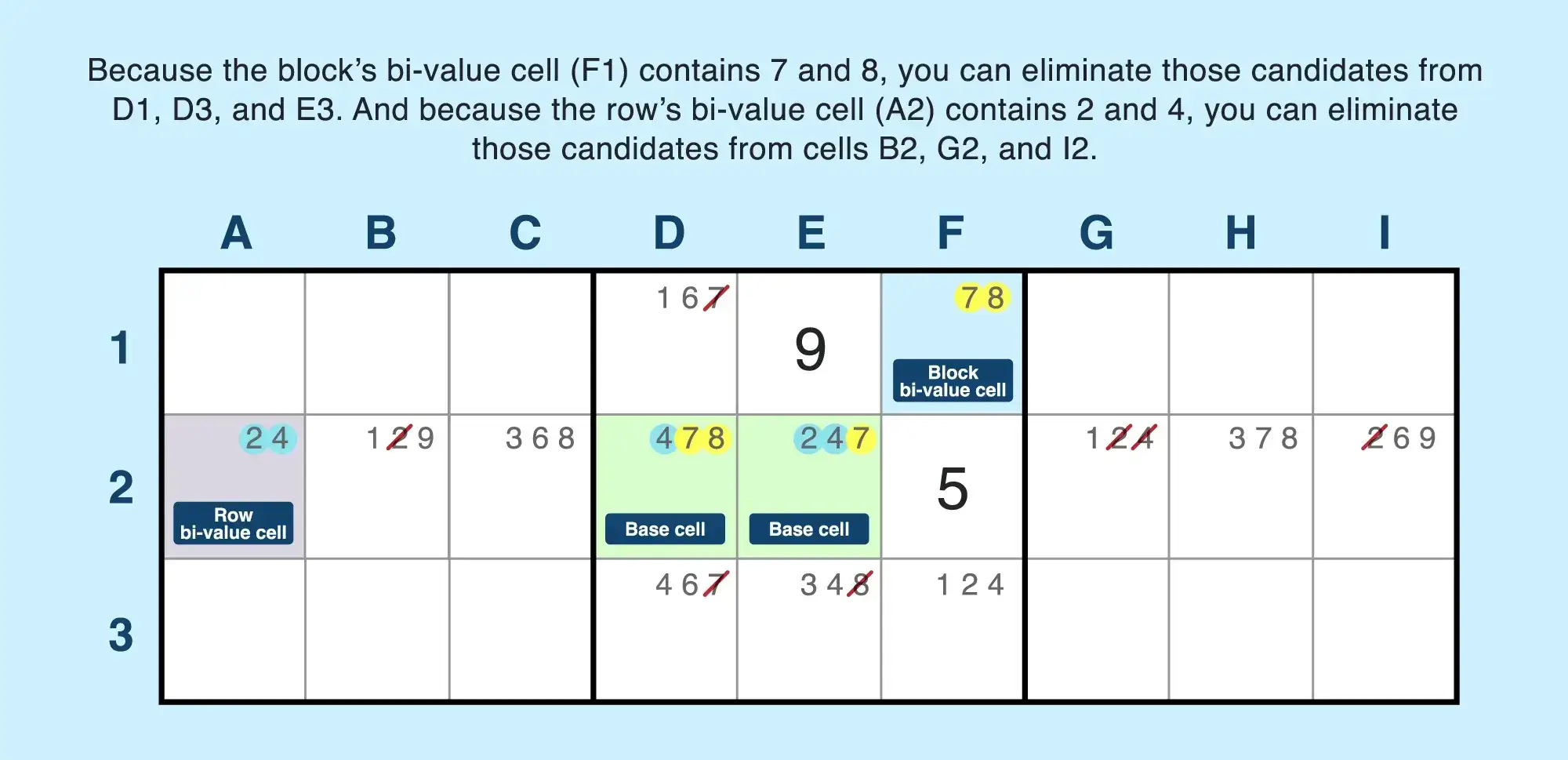
- Find the base cells—two cells in one block and the same row that contain exactly four candidates. For example, D2 and E2 contain four candidates between them (2, 4, 7, and 8) and are both in row 2, making them the base cells.
-
Find the intersecting bi-value cells in the block and row.
- Find a bi-value cell in the block that shares two of the four candidates from the base cells. For example, F1 is a bi-value cell with candidates 7 and 8.
- Find one additional bi-value cell in an intersecting row that shares the other two candidates from the base cells. For example, the intersecting row (row 2), has a bi-value cell (A2) with the other two candidates of the base cells (2 and 4).
-
Eliminate shared candidates outside the pattern.
- Eliminate any candidate found in the intersecting bi-value block cell from the rest of the block. Because F1 is the block’s bi-value cell, you can eliminate the 7 from D1 and D3, and you can eliminate the 8 from E3.
- Eliminate any candidate found in the intersecting bi-value row cell from the rest of the row. Because A2 is the row’s bi-value cell, you can eliminate the 2 from B2, G2, and I2, and you can eliminate the 4 from G2.
Four-Cell Sue de Coq in a Column
To find a four-cell Sue de Coq in a column, follow these steps:
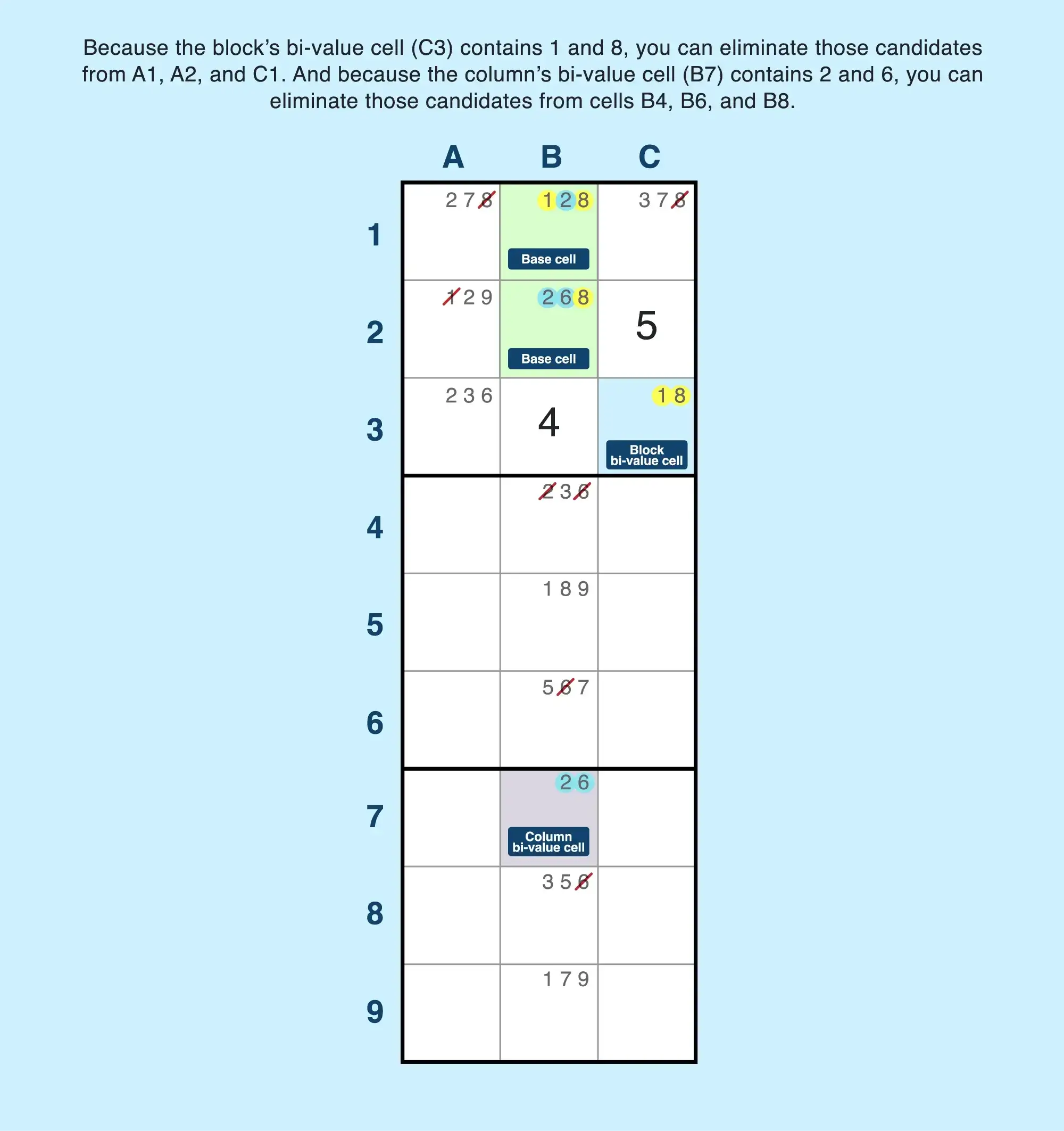
- Find the base cells—two cells in one block and the same column that contain exactly four candidates. For example, B1 and B2 contain four candidates between them (1, 2, 6, and 8) and are in the same column, making them the base cells.
-
Find the intersecting bi-value cells in the block and column.
- Find a bi-value cell in the block that shares two of the four candidates from the base cells.For example, C3 is a bi-value cell with candidates 1 and 8.
- Find one additional bi-value cell in an intersecting column that shares the other two candidates from the base cells. For example, the intersecting column (column B), has a bi-value cell (B7) with the other two candidates of the base cells (2 and 6).
-
Eliminate shared candidates outside the pattern.
- Eliminate any candidate found in the intersecting bi-value block cell from the rest of the block. Because C3 is the block’s bi-value cell, you can eliminate the 8 from A1 and C1, and you can eliminate the 1 from A2.
- Eliminate any candidate found in the intersecting bi-value column cell from the rest of the column. Because B7 is the column’s bi-value cell, you can eliminate the 6 from B4, B6, and you can eliminate the 2 from B8, and B4.
Five-Cell Sue de Coq
A basic five-cell SDC has three base cells, two bi-value cells, and five candidates with the fifth candidate offering more opportunities for elimination. Because of the constraints, the fifth candidate must be an answer in one of the base cells.
To find a five-cell Sue de Coq, follow these steps:
- Find the base cells—three cells in one block and one line that contain exactly five candidates. For example, A1, A2, and A3 contain five candidates between them (1, 2, 3, 6, and 8) and are in the same row, making them the base cells.
-
Find the intersecting bi-value cells in the block and row.
- Find a bi-value cell in the block that shares two of the four candidates from the base cells. For example, C3 is a bi-value cell with candidates 1 and 3.
- Find one additional bi-value cell in an intersecting row that shares two different candidates from the base cells. For example, the intersecting row (row 1), has a bi-value cell (H1) with the two other candidates of the base cells (2 and 6).
-
Eliminate shared candidates outside the pattern.
- Eliminate any candidate found in the intersecting bi-value block cell from the rest of the block. Because C3 is the block’s bi-value cell, you can eliminate the 3 from B2, B3, and C2.
- Eliminate any candidate found in the intersecting bi-value row cell from the rest of the row. Because H1 is the row’s bi-value cell, you can eliminate the 2 from F1.
- Eliminate the fifth candidate outside the pattern. The fifth candidate (8) doesn’t occur in either bi-value cell. However, because of the constraints in the row and block, that fifth candidate must be an answer in one of the base cells. Therefore, you can eliminate 8 from any other cell in the block and the intersecting row outside the pattern, including B2, C2, and F1.

You can extend the Sue de Coq solving strategy across even more cells in Sudoku puzzles, exchanging one or both bi-value cells for almost locked sets (ALS), but the four-cell will be the pattern you see most often. When you’re playing Sudoku online, use pencil marks to easily find and apply the Sue de Coq when you’ve exhausted basic strategies but still have blocks with several candidates left. This technique can help you make eliminations that can open up the puzzle.