Hidden quads is an advanced Sudoku strategy you can use when four cells in the same unit—row, column, or 3×3 block—collectively contain the same four candidate numbers, even if each cell has other pencil marks. Hidden alongside extra candidates in the cells, those four numbers don’t appear in any other cells within that unit, so you can confidently eliminate all other numbers from those four cells.
Hidden quads can be tricky to spot, but they’re an essential tool for solvers tackling harder Sudoku puzzles. Learning to recognize these hidden subsets gives you another reliable method to cut through complexity, reduce possibilities, trigger chain reactions, and progress toward a solution when you play Sudoku online.
How to Find Hidden Quads
To find a hidden quad, you need to find a set or subset of four numbers that appear in only four cells within a unit, similar to hidden triples. Across the four cells, the entire set of four numbers is represented, even if not every cell contains all four. For example, consider if four cells in one row contained these numbers:
- 1, 3, 5, 8, 9
- 1, 5, 7, 8
- 1, 5, 6, 7
- 1, 8, 9
As long as no other cell in that row contained a 1, 5, 8, or 9, then these four cells would qualify as a hidden quad.
The criteria for hidden quads requires:
- Four cells within the same row, column, or 3x3 block share four candidate numbers or a subset of those numbers.
- Those four numbers are exclusive and do not appear in any other cells within that unit.
- At least one of the cells includes other candidates besides the four numbers, which is what makes the quad “hidden."
Practice Finding a Hidden Quad
Now that you know what a hidden quad is, try to find one in the grid below. Check your work by pressing the Hint button, which will walk you through the answer and logic.
To identify a hidden quad, work systematically through each unit:
- Mark all possible candidates.
- Use Sudoku scanning to check each unit for the same four candidates or a subset of those candidates.
- Make sure those four numbers don’t appear as candidates in any other cells within that unit. If they’re confined to just those four cells, you’ve found a hidden quad.
Like hidden pairs and hidden triples, hidden quads rely on exclusivity: The four candidates are “locked in" to those four cells. Once you recognize the pattern, you can quickly reduce complexity and set up new solving opportunities in other cells.
Hidden Quads Examples
Although hidden quads can be rare, they can be a powerful Sudoku strategy because you can often eliminate several different candidates at one time, creating a chain reaction of eliminations and answers across units.
Hidden Quads in a Row
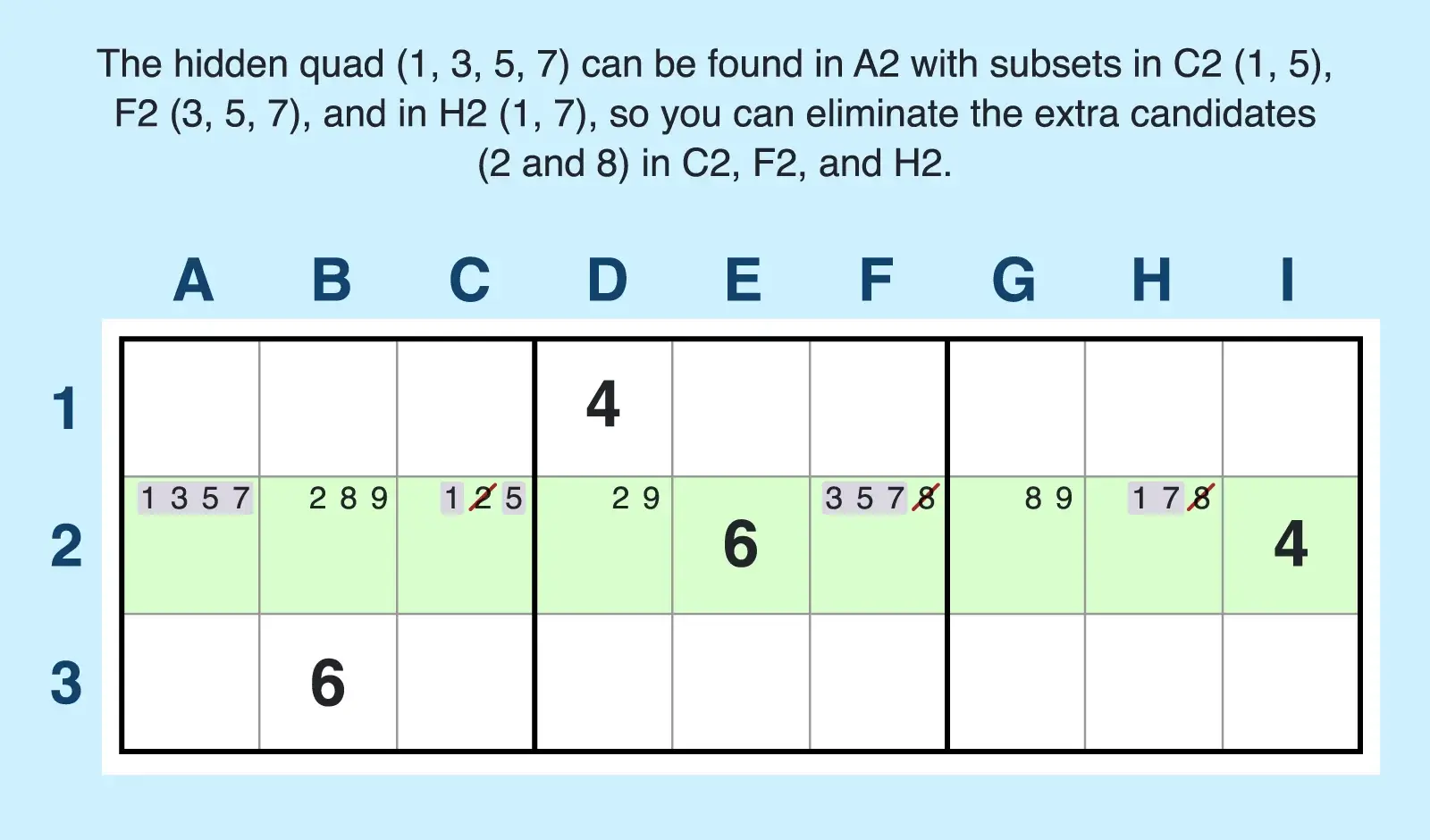
In this example, you can find the hidden quad (1, 3, 5, 7) in cells A2, C2, F2, and H2. Although A2 is the only cell with all four numbers, the other cells in the quad contain subsets of those four candidates:
- A2: 1, 3, 5, 7
- C2: 1, 5
- F2: 3, 5, 7
- H2: 1, 7
To verify this is a hidden quad, you have to check and be sure that 1, 3, 5, or 7 doesn’t appear in any other cell in row 2. If they don't, those candidates are locked into those four cells as possible answers. That means the other candidates in those four cells that aren’t part of the quad can be eliminated:
- C2: 2
- F2: 8
- H2: 8
Hidden Quads in a Block
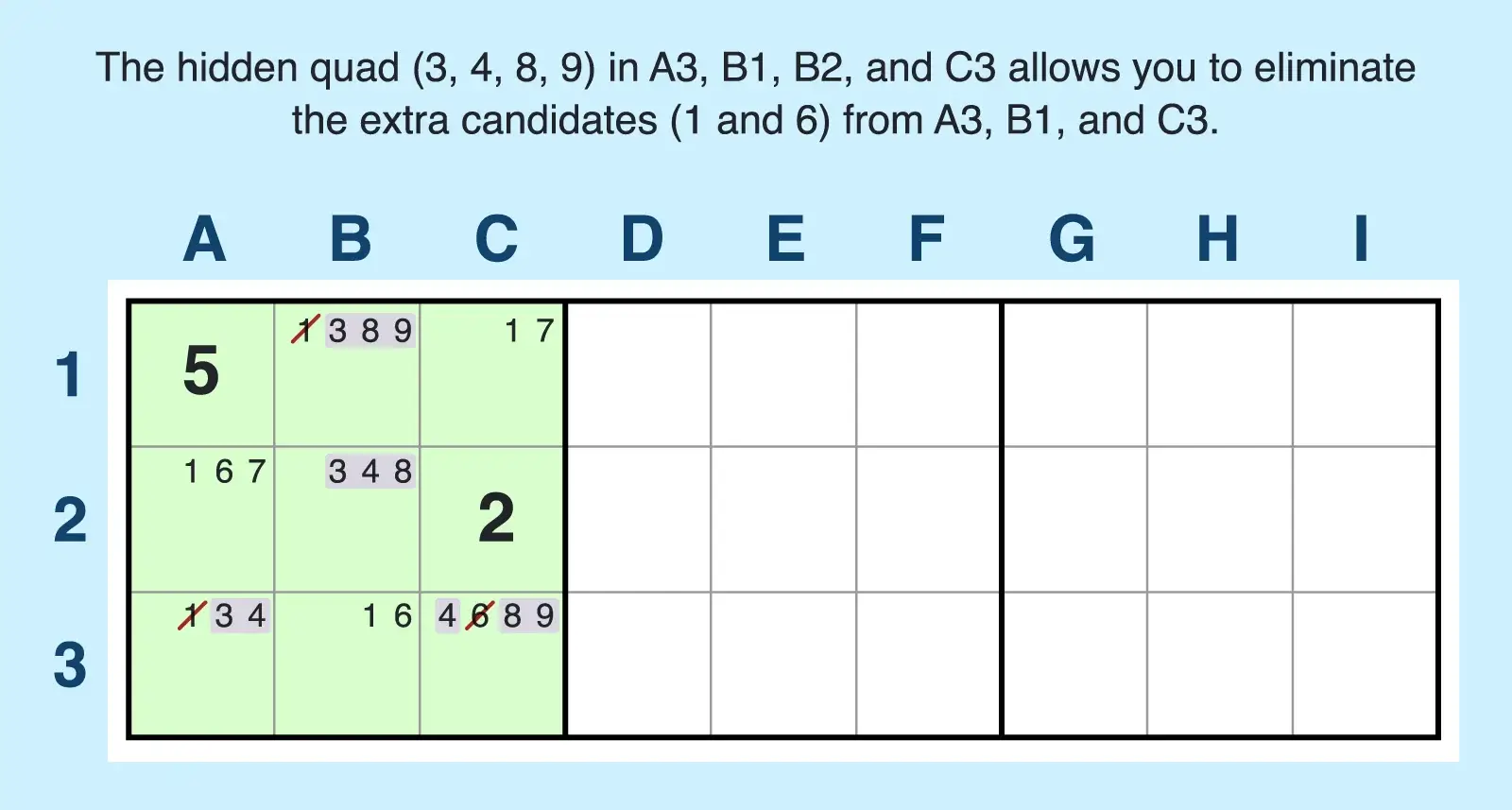
This example shows the hidden quad (3, 4, 8, 9) in A3, B1, B2, and C3 of the first block. Although not all cells contain all four candidates, they contain subsets of the four numbers:
- A3: 3, 4
- B1: 3, 8, 9
- B2: 3, 4, 8
- C3: 4, 8, 9
To make sure this is a true hidden quad, you have to check that those candidates don’t appear in any other cells in the block. Because 3, 4, 8, and 9 only appear in those four cells, you can eliminate the following candidates:
- A3: 1
- B1: 1
- C3: 6
Hidden Quads in a Column
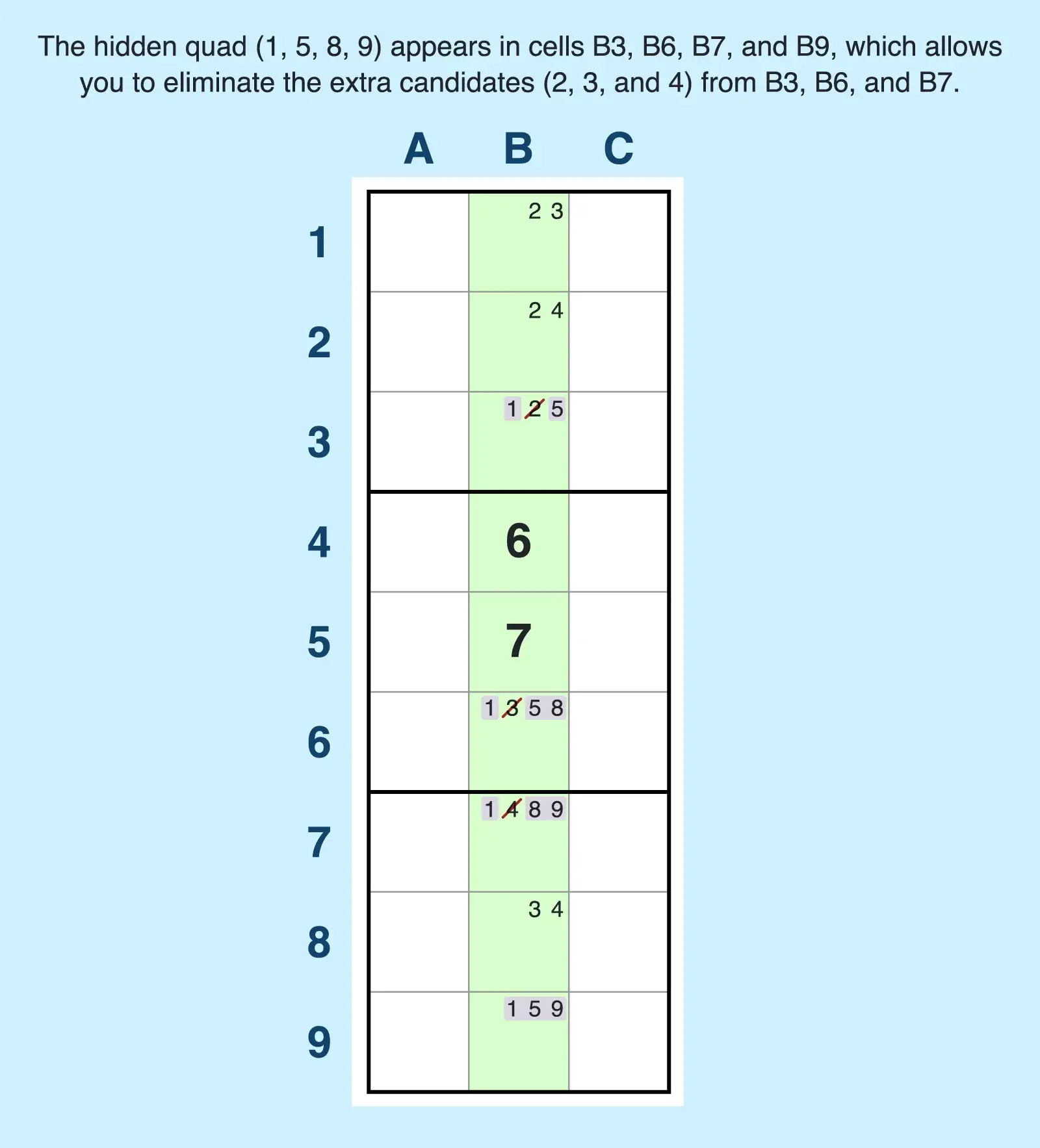
In this example, the hidden quad (1, 5, 8, 9) appears in column B. Like other hidden quads, not all four candidates appear in each cell:
- B3: 1, 5
- B6: 1, 5, 8
- B7: 1, 8, 9
- B9: 1, 5, 9
So checking to be sure that 1, 5, 8, or 9 don’t appear elsewhere in the column confirms that those four candidates form a quad. Because these candidates must be the answer for these four cells, you can eliminate the extra candidates in the cells that make up the quad:
- B3: 2
- B6: 3
- B7: 4
If you can confidently spot hidden quads, you can unlock answers in hard Sudoku puzzles or even more difficult ones. Use this technique along with other strategies the next time you play Sudoku puzzles online.