2-String Kite Sudoku Technique Explained With Examples
A 2-string kite in Sudoku is an advanced technique used to eliminate candidates by linking two conjugate pairs of the same candidate number—one pair in a row and one pair in a column—within a shared block. Both a type of turbot fish and X-chain, this puzzle-solving technique connects these four cells into a short logical chain that allows you to make eliminations.
Although this Sudoku strategy doesn’t directly place a number, you can use it to eliminate the candidate from any cell that sees both endpoints of the pattern. When applied correctly, a 2-string kite can break through grids in hard Sudoku puzzles where you’ve already applied simpler strategies.
How to Find a 2-String Kite in Sudoku
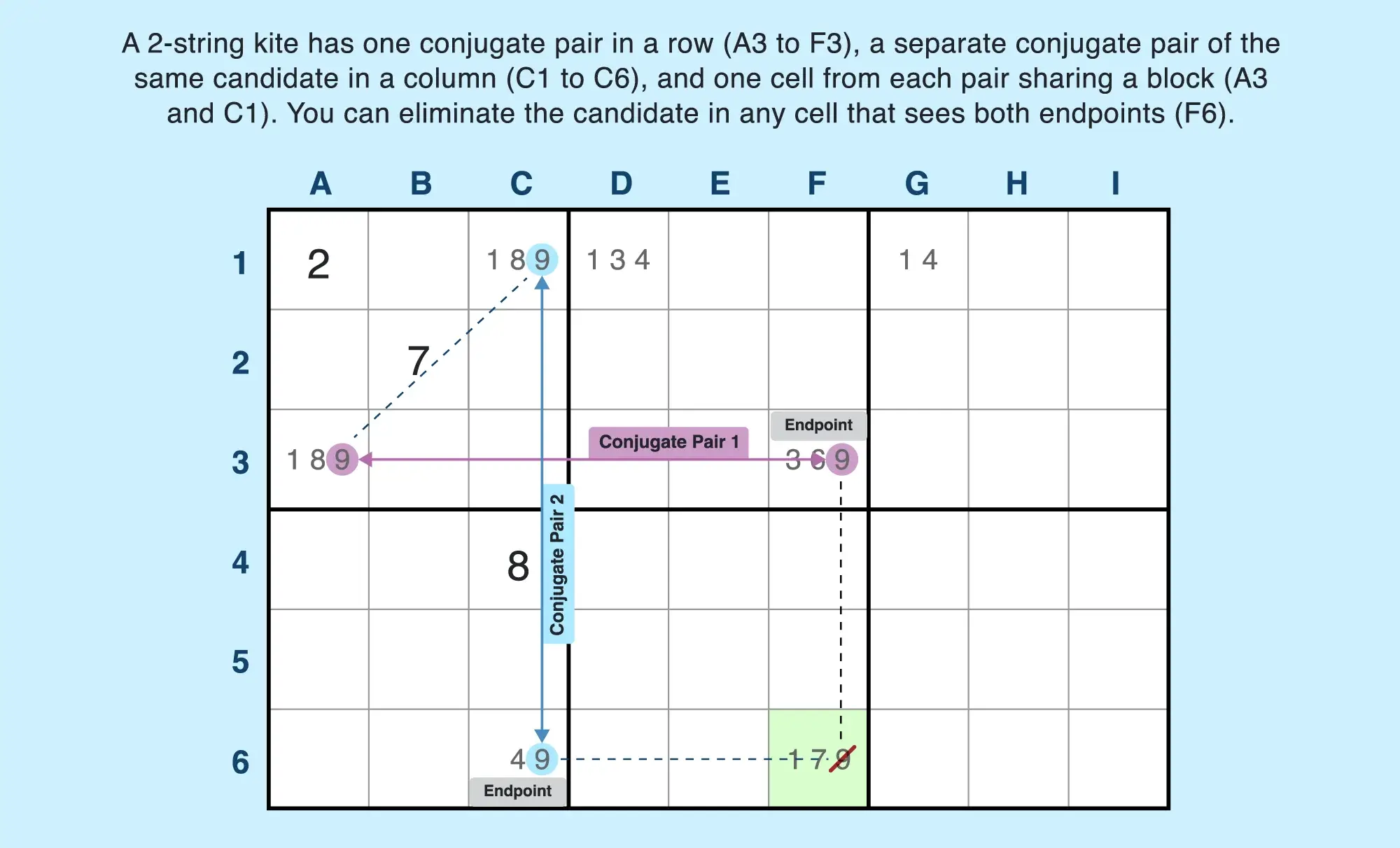
You can find a 2-string kite by following these steps:
- Look for one conjugate pair in a row (the first string). Identify a row where a single candidate appears in exactly two cells, thus creating a conjugate pair. For example, 9 only appears twice in row three, in cells A3 and F3, creating a conjugate pair. This is the first string.
- Find one conjugate pair of the same candidate in a column (the second string). Find another set of exactly two cells containing that same candidate in a column. This pair of cells cannot share a cell with the conjugate pair from the row—you should have four cells with two separate conjugate pairs. For example, 9 also only appears twice in column C, in cells C1 and C6, creating a conjugate pair. This can be seen as the second string.
- Confirm that one cell from each conjugate pair lies in the same block to create a strong or weak link. In this case, A3 and C1 appear in the same block (top left). They create a strong link because 9 only appears in those cells for that unit. When you connect these with a line, you see a small shape like the end of a kite with the two strings crossed over.
- Eliminate the candidate from any cell that sees both endpoints of the pattern. The endpoints are the cells from each conjugate pair not in the shared block. In this case, the endpoints are C6 and F3, and the only cell that sees both endpoints is F6. So the 9 in that cell can be eliminated. When you draw a line connecting the end points, it’s like the big end of a kite. So this is a two-string kite.
2-String Kite Sudoku Logic
The Sudoku 2-string kite solving technique works because one of the two cells in each conjugate pair must be 9 and the other cannot be 9. That means one of the endpoints will have to be 9.
- If C6 is 9, C3 cannot be 9, which means A3 must be 9 and F3 cannot be 9.
- If F3 is 9, then A3 cannot be 9, which means C1 must be 9 and C6 cannot be 9.
So any cell that sees both endpoints (F6) cannot contain the candidate and can be safely eliminated.
2-String Kite Patterns
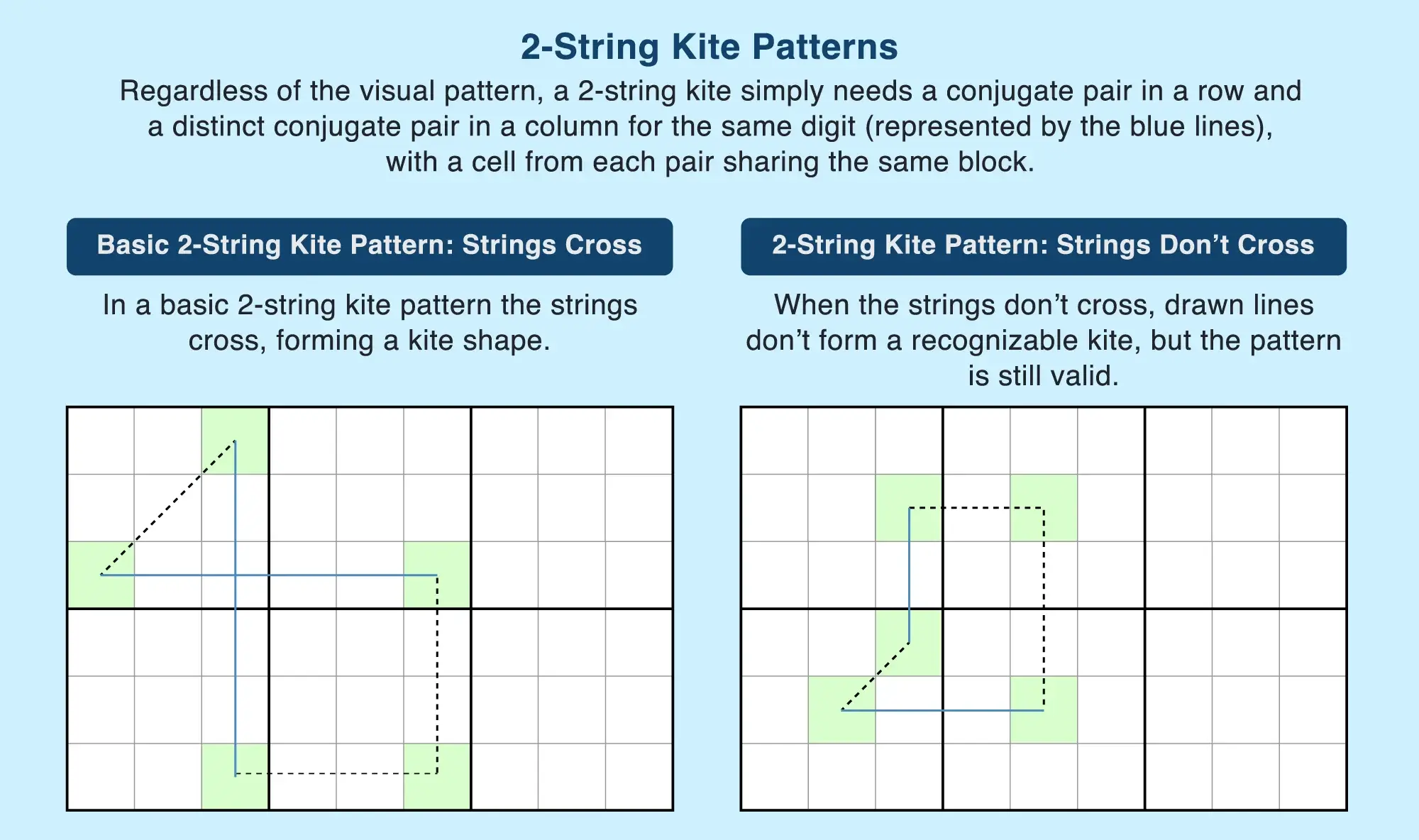
The basic pattern of a 2-string kite has the two strings crossing, but you won’t consistently see the visual of a kite. Rather than referring to a visual pattern, the strings refer just to the conjugate pairs—one string is the conjugate pair in a row, and the second string is the conjugate pair in a column.
Although one cell from each conjugate pair shares a block, this block-sharing element doesn’t always produce the nicely crossed “strings” that result in a more obvious kite pattern.
Remember that 2-string kites are part of the turbot fish family, and an open 2-string kite visual is also a type of turbot fish.
2-String Kite Examples
You can find 2-string kites that create a strong link or a weak link in the shared block with a single digit. But in either case, the logic remains, allowing you to eliminate the candidate from any cell that sees both endpoints of the pattern.
2-String Kite Type 1: Strong Link in Shared Block
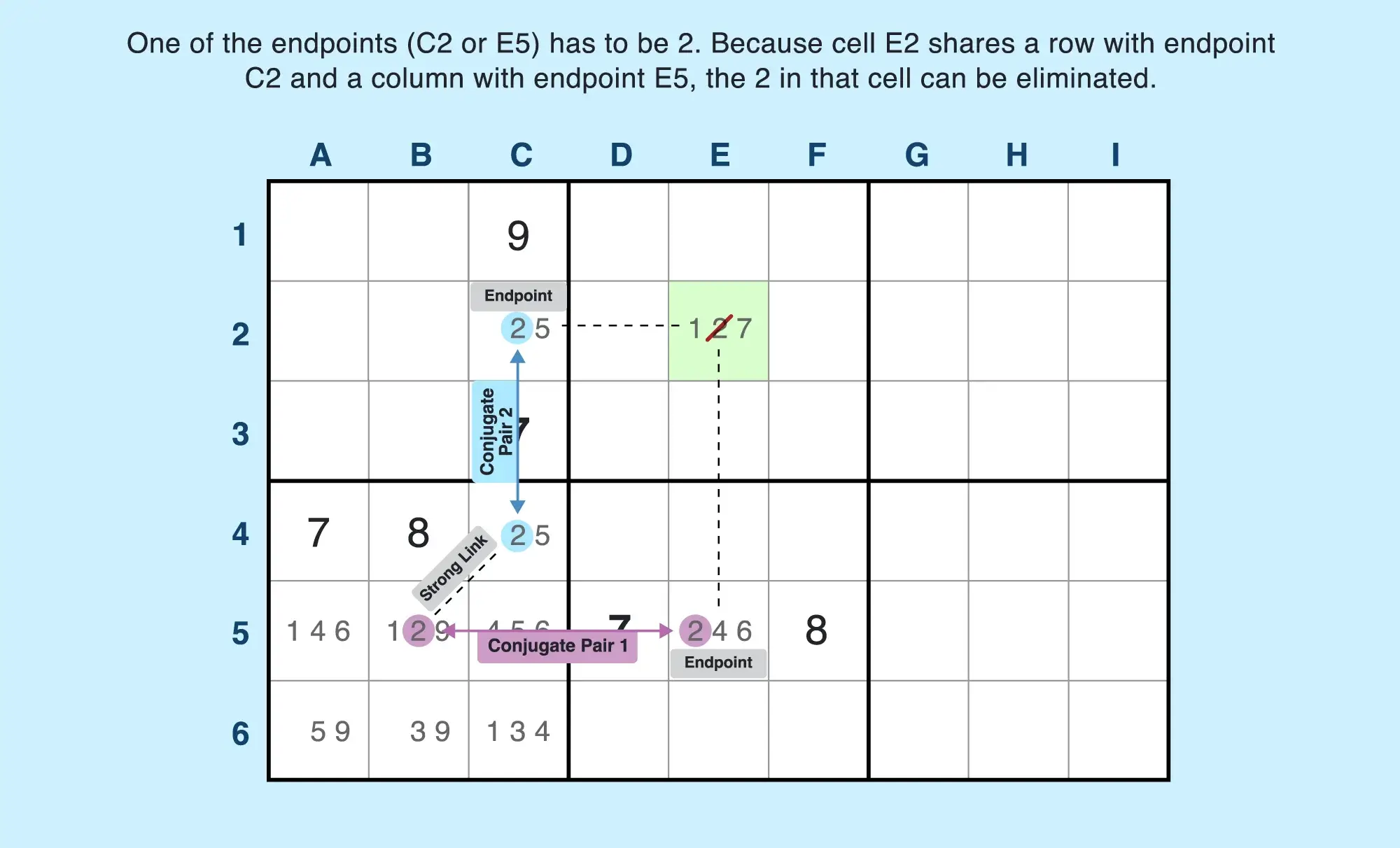
A 2-string kite can have a strong link in the shared block, and you can find one by doing the following:
- Look for the first string—one conjugate pair in a row. For example, 2 only appears twice in row three, in cells B5 and E5, creating a conjugate pair.
- Find the second string—a separate conjugate pair of the same candidate in a column. For example, 2 also only appears twice in column C, in cells C2 and C4, creating another conjugate pair.
- Confirm that one cell from each conjugate pair lies in the same block, creating a strong link. In this case, B5 and C4 appear in the same block and create a strong link because 2 only appears in those cells for that block.
- Eliminate the candidate from any cell that sees both endpoints of the pattern. For example, the endpoints are C2 and E5, and the only cell that sees both endpoints is E2. So the 2 in that cell can be eliminated.
2-String Kite Type 2: Weak Link in Shared Block
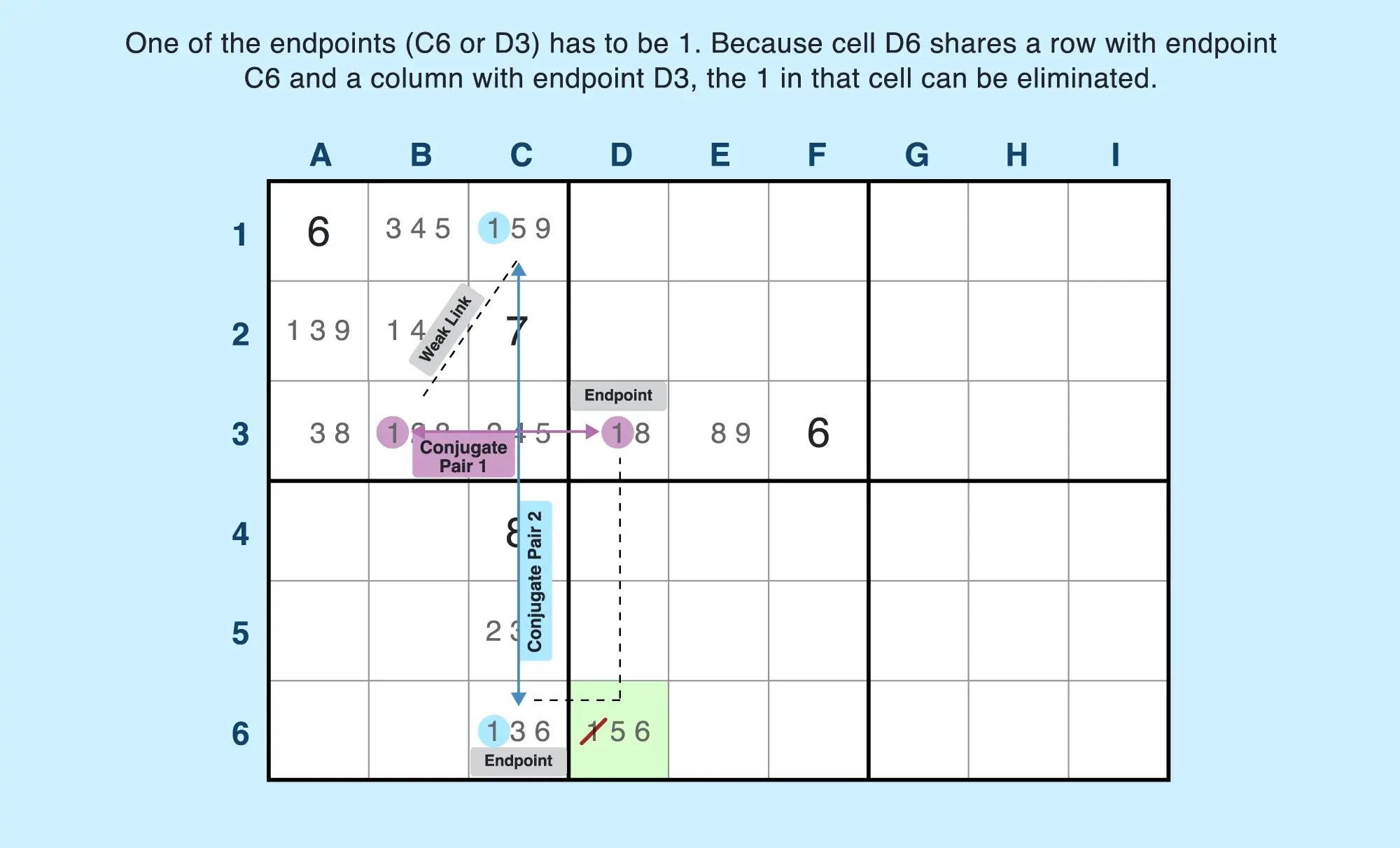
A 2-string kite can also have a weak link in the shared block and still set you up for an elimination. You can find one by doing the following:
- Look for the first string—one conjugate pair in a row. For example, 1 only appears twice in row three, in cells B3 and D3, creating a conjugate pair.
- Find the second string—a separate conjugate pair of the same candidate in a column. For example, 1 also only appears twice in column C, in cells C1 and C6, creating another conjugate pair.
- Confirm that one cell from each conjugate pair lies in the same block, creating a weak link. In this case, C1 and B3 appear in the same block, but 1 appears in other cells in that block as well. This creates a weak link for that candidate in the block, but you can still make an elimination.
- Eliminate the candidate from any cell that sees both endpoints of the pattern. For example, the endpoints are C6 and D3, and the only cell that sees both endpoints is D6. So the 1 in that cell can be eliminated.
Although a weak link is created in the shared block, the logic holds true. One cell in each conjugate must be 1. If C6 is not 1, then 1 must be placed in C1, eliminating 1 as a candidate in the rest of the block. That means D3 would have to be 1. If D3 is not 1, then B3 must be 1, and all 1 candidates in the rest of the block must be eliminated, which would make C6 become 1. Either way, D6 cannot be 1.
If you need a solid Sudoku solving technique for difficult puzzles when other, simpler strategies have been exhausted, you can use the 2-string kite to make eliminations and break open the puzzle. Try this technique the next time you’re playing Sudoku online.