Naked singles occur when a cell has only one possible candidate remaining. Unlike hidden singles (where the correct number is concealed among multiple candidates), a naked single is immediately visible because all other possibilities have already been eliminated.
This is the most fundamental Sudoku strategy and often the first solving technique players learn. Naked singles appear frequently in easy puzzles and serve as the foundation for all other solving methods. By consistently identifying naked singles, you can create chain reactions that help you fill in the grid and begin to learn more advanced techniques as you play Sudoku.
How to Find Naked Singles
Naked singles have only one rule: The cell contains just one possible candidate.
You may also see naked singles referred to as a “full house.” A full house is a type of naked single that occurs when a row, column, or block has only one empty cell, so the missing number must go there. So if a column has every number placed except 6 and one cell is empty, that 6 is a naked single that you can place in the empty cell.
Because naked singles rely on elimination, it’s important to track candidates carefully. After you mark all possible candidates in each cell of the block, you’ll notice some cells may have only a single remaining candidate—these are your naked singles. Continue updating candidates throughout the solving process because advanced techniques like finned swordfish or and X-wings often expose naked singles.
To identify naked singles, follow these steps:
- Fill empty cells with candidates. Focus on a single unit at a time and use candidate mode or pencil marks to note all possibilities in each cell of the block. On Sudoku Bliss, you can click the “Show Possibilities" box to have all the candidates filled in, or you can use scanning techniques to analyze the possibilities for each cell and add candidates by checking the box under the puzzle that says, “This number is a possibility.”
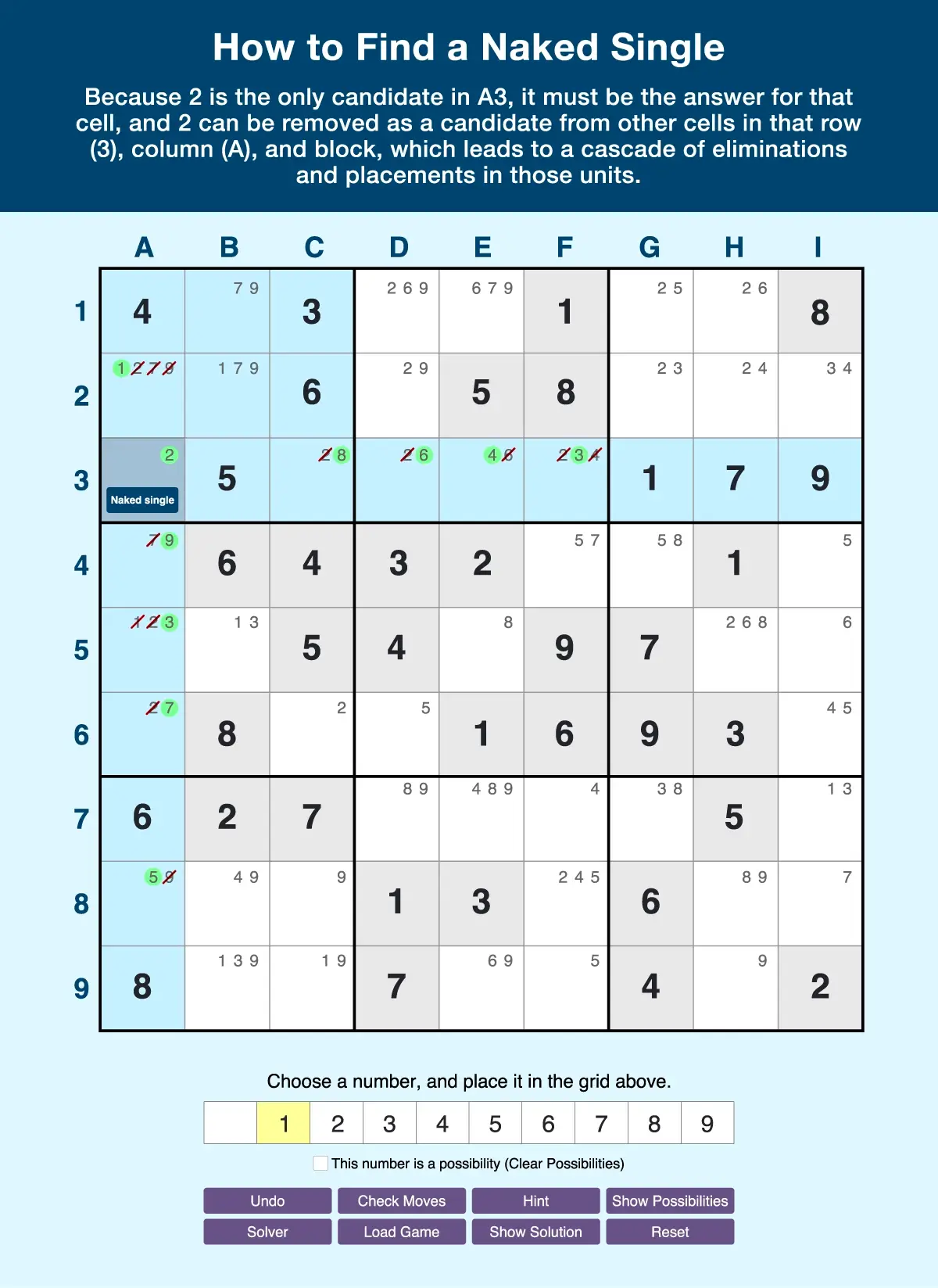
- Find a cell with only one candidate. For example, in the top-left block, cell A3 has just one candidate (2) marked.
- Place the naked single. Because 2 is the only candidate in A3, it must be the answer for that specific cell.
- Update candidates in the attached units (row, column, and block). A naked single often turns into a chain reaction. So after you place the answer in a cell, be sure to remove that number as a candidate in the corresponding units. For example, in column A:
- Placing 2 in A3 removes 2 from other cells, creating a naked single 7 in A6.
- Placing 7 in A6 removes 7 from other cells, leaving 9 as a naked single in A4.
- Placing 9 in A4 leaves 5 as a naked single in A8.
- Placing 5 in A8 leaves 1 in A2 after removing candidates 2, 7, and 9.
- Placing 1 in A2 leaves 3 in A5 after removing candidates 1 and 2.
You can repeat the process of updating candidates and placing answers for the row and block that contain A3.
Naked Single Examples
Whenever you place a naked single, update candidates in its row, column, and block. Doing this repeatedly can reveal new naked singles and trigger a chain of placements.
Naked Singles in a Row
To find a naked single in a row:
- Fill empty cells with candidates. Place possible candidates in each empty cell in the grid.
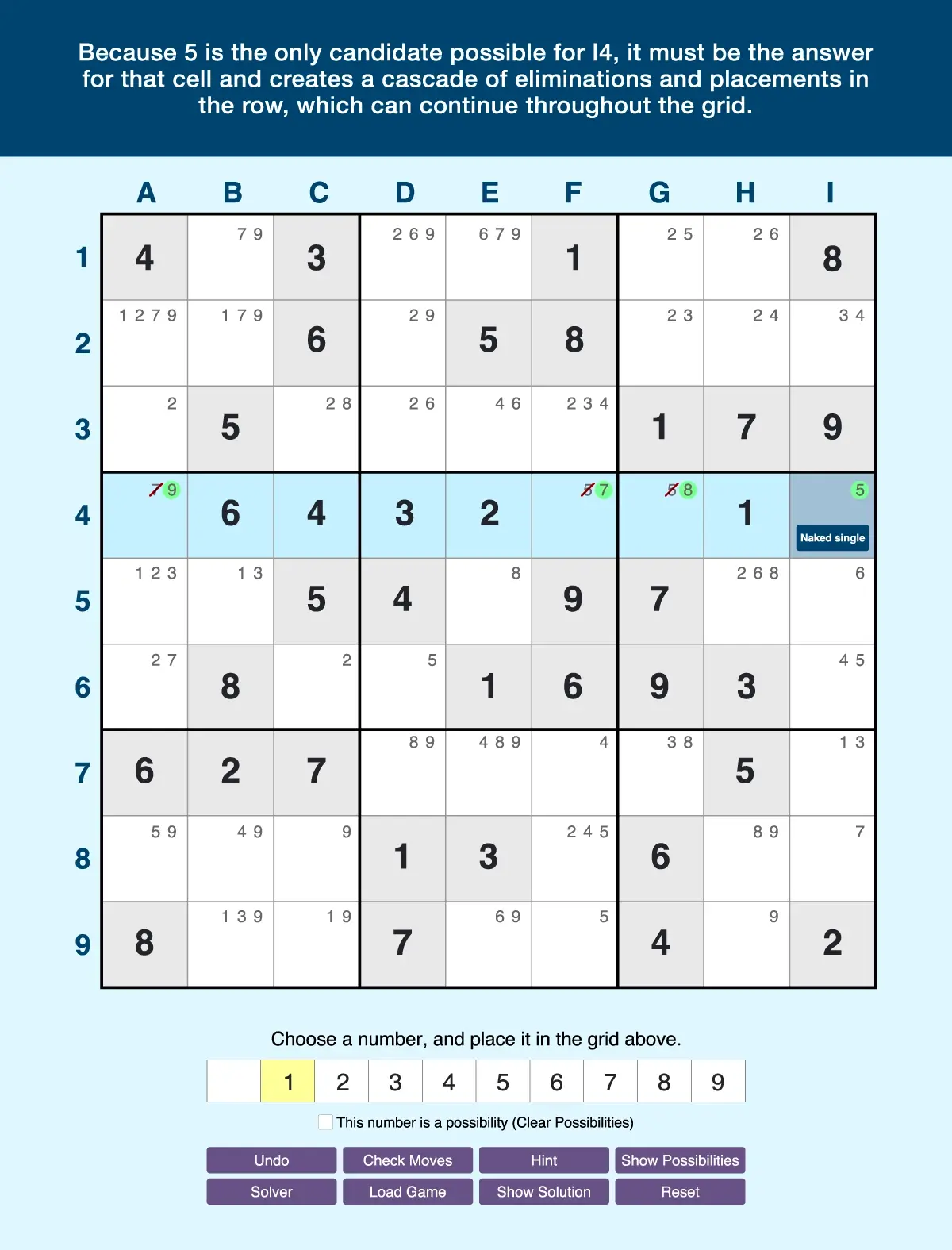
- Find a cell in a row with only one remaining candidate. For example, row 4 has one cell (I4) that only has one candidate (5).
- Place the naked single. Because 5 is the only candidate possible for I4, it must be the answer for that cell.
- Update candidates in the row, column, and block. Because 5 is the answer in I4, it can’t appear in any other cell in that same row (4), column I, or the middle-right block. After 5 is placed in I4, you can remove 5 as the candidate from any other cells in that row, which will solve the entire row:
- Removing 5 as a candidate creates a naked single 8 in G4 and a naked single 7 in F4, so you can add those answers.
- Placing 7 in F4 creates a naked single 9 in A4, solving the row.
Repeat this process to update candidates and place answers in column I and the middle-right block.
Naked Singles in a Column
To find a naked single in a column:
- Fill empty cells with candidates. Place possible candidates in each empty cell in the grid.
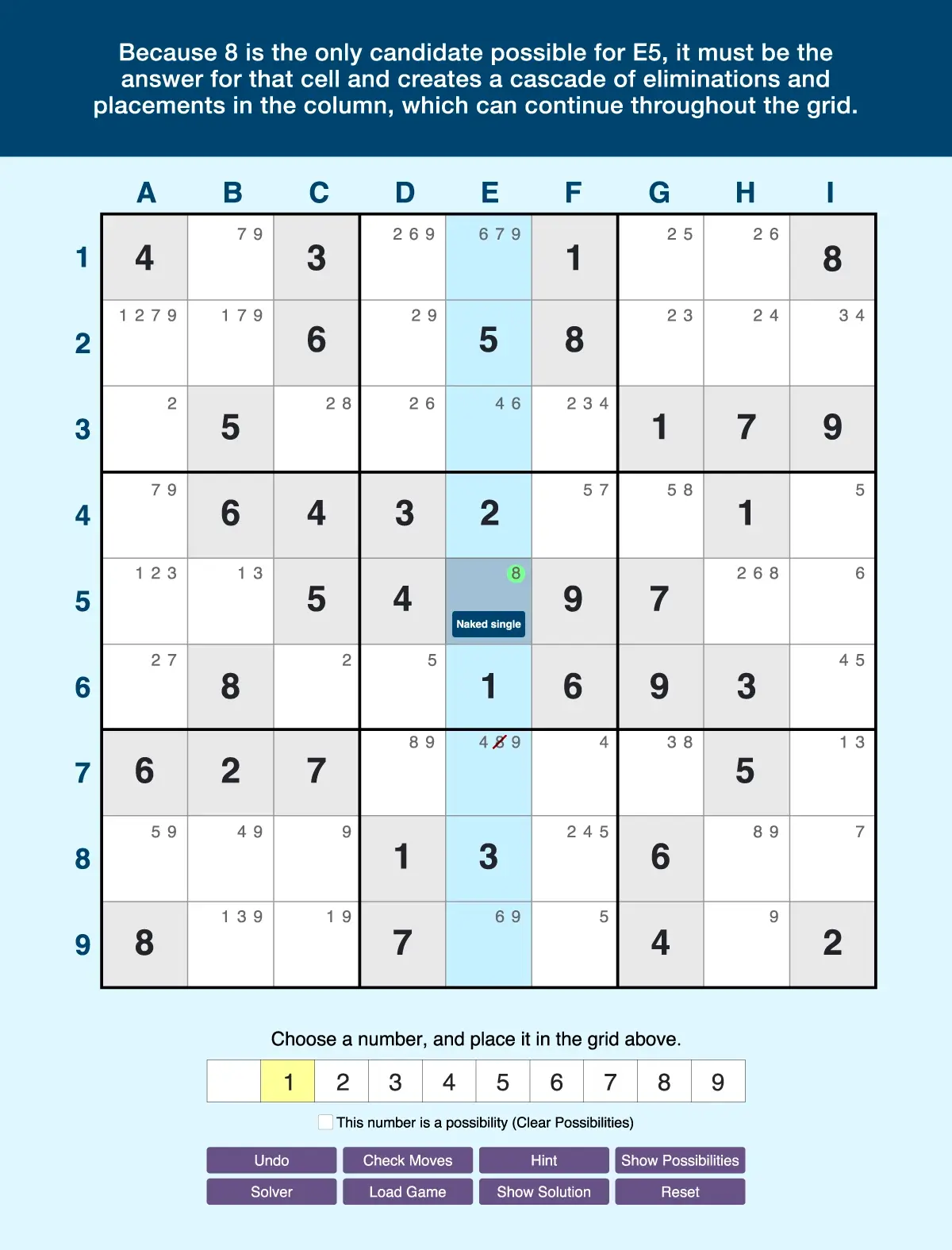
- Find a cell in a column with only one remaining candidate. For example, column E has one cell (E5) that only has a single candidate (8).
- Place the naked single. Because 8 is the only possible candidate for E5, it must be the answer for that cell.
- Update candidates in the row, column, and block. Because 8 is the answer in E5, it can’t appear elsewhere in that same column (E), row 5, or the middle block. So you can remove candidate 8 from E7.
Naked Singles in a Block
To find a naked single in a block:
- Fill empty cells with candidates. Place possible candidates in each empty cell in the grid.
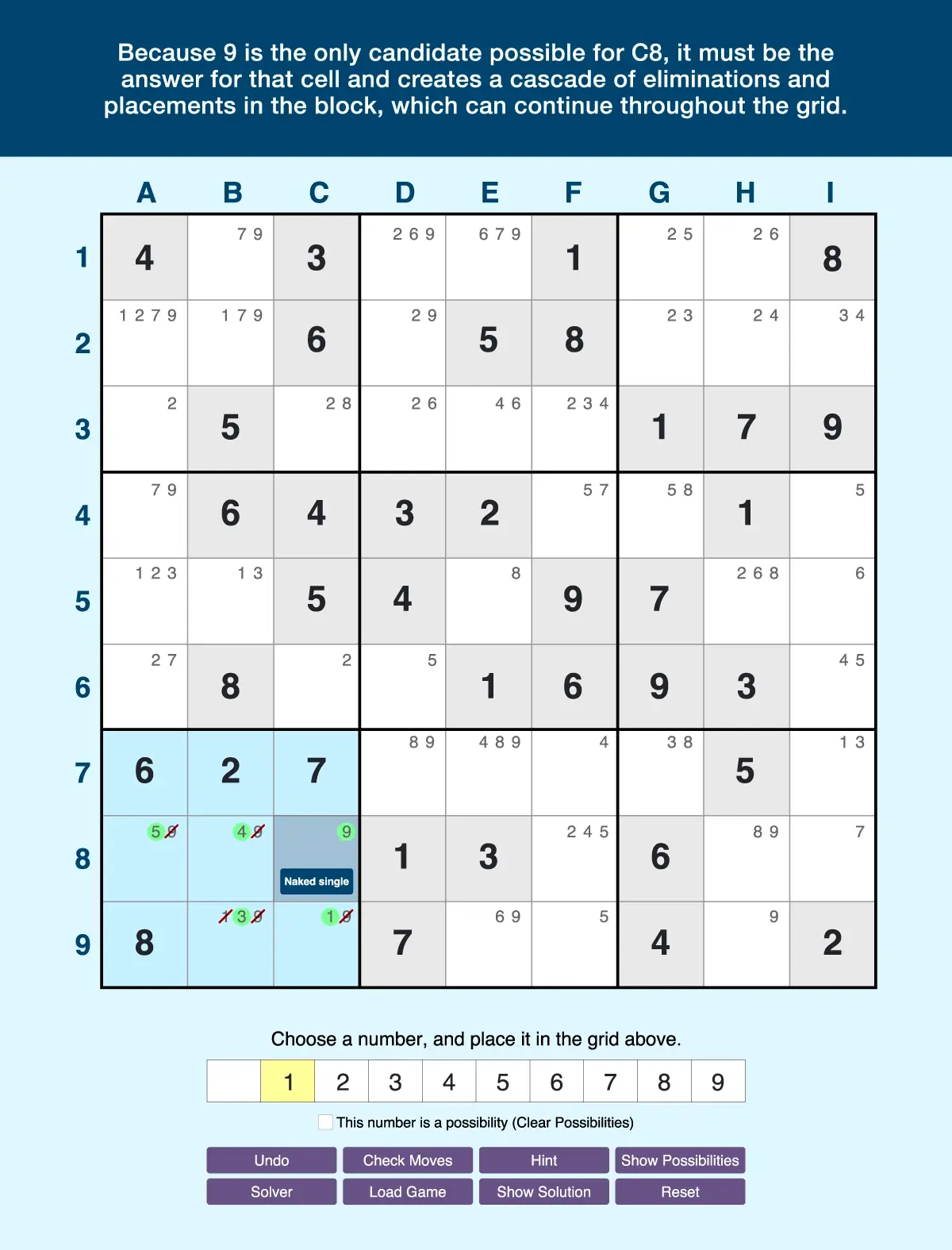
- Find a cell in a block with only one remaining candidate. For example, the bottom-left block has one cell (C8) that only has one candidate (9).
- Place the naked single. Because 9 is the only candidate possible for C8, it must be the answer for that cell.
- Update candidates in the row, column, and block. After 9 is placed in the bottom-left block, you can remove 9 as the candidate from any other cells in that block, which will solve the entire 3x3 block:
- A8 becomes a naked single 5.
- B8 becomes a naked single 4.
- C9 becomes a naked single 1.
- Placing 1 in C9 leaves 3 as a naked single in B9.
Repeat this process to update candidates and place answers in column C and row 8.
The naked singles Sudoku technique is perfect for beginners working their way through easy Sudoku puzzles. Because you’re looking for just one digit standing alone in a single cell, they are easy to spot in a Sudoku grid and can help you level up your Sudoku solving skills when you play Sudoku online.