Sashimi Swordfish Sudoku Technique: How to Find and Examples
A sashimi swordfish is an advanced Sudoku technique from the family of fish patterns, such as X-wings and standard swordfish. Like the basic swordfish technique, it works by restricting a candidate to three base sets (rows or columns) that line up with three corresponding cover sets (columns or rows).
If an extra candidate appears in a cell within a base set but outside the cover sets, the pattern becomes a finned swordfish. The extra cell, called a fin, modifies how eliminations are made, but if you removed it, the underlying swordfish would still exist.
A sashimi swordfish looks similar because it also includes a fin (or two!). However, the structure works differently. In this case, one base set does not have enough candidates within the cover sets to form a standard swordfish. The fin prevents that row or column from collapsing into a single forced placement, allowing eliminations in cells that lie in both the cover sets and the fin’s block.
How to Find a Sashimi Swordfish in Sudoku
To find a sashimi swordfish, look for a candidate confined to three base sets and three cover sets. Then verify that one of the base sets contains a fin outside the cover set alignment and that this fin is essential for the fish to exist.
A valid sashimi swordfish must follow these criteria:
- Only one base can contain a fin (or fins).
- Only one block can contain a fin (or fins).
- If the fin were removed, the remaining candidate in that base set would become a naked single, breaking the fish pattern.
- Eliminations occur where the fin’s block intersects the cover sets, for cells that see the fin.
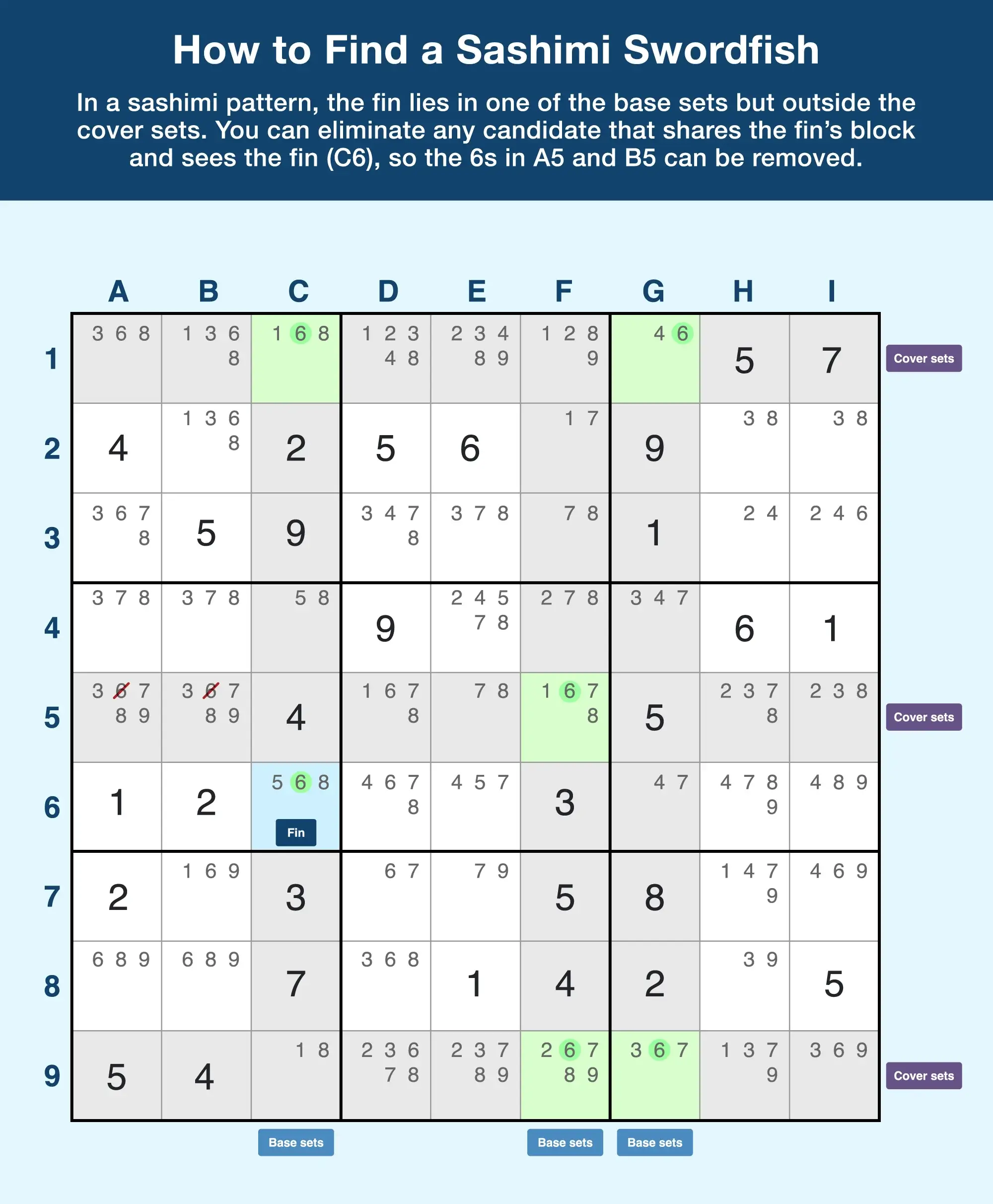
To find a sashimi swordfish and make eliminations, follow these steps:
- Find the base sets. The digit 6 appears twice in three columns (C, F, and G) to create the base sets with cells C1, C6, F5, F9, G1, and G9.
- Confirm that the cells align in three cover sets. The cells align in three rows: 1, 5, and 9.
- Locate the fin and confirm that it is necessary for the fish structure. The fin (C6) lies within the base set of column C, but because it doesn’t fall in any of the same rows as the other cells, it isn’t aligned in the cover sets (rows 1, 5, and 9). To confirm that this fin creates a sashimi swordfish, imagine removing the fin. If 6 were removed from C6, then the 6 in C1 would become a naked single, forcing G1 to be 4 and collapsing the fish structure. So the fin is necessary to complete the fish.
- Eliminate any candidate in the fin’s block that also lies in a cover set. You can eliminate the 6s in A5 and B5 because they both lie within the row 5 cover set and share the same block as the fin.
Finned Swordfish vs. Sashimi Swordfish
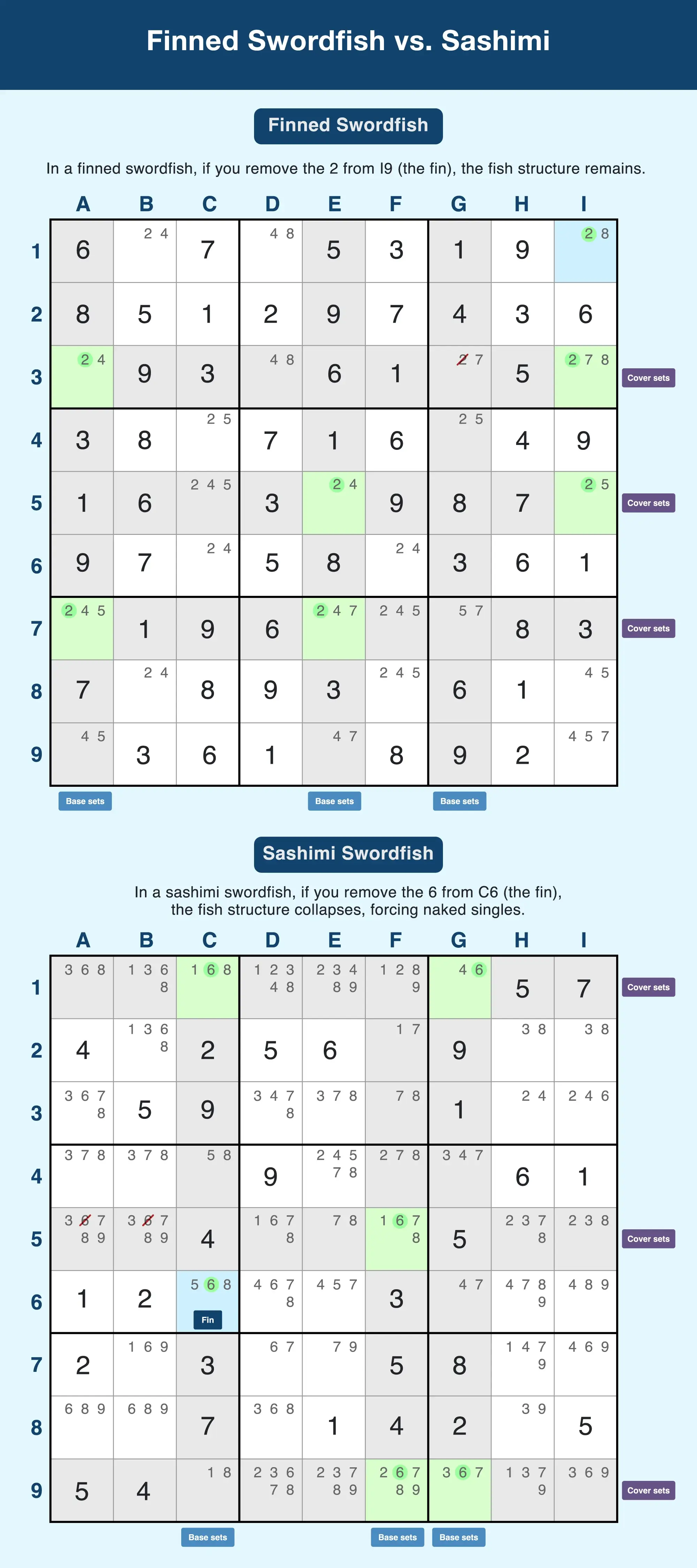
This Sudoku strategy differs in logic from a finned swordfish, which simply has an extra candidate (fin) in a base set. The defining feature of the sashimi fish is not the shape of the pattern, but the logic behind it: without the fin, the fish would not exist.
A finned pattern becomes a sashimi if one base set is so constrained that, if the fin were removed, that row would be reduced to a forced single, causing the fish structure to collapse. The fin prevents that forced placement and keeps the pattern from collapsing into singles.
- Finned swordfish example: In a regular finned swordfish, I1 acts only as a fin—it’s not a sashimi. If you removed the 2 from I1, it wouldn’t force placements in that column and collapse the structure because you still have cells I3 and I5 in that base set that align with cover sets.
- Sashimi swordfish example: In a sashimi, the fin is necessary to complete the fish and not force placements. Removing the 6 from C6 creates a naked single in C1, which forces G1 to be 4. With these cells removed, there is no swordfish pattern.
Sashimi Swordfish Examples
Like other swordfish strategies, a sashimi swordfish can be found in a horizontal and vertical orientation. In both cases, you’re looking for the same basic pattern. Most importantly, you must test whether removing the fin collapses the structure to confirm that you have a true sashimi pattern.
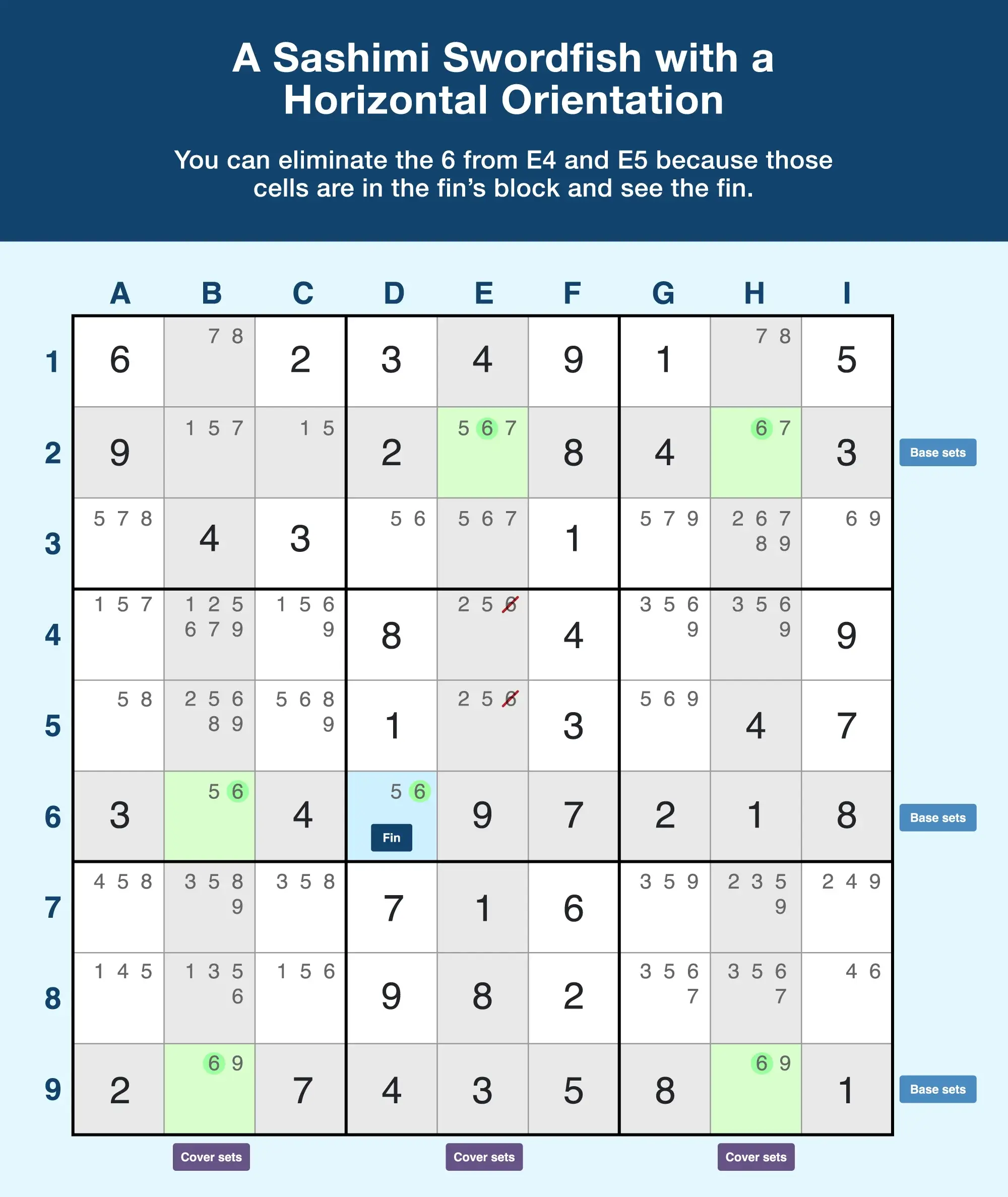
Sashimi Swordfish Horizontal Orientation
To find a sashimi swordfish in a horizontal orientation, follow these steps:
- Find the base sets in three rows. For example, the single digit 6 appears two times each in three rows (2, 6, and 9) to create the base sets with cells B6, B9, D6, E2, H2, and H9.
- Confirm that the cells align in three cover sets. For example, the cells align in three columns (B, E, and H).
- Locate the fin and confirm that it is necessary for the fish structure. The fin (D6) lies within the base set of row 6 but is not aligned in the cover set columns B, E, and H. If 6 were removed from D6, the 6 in B6 would become a naked single, forcing B9 to be 9, H9 to be 6, H2 to be 7, and D3 to be 6, which would force E2 to be 6. Because the fish structure collapses, the fin is necessary to complete the fish.
- Eliminate any candidate in the fin’s block that also lies in a cover set. You can eliminate the 6s in E4 and E5 because they lie within the column E cover set and share the same block as the fin.
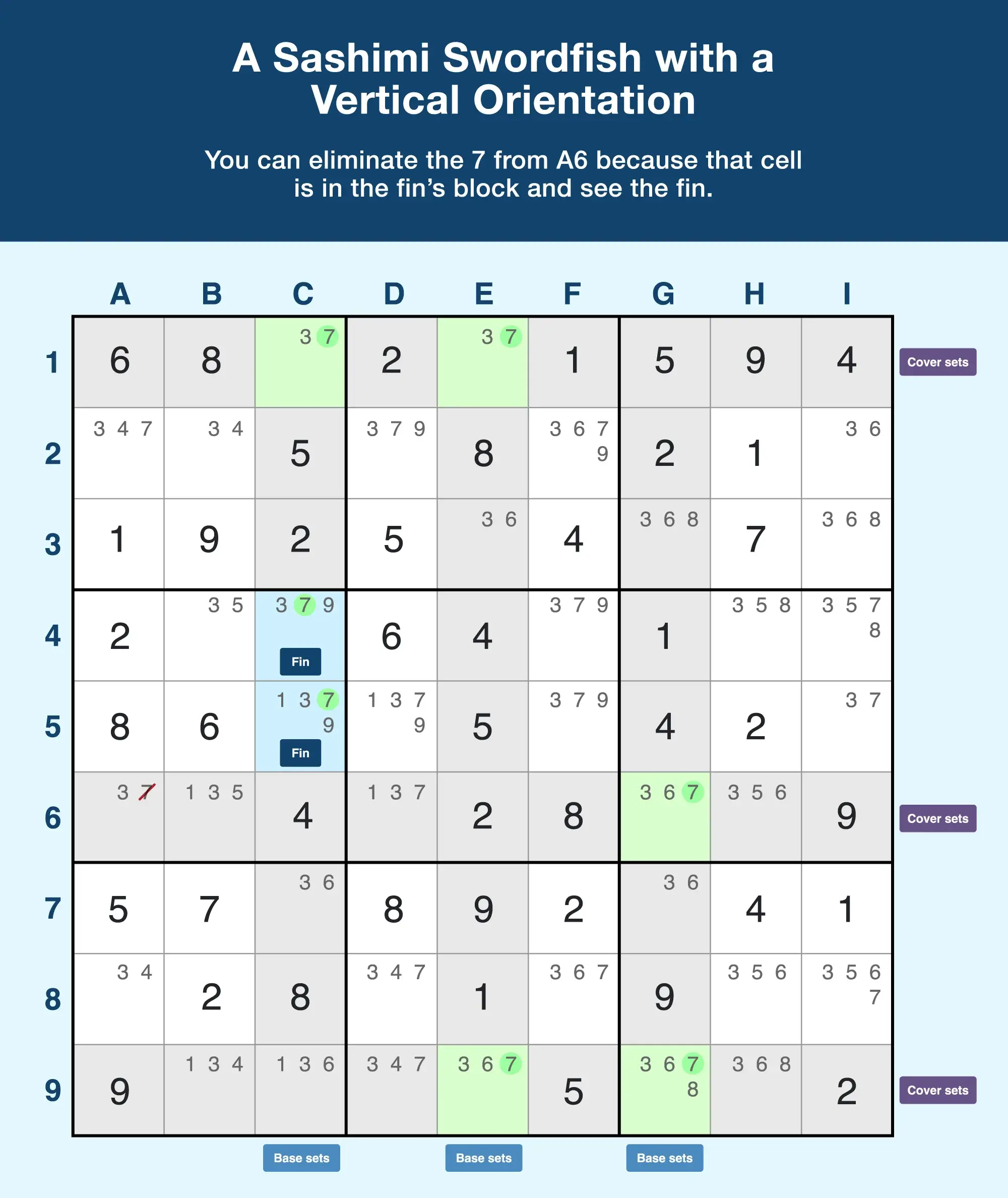
Sashimi Swordfish Vertical Orientation
To find a sashimi swordfish in a vertical orientation, follow these steps:
- Find the base sets in three columns. For example, the digit 7 appears three times in column C and two times each in columns E and G to create the base sets with cells C1, C4, C5, E1, E9, G6, and G9.
- Confirm that the cells align in three cover sets. For example, the cells align in rows 1, 6, and 9.
- Locate the fins and confirm that they are necessary for the fish structure. The fins lie within the base set of column C but are not aligned in rows 1, 6, and 9. If 7 were removed from C4 and C5, the 7 in C1 would become a naked single, forcing E1 to be 3 and collapsing the fish structure.
- Eliminate any candidate in the fin’s block that also lies in a cover set. You can eliminate the 7 in A6 because it lies in the row 6 cover set and shares the same block as the fins.
The sashimi swordfish Sudoku technique is a finned swordfish with even more constraints that can be useful when solving puzzles at an expert level. When you’re playing Sudoku online and other strategies leave the puzzle locked, this technique can help you make eliminations and break open the grid.