A conjugate pair in Sudoku occurs when a candidate number appears in only two cells within a unit—a row, column, or 3x3 block. Because of puzzle constraints, the candidate must be true (the answer) in one cell and false (not the answer) in the other cell. This either-or relationship establishes a strong link between the two candidates, creating the base for a wide range of solving strategies.
Conjugate pairs can help uncover more basic patterns, such as Sudoku simple coloring, hidden singles, and locked candidates, and they form the foundation for several advanced techniques, including X-wings, 2-string kites, and X-cycles.
That versatility makes conjugate pairs worth learning for every Sudoku solver, from beginner to advanced. Even if you're not ready to tackle more intricate techniques, you can learn how to find conjugate pairs and recognize the useful patterns they create. Then once you start finding them regularly, you'll see that many Sudoku strategies that seem vastly different actually share the same underlying logic.
How to Find a Conjugate Pair
A conjugate pair has just one requirement: One candidate number must appear in exactly two cells in the row, column, or block. For example, in row 6, candidate 7 can only appear in cells A6 and C6, and they create a conjugate pair.
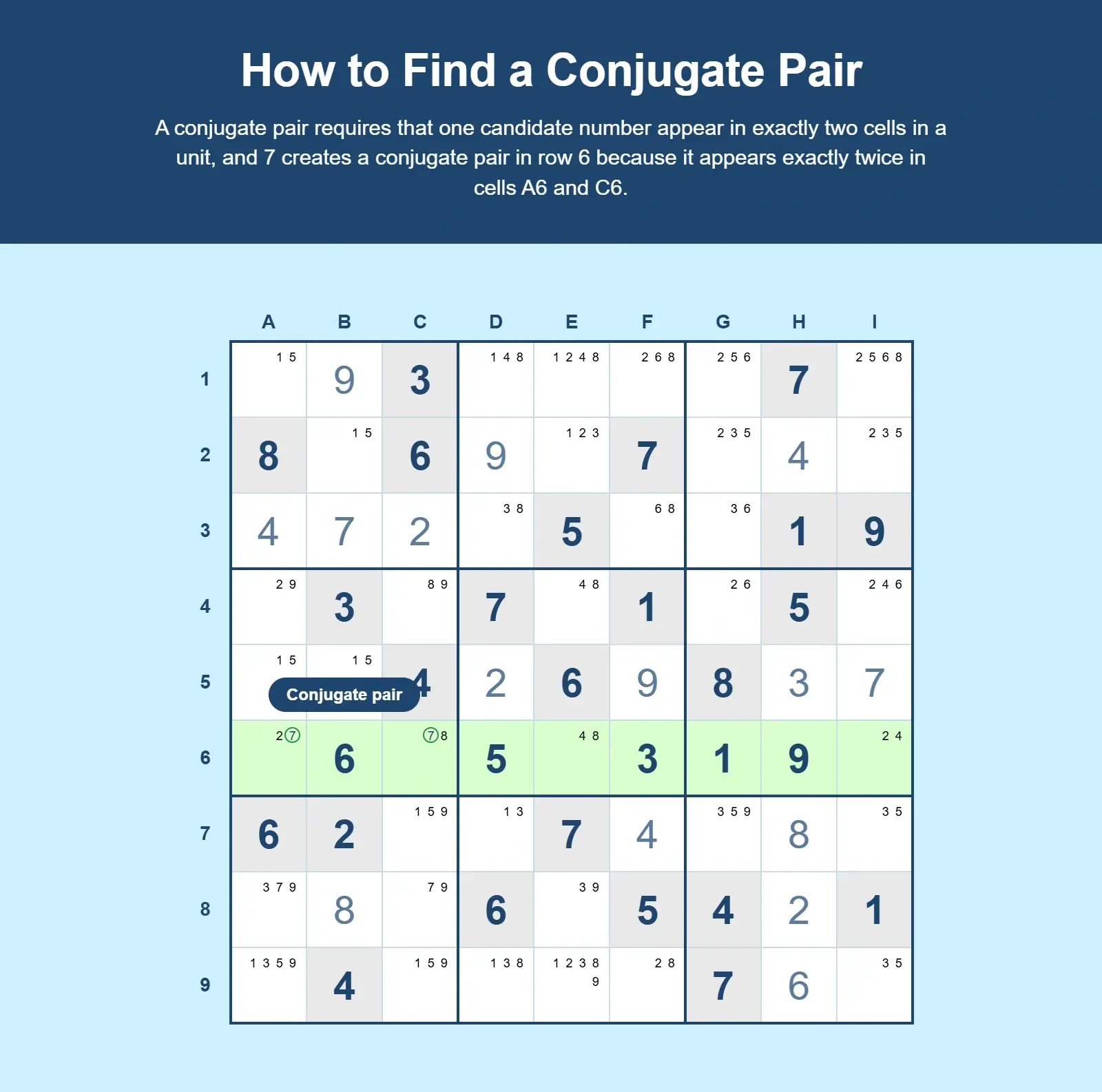
Remember: The cells don't need to contain the exact same set of candidate numbers to form a conjugate pair, and that is why this technique confuses some beginners. In this example, A6 contains a 2 and 7, and C6 contains a 7 and 8. The only candidate they have in common is the 7 that forms the conjugate pair. But because this basic logic is the foundation of so many other techniques, the cells sometimes do have the same candidates, which means you've discovered another technique or overlapping pattern. This overlap is shown in our examples below, so you can see just how common conjugate pairs are to other techniques.
You can find conjugate pairs at several points while solving a Sudoku puzzle:
- When you first enter pencil marks: If you use candidate mode to add pencil marks to your puzzle, just scan one candidate number at a time across the rows, columns, and blocks. Look for any unit in which the number appears exactly twice. Snyder notation, a pencil marking technique that records a candidate only when it's restricted to two cells within a block, makes block-based conjugate pairs immediately recognizable.
- After placing an answer or making an elimination: Every solved cell removes that number as a candidate from the rest of its row, column, and block. A unit that previously had three or more possible locations for a digit may now have only two, creating a new conjugate pair.
- When you reach a roadblock: If you're stuck with a hard puzzle, instead of searching the entire grid for a specific advanced pattern, looking for a single candidate often leads to finding conjugate pairs in more than one spot, helping you uncover a useful pattern you can use for elimination.
Conjugate Pair Examples
Conjugate pairs can be found in any unit of the grid, and they often form the base for other patterns. So these examples not only show you conjugate pairs but also where they form the logic for useful techniques. We've used the same grid in every example to show you how prevalent conjugate pairs can be in one puzzle as well as the Sudoku techniques they support.
Conjugate Pair in a Block
By looking at the candidates in the top left block, you can see that candidate 1 appears in exactly two cells (A1 and B2) within the block, forming a conjugate pair. Candidate 5 also appears in exactly two cells (A1 and B2) within the block, forming a second conjugate pair. This means if A1 is 1, B2 can't be 1. If B2 is 1, A1 can't be 1. The same is true for the 5s.
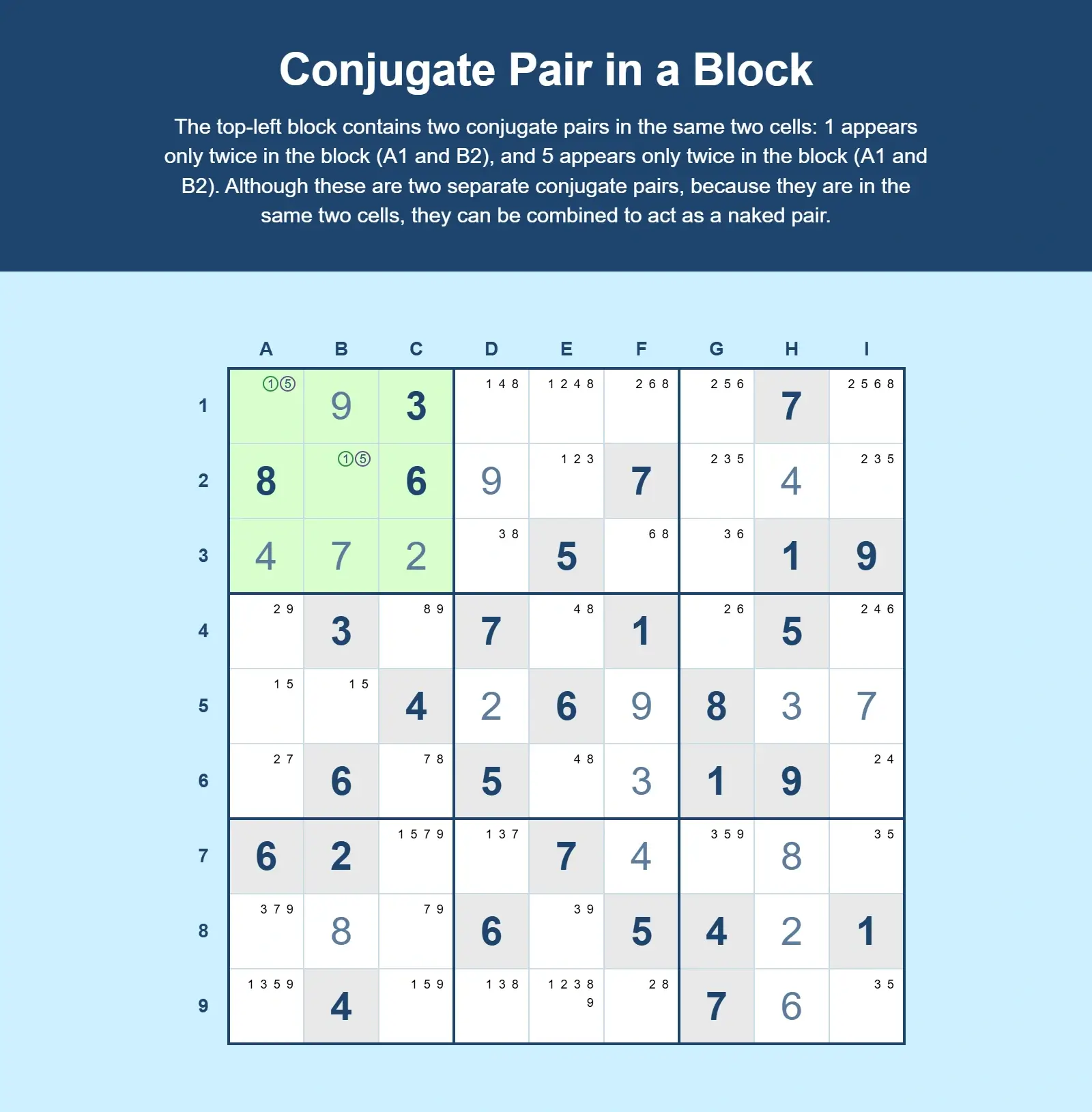
This is a case where the cells forming the conjugate pair actually contain the exact same candidate numbers. So in this example, A1 and B2 not only form two conjugate pairs, but they also form a naked pair because both cells contain exactly the same two candidate numbers, 1 and 5, and no others.
While this naked pair alone doesn't offer a direct elimination, it can work with another naked pair in A5 and B5. Those two cells not only form conjugate pairs for 1 and 5, but they're also the only two cells that contain exactly 1 and 5, making them another naked pair. Now that either-or logic behind these strong links can offer some eliminations. Because either A1 or A5 must be a 1 or 5 you can eliminate the 1 and 5 in A9.
Are Naked Pairs and Conjugate Pairs the Same?
Naked pairs overlap in logic with conjugate pairs, which is why it may look like a solving explanation refers to "conjugate pair" and "naked pair" as though they mean the same thing. In the example above, the same two cells satisfy both definitions, but the terms describe different relationships worth pointing out:
- A naked pair focuses on two cells and two candidates. Each of the two cells contains only the same two numbers.
- A conjugate pair focuses on two cells and one candidate. One candidate number appears exactly twice in two cells, and those two cells may contain the same or different additional candidates.
In the case of A1 and B2 as well as A5 and B5, the cells contain only the exact same candidates so the two conjugate pairs form naked pairs. This will not always happen with this technique.
Conjugate Pair in a Row
By looking at the candidates in row 3, you can find three conjugate pairs.
- Candidate 3 appears exactly twice in D3 and G3.
- Candidate 6 appears exactly twice in F3 and G3.
- Candidate 8 appears exactly twice in D3 and F3.
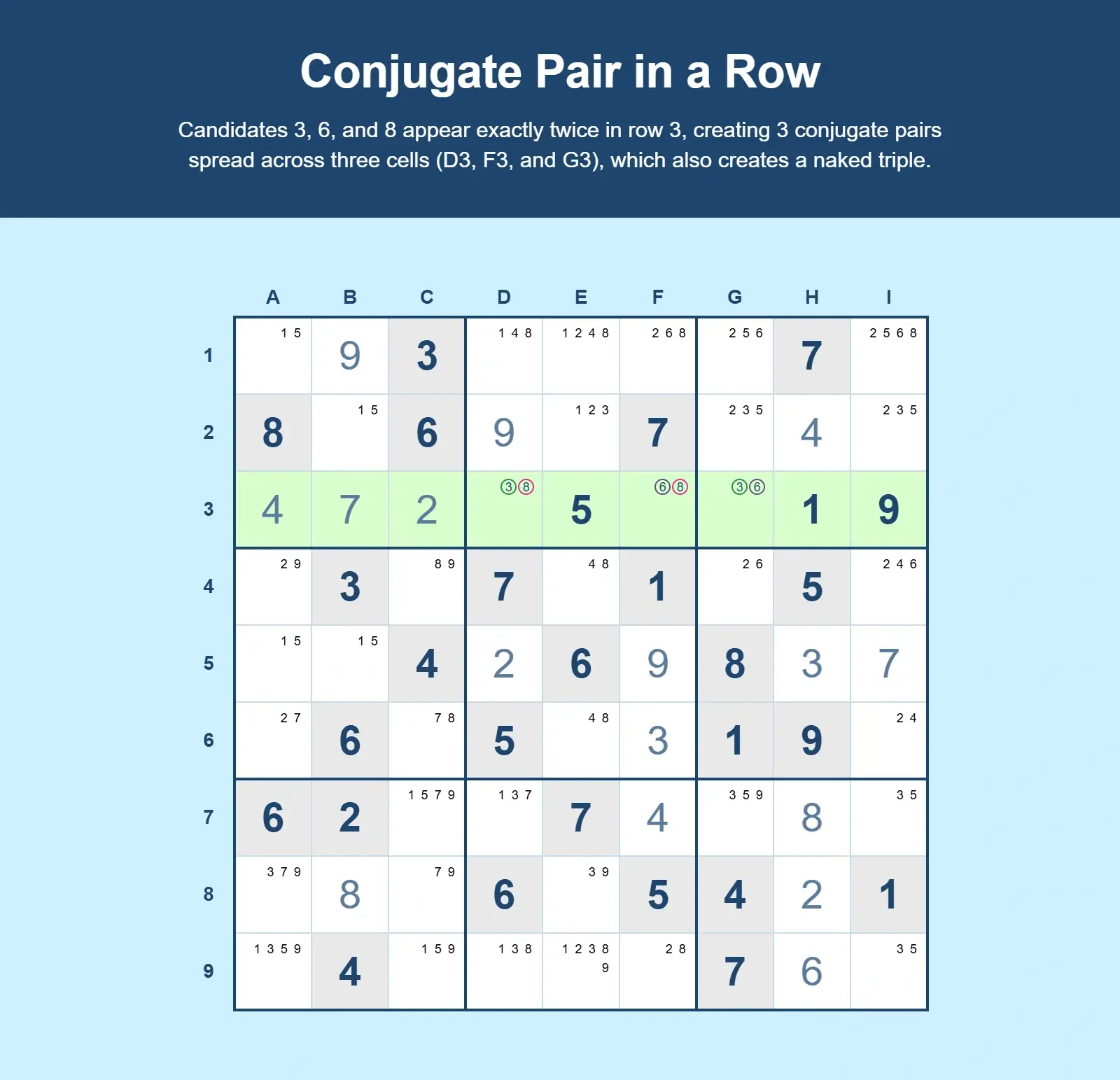
Uncovering these three conjugate pairs reveals another Sudoku pattern: naked triple. Three candidates (3, 6, 8) are restricted to just three cells in that row. While they don't offer any elimination opportunities, they're important to identify because you may need them for a pattern later in your Sudoku game.
In row 6, you can find four conjugate pairs:
- Candidate 2 appears only in A6 and I6.
- Candidate 4 appears only in E6 and I6.
- Candidate 7 appears only in A6 and C6.
- Candidate 8 appears only in C6 and E6.
Similar to the conjugate pairs in row 3, these conjugate pairs create a naked quad, because four candidates are restricted to exactly four cells in this row. Again, like the naked triple in row 3, these don't offer any eliminations at this point, but finding them can be crucial to discovering advanced patterns for elimination later in the puzzle.
Conjugate Pair in a Column
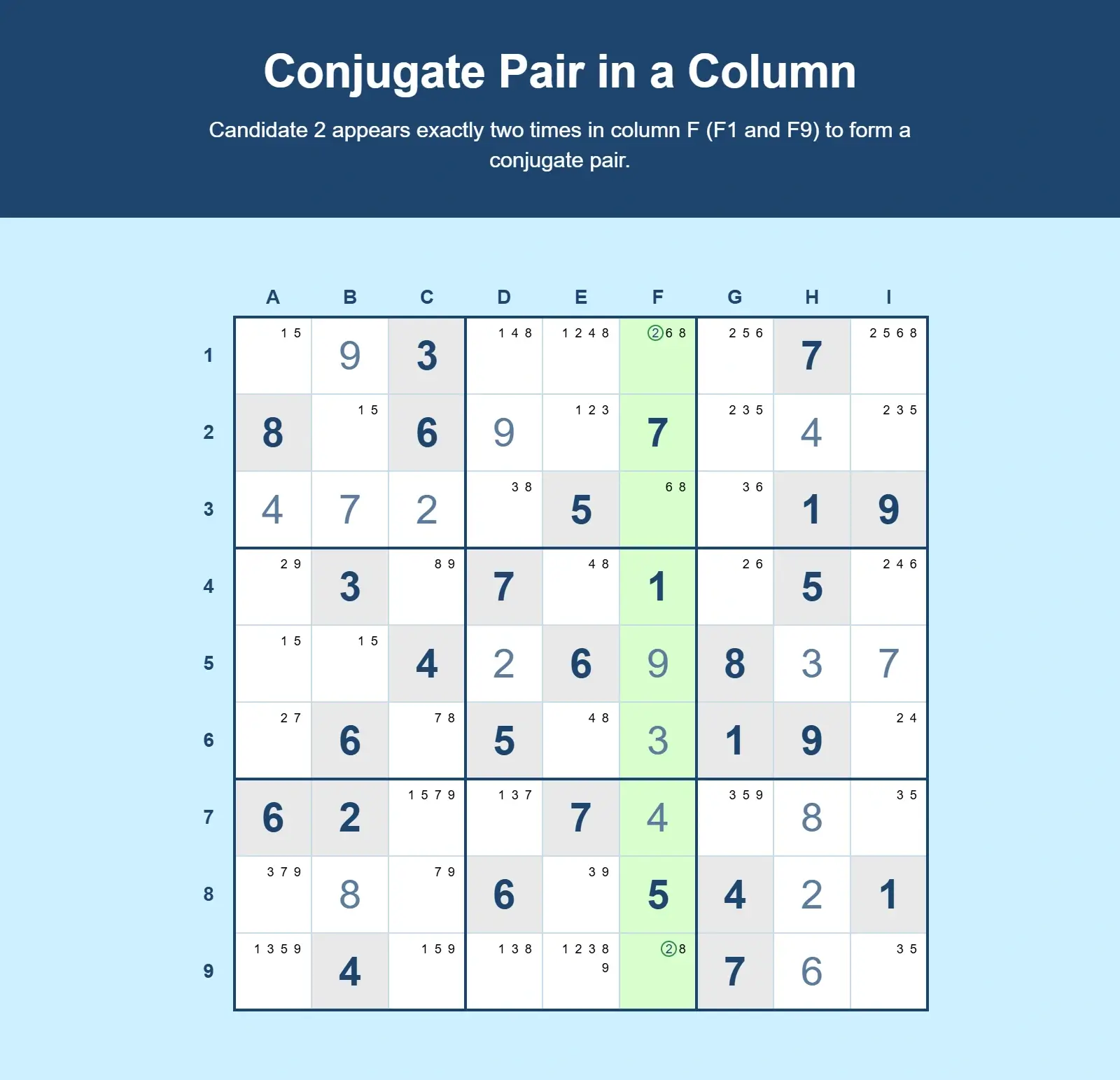
By looking at the candidate options for column F, you can see that candidate 2 appears in only two cells (F1 and F9), to form a conjugate pair. If F1 is 2, F9 cannot be 2 and vice versa. This is a straightforward example of a conjugate pair that doesn't overlap with another technique. It's simply a strong link for candidate 2. This strong link can come in handy as you find other conjugate pairs and patterns.
Conjugate Pairs and Advanced Techniques
Conjugate pairs are especially useful because they're not limited to one solving method. They provide strong links that can be used individually, combined with other restrictions, or connected into chains. After you get good at recognizing them, you can use them in the following advanced techniques:
- Hidden singles: If one end of a conjugate pair is eliminated, the other becomes the only possible location for that number in the house.
- Locked candidates: A conjugate pair within a block may also form a pointing pair if its two cells lie in the same row or column.
- X-wings: Two rows or columns may each contain a conjugate pair for the same candidate. If the pairs align in the same two opposite houses, they can form an X-wing.
- Skyscrapers: Two conjugate pairs for the same candidate can form a skyscraper when one end of each pair aligns while the other ends do not.
- 2-string kites: A conjugate pair in a row and a conjugate pair in a column can connect through a shared block to create a candidate elimination.
- Simple coloring: Multiple conjugate pairs for the same candidate can be connected into a color chain. Contradictions or cells that see both colors may then allow eliminations.
- X-cycles: Conjugate pairs provide the strong links that alternate with weak links as the chain moves through the grid.
Not every conjugate pair will create one of these patterns, and beginners may be intimated to try them. But conjugate pairs offer a great foundation to level up. If you find conjugate pairs in a puzzle, see if your pairs match up to an XY-wing or swordfish pattern or a different advanced technique you've never used before.
Because conjugate pairs are the tool for so many solving patterns, identifying these pairs is a core skill you want to build. You can find these pairs in everything from easy to expert-level puzzles, and they can help you solve at every point of the puzzle. Practice finding conjugate pairs while playing Sudoku online to increase your level of solving and to get familiar with new techniques for advanced eliminations!