A Sudoku chain is a sequence of candidates linked by strong and weak relationships that highlight how one candidate being true or false affects another. Following those relationships can reveal eliminations or placements that aren’t obvious when you look at individual cells. Rather than a single strategy, building and interpreting chains in Sudoku come from several different advanced techniques, from X-cycles to forcing chains.
Most chains rely on strong links and weak links to connect candidates.
- A strong link means that if one candidate is false, the other must be true. A conjugate pair, in which a candidate has only two possible positions within a row, column, or box, is a common example.
- A weak link means that if one candidate is true, the other must be false.
By connecting these relationships, you can build a chain across units or the entire grid to help you eliminate candidates or make placements. When basic solving strategies aren’t enough to crack a Sudoku puzzle, this post helps you understand how chains can uncover logical connections when you play Sudoku online.
How to Find Chains in Sudoku
Finding a chain means following candidates whose strong and weak relationships allow you to carry a logical inference from one part of the Sudoku grid to another. Chains can involve the same digit or different digits, and the links can occur within a cell or between cells. Each chain type builds a chain in its own way, and the most basic chain, an X-chain, is built following these steps:
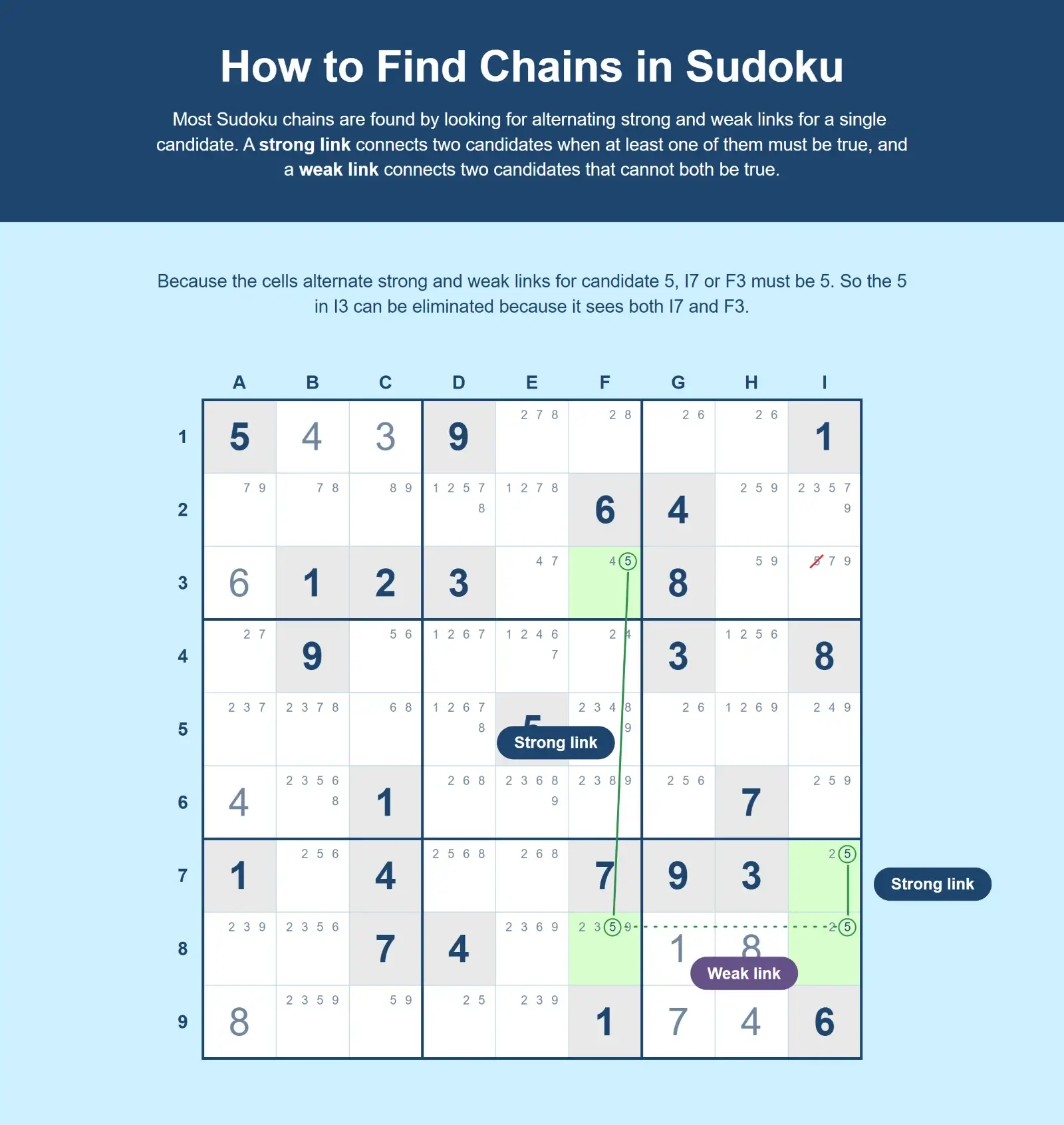
- Start by finding a strong link, such as conjugate pairs or two candidates in the same bi-value cell. A strong link connects two candidates when at least one of them must be true. For example, I7 and I8 create a strong link for candidate 5 because they are the only two cells in column I that contain 5. So if I7 is not 5, I8 must be 5, and if I8 is not 5, I7 must be 5.
- Connect the strong link to a weak link. A weak link connects two candidates that cannot both be true. For example, I8 and F8 both contain candidate 5 in the same row (8), so they can’t both be 5. However, because there are other 5s in that row, the relationship is weak, not strong.
- Continue finding links, alternating strong and weak. From the weak link, look for another strong link that lets you continue the inference. For example, F8 and F3 both have candidate 5, and they're the only two cells in column F with that candidate, creating a strong link. If F8 is not 5, F3 must be 5, and if F3 is not 5, F8 must be 5.
- Find placements and/or make eliminations, if possible. Not every chain you find will result in a placement or candidate eliminations, and each type of chain supplies its own logic. For example, because every node of the chain concerns the same candidate and the links alternate strong/weak, this is an X-chain, which is a type of alternating inference chain (AIC). This chain proves that at least one endpoint, I7 or F3, must be 5. You can then eliminate any 5 that see both endpoints. In this case, I3 sees both I7 and F3, so you can eliminate the 5 from that cell.
Remember: You won’t always eliminate and place candidates when using a chain. Sometimes you may just eliminate a candidate (or more than one). Other times you may be able to place a candidate or both eliminate and place a candidate. However, there will be times that the chain gives you no elimination or placement. That’s okay. Chains offer information. So even if you can’t use the information, you may need it later in the solving process.
Examples of Sudoku Chains
Sudoku chains can be divided into two broad types, all with their own logic structure. The key difference between the two chain families is how you follow the logic. Alternating inference chains (AICs) trace alternating strong and weak inferences through the grid, while forcing chains start with a possible condition and trace what that condition would force. And different chain methods can sometimes reveal the same underlying deduction.
Alternating Inference Chains (AICs)
Alternating inference chains follow alternating strong and weak inferences.
X-Chains
An X-Chain is a type of alternating inference chain (AIC) in which every node represents the same candidate. What distinguishes it from many other AICs is that the digit never changes as the chain alternates between strong and weak links.
The example in the earlier section was an X-chain. To find one:
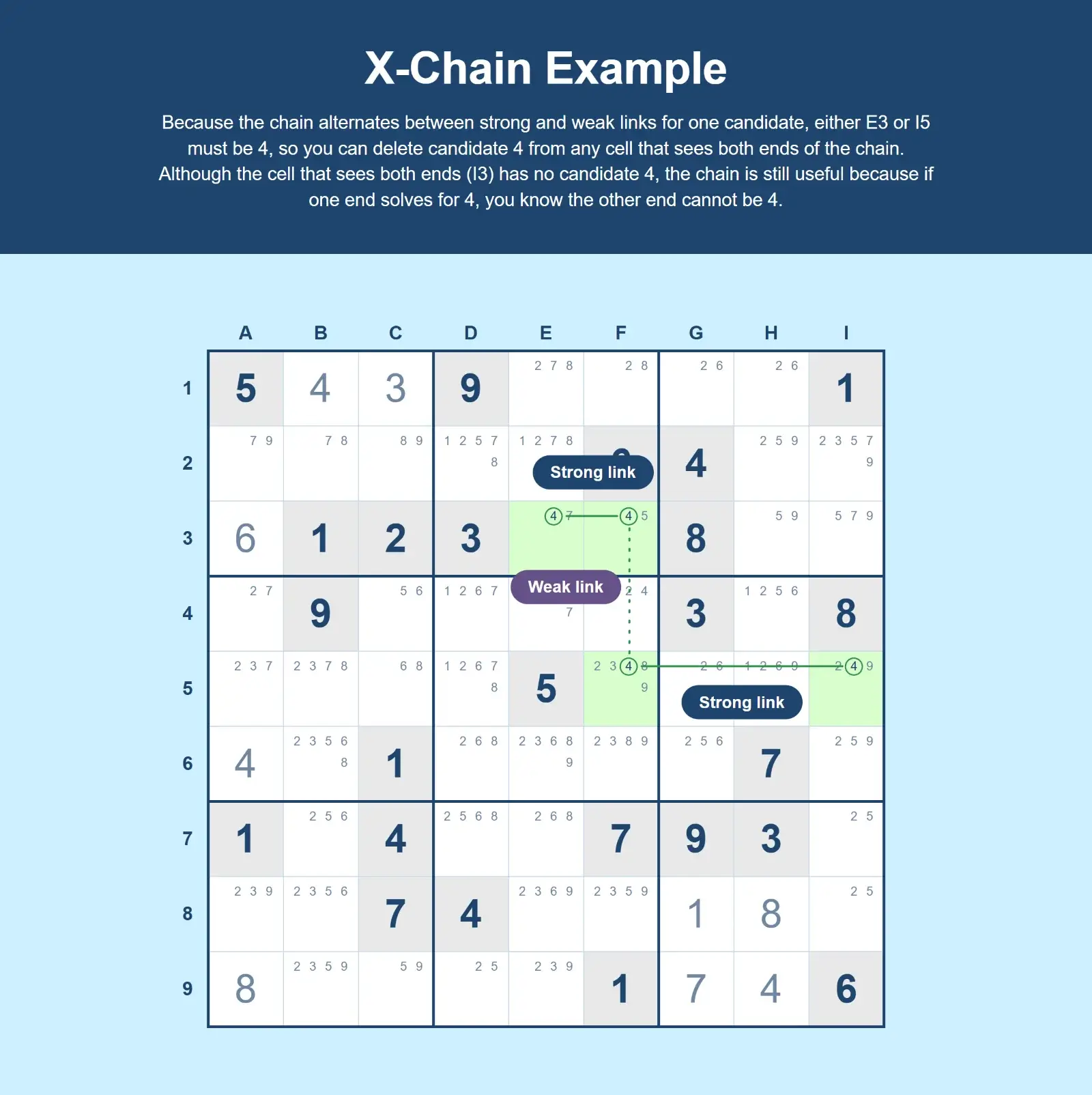
- Start by finding a strong link. For example, E3 and F3 create a strong link for candidate 4 because they are the only two cells in that row that contain 4. So if E3 is not 4, F3 must be 4, and if F3 is not 4, E3 must be 4.
- Connect the strong link to a weak link. For example, F3 and F5 both contain candidate 4 in the same column, so they can’t both be 4. However, because there are other 4s in that column, the relationship is weak, not strong.
- Continue finding links, alternating strong and weak. For example, F5 and I5 both have candidate 4, and they are the only two cells in row 5 with that candidate. If F5 is not 4, I5 must be 4, and if I5 is not 4, F5 must be 4.
- Find placements and/or make eliminations, if possible. For example, this chain proves that at least one endpoint, E3 or I5, must be 4. You can then eliminate any 4 that shares a row, column, or 3x3 block with both endpoints. In this case, no eliminations can be made. However, with this knowledge, if E3 is later determined to not be 4, the chain tells you that I5 must be 4. Keep this chain in mind as the puzzle develops in case you need to use that information later.
XY-Chains
An XY-chain is a chain of bi-value cells, meaning each cell contains exactly two candidates, and those two candidates create a strong link within the cell. Unlike an X-chain, which follows the same candidate throughout, an XY-chain changes candidates as it moves from cell to cell. Each cell shares one candidate with the next, creating a weak link between the cells, and you build the chain so that the candidate at the starting and ending nodes is the same.
To find one:
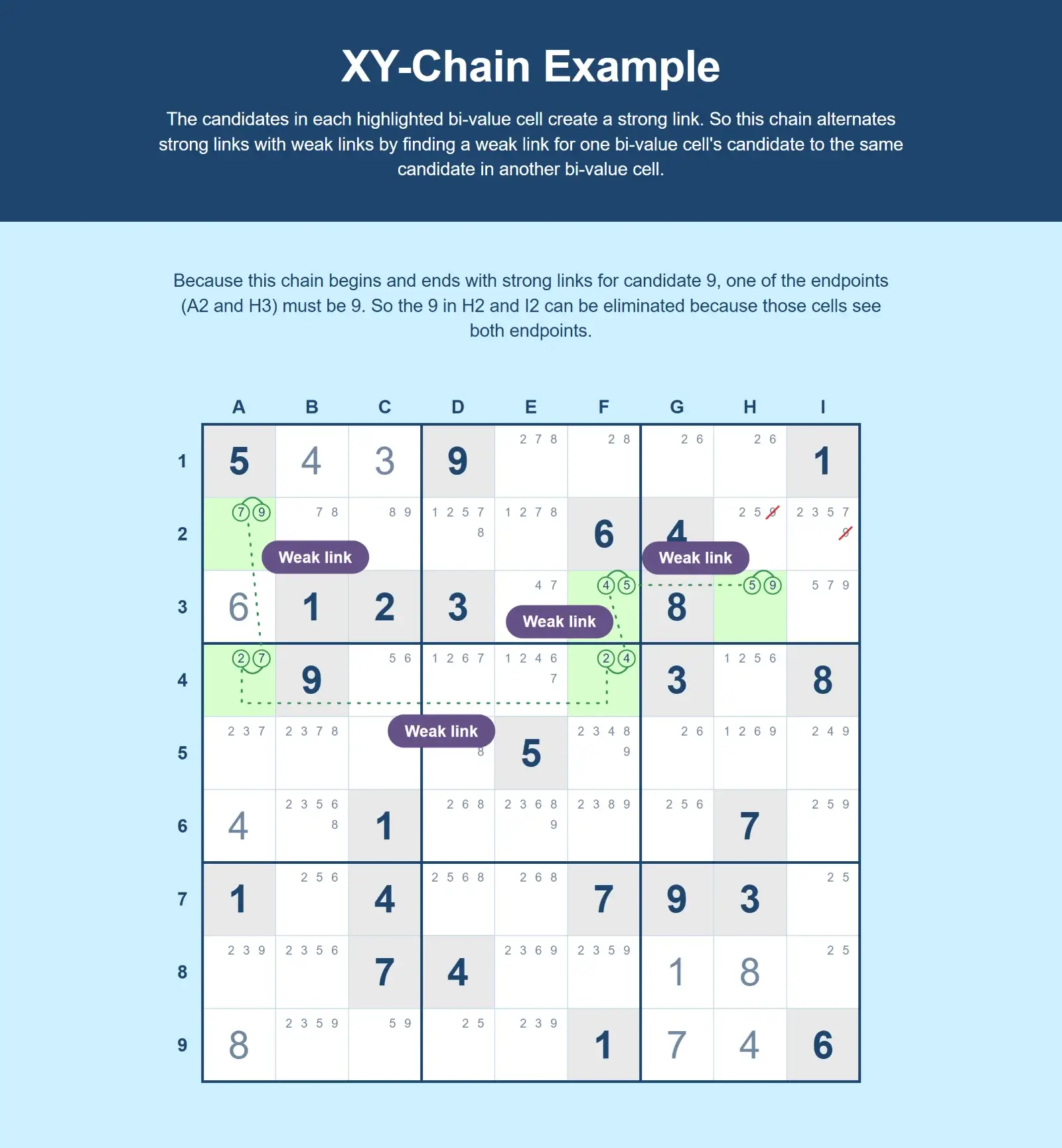
- Start with a bi-value cell and choose an endpoint candidate. For example, A2 contains only candidates 7 and 9. You can begin with either candidate and look for another bi-value cell that sees A2 and shares one of its candidates. If you use 9 as one endpoint, the other candidate, 7, gives you a possible way to extend the chain.
- Look for another bi-value cell that sees the first and contains its other candidate. A4 sees A2 and contains candidate 7. The 7s form a weak link between the cells, while 2 and 7 form a strong link within A4. You can now continue by looking for another bi-value cell containing 2.
- Continue alternating weak links between cells and strong links within cells. A4 (2,7) connects to F4 (2,4); F4 connects to F3 (4,5); and F3 connects to H3 (5,9). Stop when you reach a bi-value cell whose other candidate matches your original endpoint candidate. Here, H3 contains 5 and 9, bringing the chain back to candidate 9.
- Look for candidates to eliminate that see both endpoints. The chain begins and ends with candidate 9, proving that at least one of A2 or H3 must be 9. Any other candidate 9 that sees both endpoints can therefore be eliminated. In this puzzle, H2 sees A2 through row 2 and H3 through column H, so 9 can be eliminated from H2. I2 also sees A2 through row 2 and H3 through their shared 3x3 block, so 9 can be eliminated from I2. Because the chain begins and ends with strong links, at least one endpoint, A2 or H3, must be 9. Therefore, any other candidate 9 that sees both A2 and H3 can be eliminated. In this puzzle, that eliminates 9 from H2 and I2.
X-Cycles
An X-cycle is a type of alternating inference chain (AIC) that follows the same candidate through a closed loop of strong and weak links. Like an X-chain, the digit stays the same throughout, but instead of having two endpoints, an X-cycle eventually connects back to where it started. The arrangement of strong and weak links in the completed cycle determines whether you can make an elimination or placement.
These chains have two rules for elimination. Use this example to find an X-cycle that follows rule 1, but use our X-cycle post for more details on rule 2:
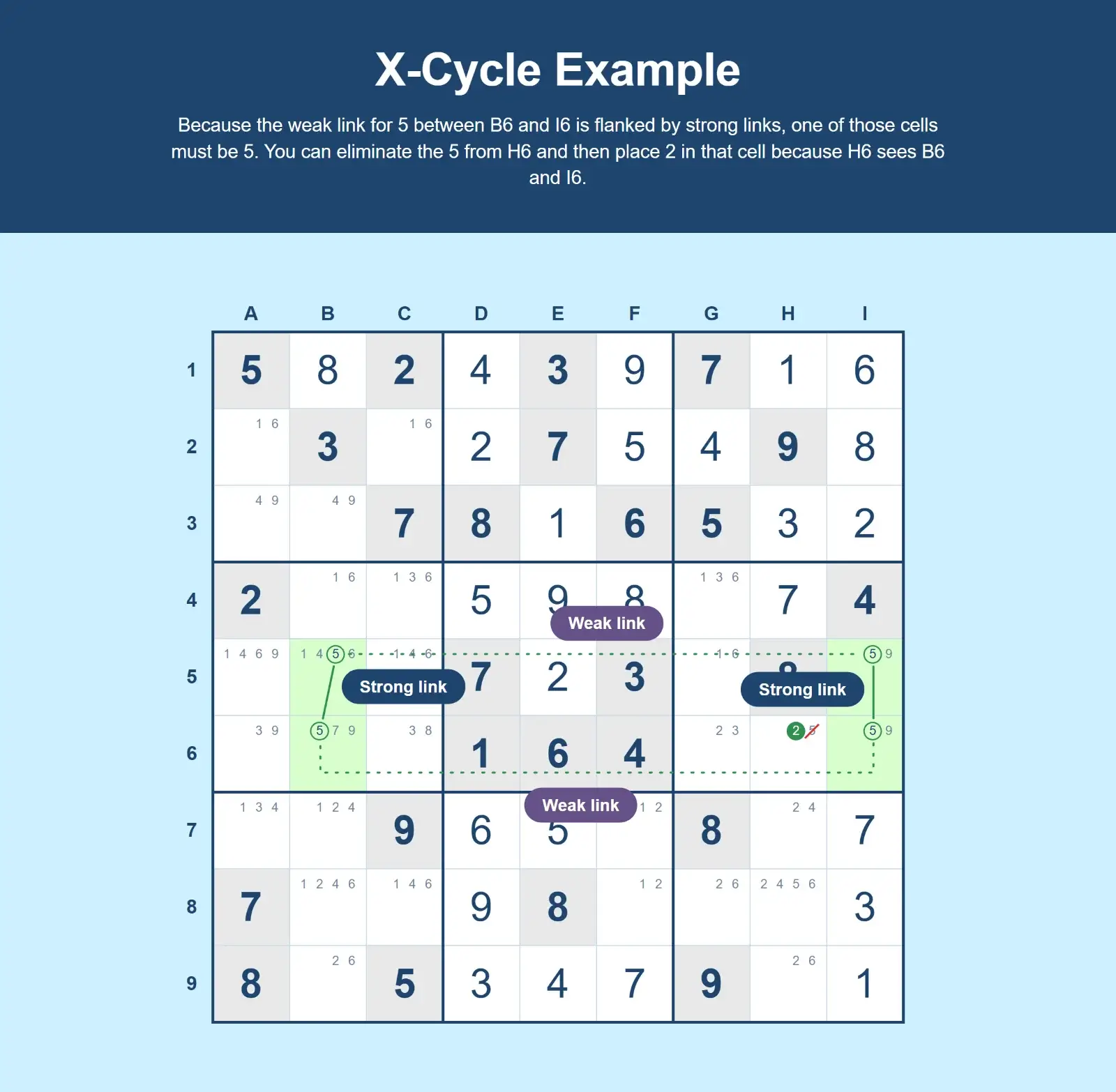
- Start with a candidate that has a strong link. For example, 5 has a strong link in I5 and I6 because those are the only two cells in column I that contain candidate 5.
- Follow alternating strong and weak links for the same candidate. Candidate 5 forms a weak link between I6 and B6 because the cells share row 6 and cannot both contain 5. But then 5 has a strong link to B5 because those are the only two possible positions for 5 in column B.
- Continue until the chain closes into a loop. B5 sees I5 in row 5, bringing the chain back to its starting point. These two candidates are actually the only possible 5s in row 5, making their relationship both strong and weak. Here, the link can be used in its weak direction to complete the alternating cycle.
- Use the completed cycle to make deductions. In this continuous X-cycle, the weak link for 5 between B6 and I6 is flanked by strong links, which means one of those two candidates must be true. Any other candidate 5 that sees both can therefore be eliminated. H6 sees both because it’s in the same row, so you can eliminate 5 from H6 and then place 2 in H6.
Forcing Chains
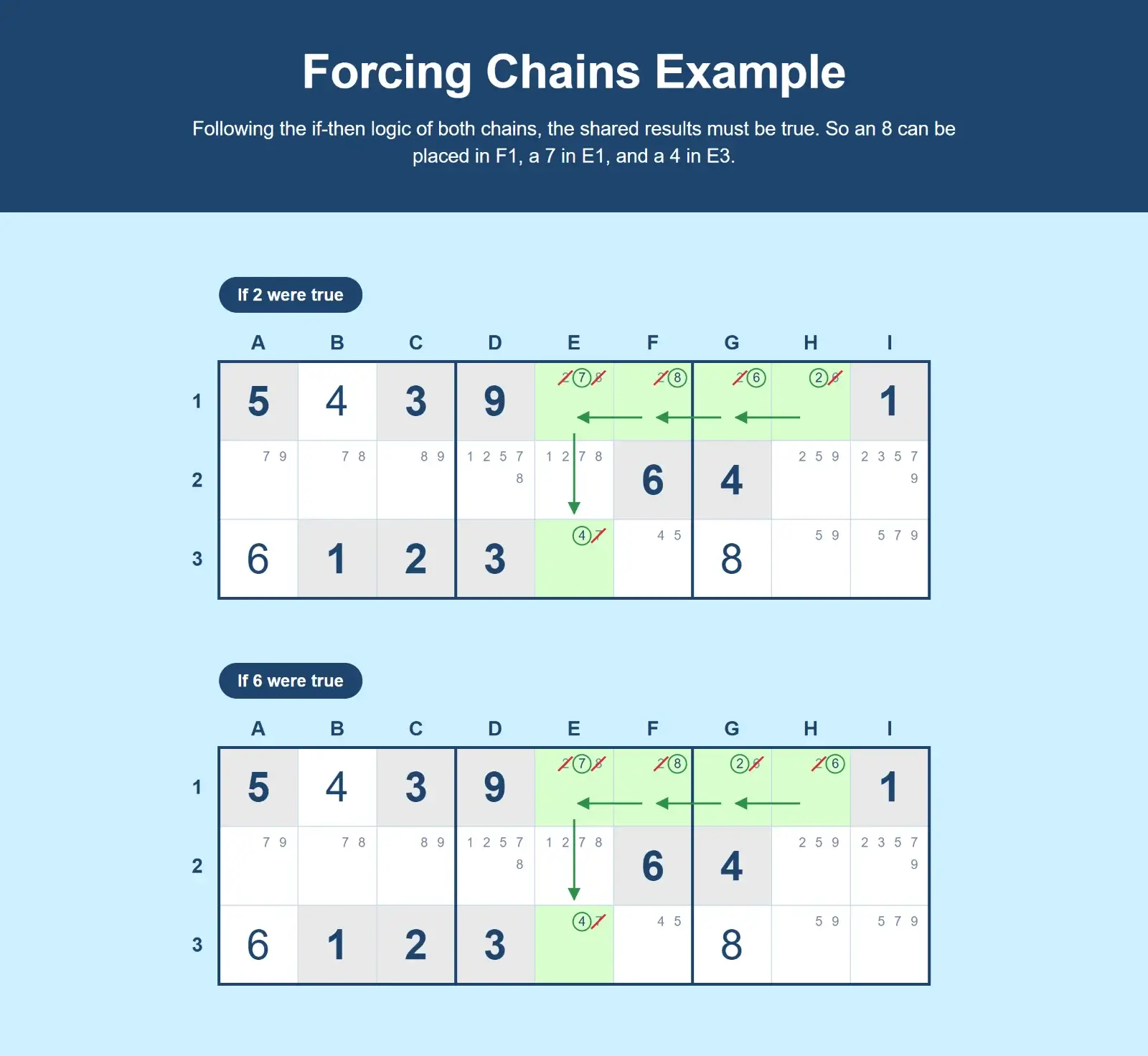
Unlike alternating inference chains, which follow a defined pattern of strong and weak links, forcing chains begin with a possible value or condition and trace the logical consequences that follow. If different possibilities lead to the same conclusion, that conclusion must be true regardless of which possibility is correct. For example, A2 contains only candidates 7 and 9, so you can test both possibilities and follow what each one forces.
To find and use a forcing chain:
- Choose a candidate or cell with a limited number of possibilities. For example, H1 contains only 2 and 6, giving you two possible starting conditions: H1 is either 2 or 6.
- Follow the consequences of the first possibility. If H1 is 2, no other cell in row 1 can be 2. That means the 2s in E1, F1, and G1 can be eliminated, which forces placements:
- H1: 2
- G1: 6
- F1: 8
- E1: 7
- E3: 4
- Return to the starting point and follow the other possibility. If H1 is 6, then no other cell in that row can be 6, which forces placements:
- H1: 6
- G1: 2
- F1: 8
- E1: 7
- E3: 4
- Look for a conclusion shared by both paths. Whether H1 contains 2 or 6, the result in cells F1, E1, and E3 are the same. So you can place an 8 in F1, a 7 in E1, and a 4 in E3.
Chains are typically used on hard and expert-level puzzles after earlier techniques have narrowed down candidates. Using candidate mode can help highlight some of these strong and weak links so you can use chains effectively the next time you’re playing Sudoku online.