A finned swordfish is a Sudoku swordfish pattern with an extra candidate, called the fin, located in one of the base sets but outside of the cover sets. Like a regular swordfish, it restricts a single candidate to three base sets (rows or columns) and three corresponding cover sets (columns or rows), but the fin limits eliminations.
A candidate can be eliminated only if it does all of the following:
- Lies in a cover set
- Lies outside of the base sets
- Sees all fins (shares a row, column, or block with the fins)
While the fin may seem like a limitation to solving your puzzle, this strategy comes in handy after you've exhausted other, simpler techniques when working on hard to extreme Sudoku puzzles. After all, eliminating even just one candidate can often unlock a cascade of eliminations to help you break through when you play Sudoku online.
How to Find a Finned Swordfish in Sudoku
To find a finned swordfish, look for a single candidate that:
- Appears in three base sets: Base sets are the three rows or columns that form the foundation of the swordfish pattern. In two of them, every candidate cell lies within the same three columns or rows (the cover sets). In the third, all but one or two cells do. The leftover cell or cells are the fin. For example, the 3 candidate appears in rows 2, 3, and 7, aligning into cover columns C, D, and G except for one leftover: the 3 in H7, which is the fin.
- Corresponds to three cover sets: Cover sets are the three columns or rows that contain the candidate's base-set positions, excluding the fin. If the base sets are rows, the cover sets are columns, and vice versa.
- Has a fin in one of the base sets and outside the cover sets that isn't necessary for the swordfish pattern: While the fin (H7) breaks the traditional swordfish pattern, it can still create an elimination. What matters is whether the swordfish survives without it:
- If removing the fin leaves a regular swordfish, you have a finned swordfish.
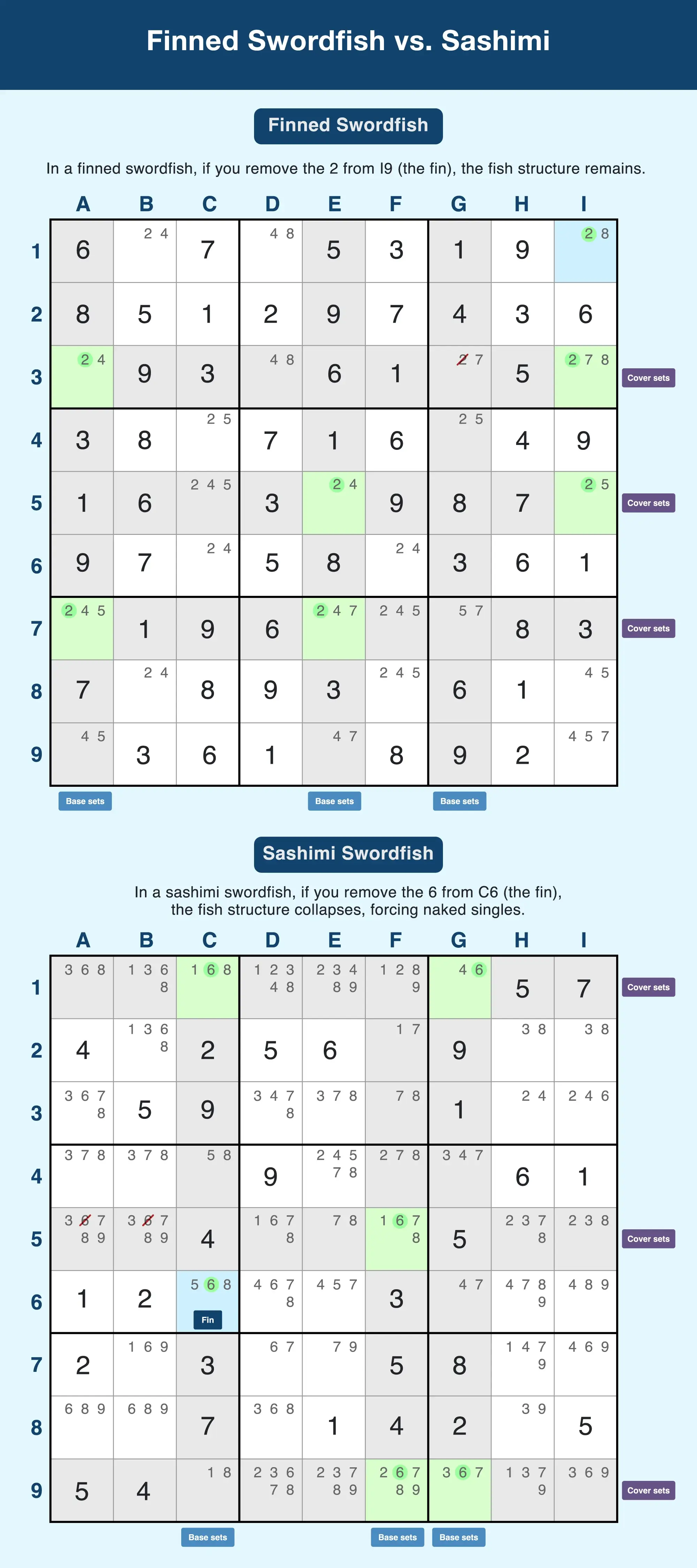
- If removing the fin destroys the swordfish, the pattern is called sashimi, which we discuss in the examples below.
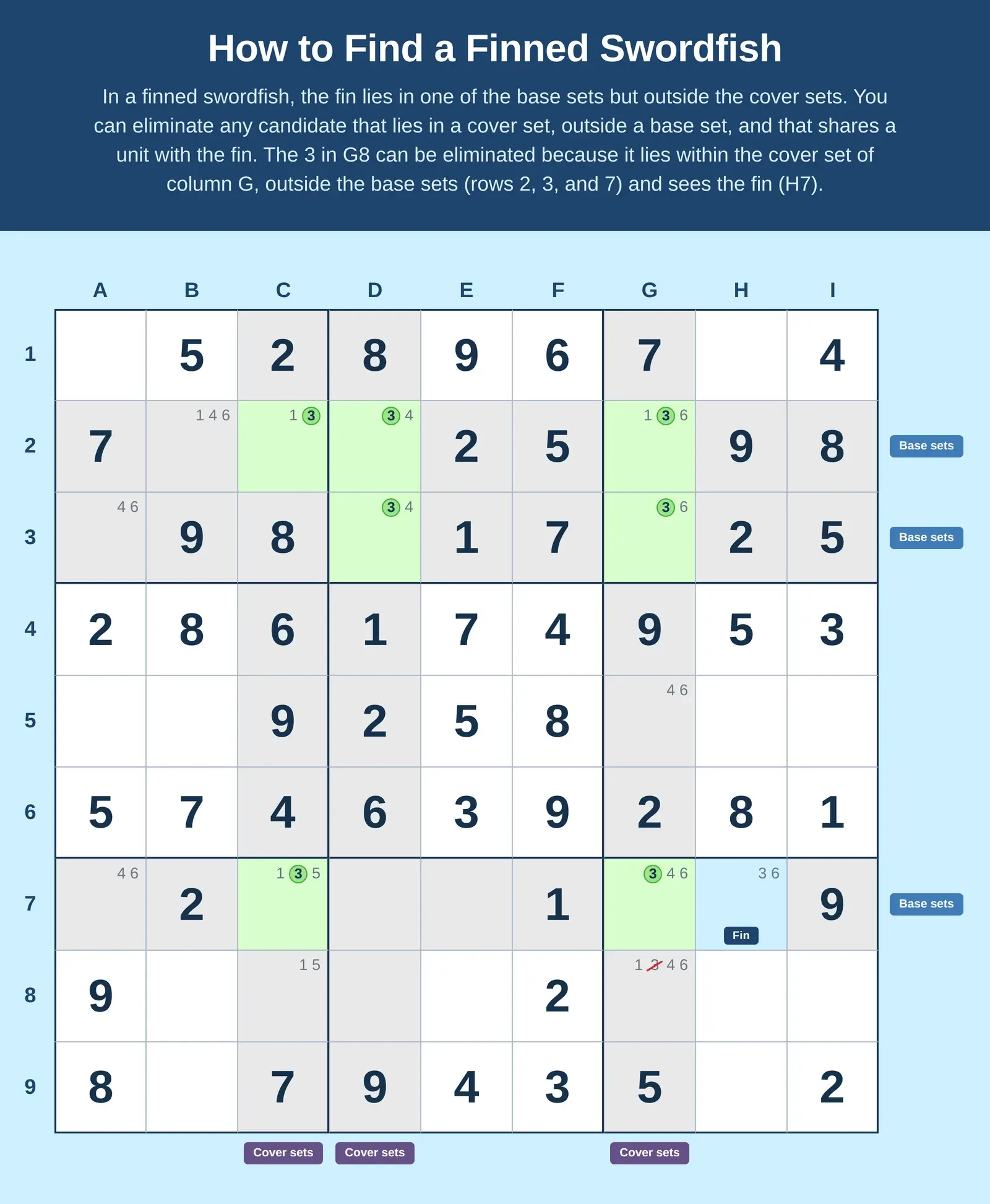
Eliminating Candidates in a Finned Swordfish
In a finned swordfish, you can eliminate any candidate that lies in one of the cover sets, is not part of the base sets, and shares a unit (row, column, or block) with the fin. So the 3 in G8 can be eliminated because it is in a cover set (column G), outside the base sets (rows 2, 3, and 7), and shares the same block as the fin. Often eliminating a candidate will trigger naked singles, leading to several eliminations.
Solving tip: Most often, the candidate to be eliminated will be in the same block as the fin.
This advanced Sudoku technique is part of the family of fish patterns, like X-wings and jellyfish, all of which use base and cover sets and all of which can be finned. So by understanding how to find the basic elements of a fish pattern (base sets and cover sets), you can increase your chances of finding a pattern that is useful for eliminations but that is part of the fish Sudoku strategy.
Finned Swordfish Logic
The key idea behind a finned swordfish is that eliminations remain valid no matter whether the fin is true or false.
- If the candidate in the fin is false, you'd simply have a regular swordfish and can eliminate candidates using that strategy. For example, the 3 in G8 would be eliminated in a regular swordfish because it appears in a cover set (column G) but outside of the base sets (rows 2, 3, and 7).
- If the fin is true, then any candidate that shares a row, column, or block with the fin would be eliminated. For example, the 3 in G8 would still be eliminated because if the answer to H7 is 3, G8 couldn't be 3 because it shares the same block as H7.
Finned Swordfish Examples
A basic finned swordfish can appear with a horizontal or vertical orientation, depending on the base sets. If the base sets are in rows, you have a horizontal orientation, but if the base sets are in columns, the orientation is vertical. However, finned swordfish patterns can also appear with two fins (or more!) or get even more advanced with a sashimi pattern.
Finned Swordfish Horizontal Orientation
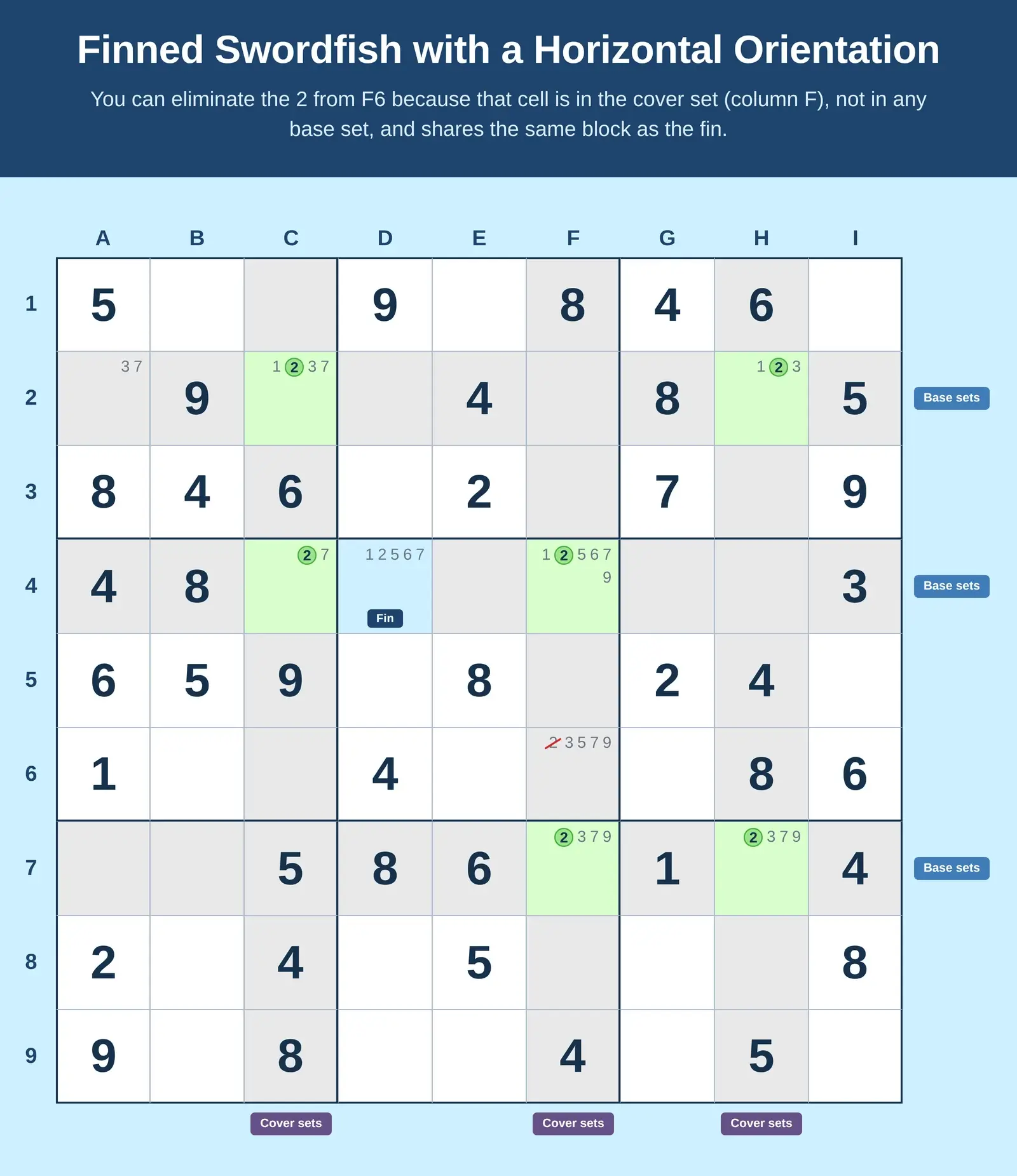
To find a finned swordfish in a horizontal orientation, follow these steps:
- Find the base sets. The digit 2 appears in rows 2, 4, and 7 to create the base sets with cells C2, C4, F4, F7, H2, and H7.
- Confirm that the cells align in three cover sets. The 2s line up in three columns (C, F, and H).
- Locate the fin. The fin (D4) lies within the base set of row 4, but it doesn't align within any of the cover sets. Remove it and a clean swordfish remains, so this is a finned swordfish, not sashimi.
- Eliminate any candidate that lies in a cover set but outside of a base set and that sees the fin. You can eliminate the 2 in F6 because it's in a cover set (column F), not in any base set, and it shares the same block as the fin.
Finned Swordfish Vertical Orientation
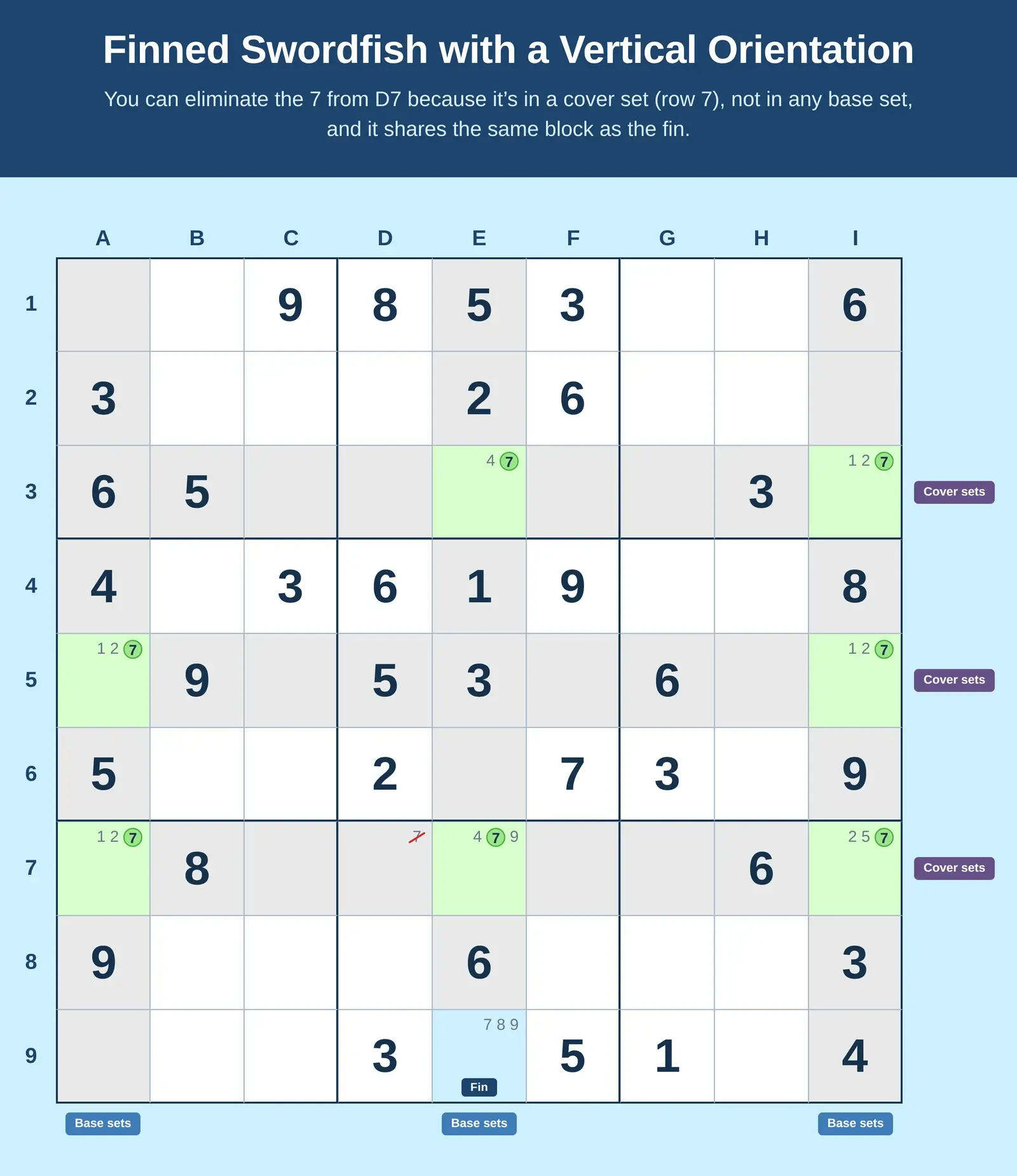
To find a finned swordfish in a vertical orientation, follow these steps:
- Find the base sets. The digit 7 appears in columns A, E, and I to create the base sets with cells A5, A7, E3, E7, I3, I5, and I7.
- Confirm that the cells align in three cover sets. The 7s line up in rows 3, 5, and 7.
- Locate the fin. The fin (E9) lies within the base set of column E, but it doesn't align within any of the cover sets. However, even if the fin were removed, you'd still have a valid swordfish, making this a fin and not a sashimi.
- Eliminate any candidate that lies in a cover set but outside of a base set and that sees the fin. You can eliminate the 7 in D7 because it's in a cover set (row 7), not in any base set, and it shares the same block as the fin.
2-Finned Swordfish Example
You can have one, two, or more fins on a swordfish, but because the candidates you can potentially eliminate must see all the fins, your opportunities for elimination are often more limited as fins are added.
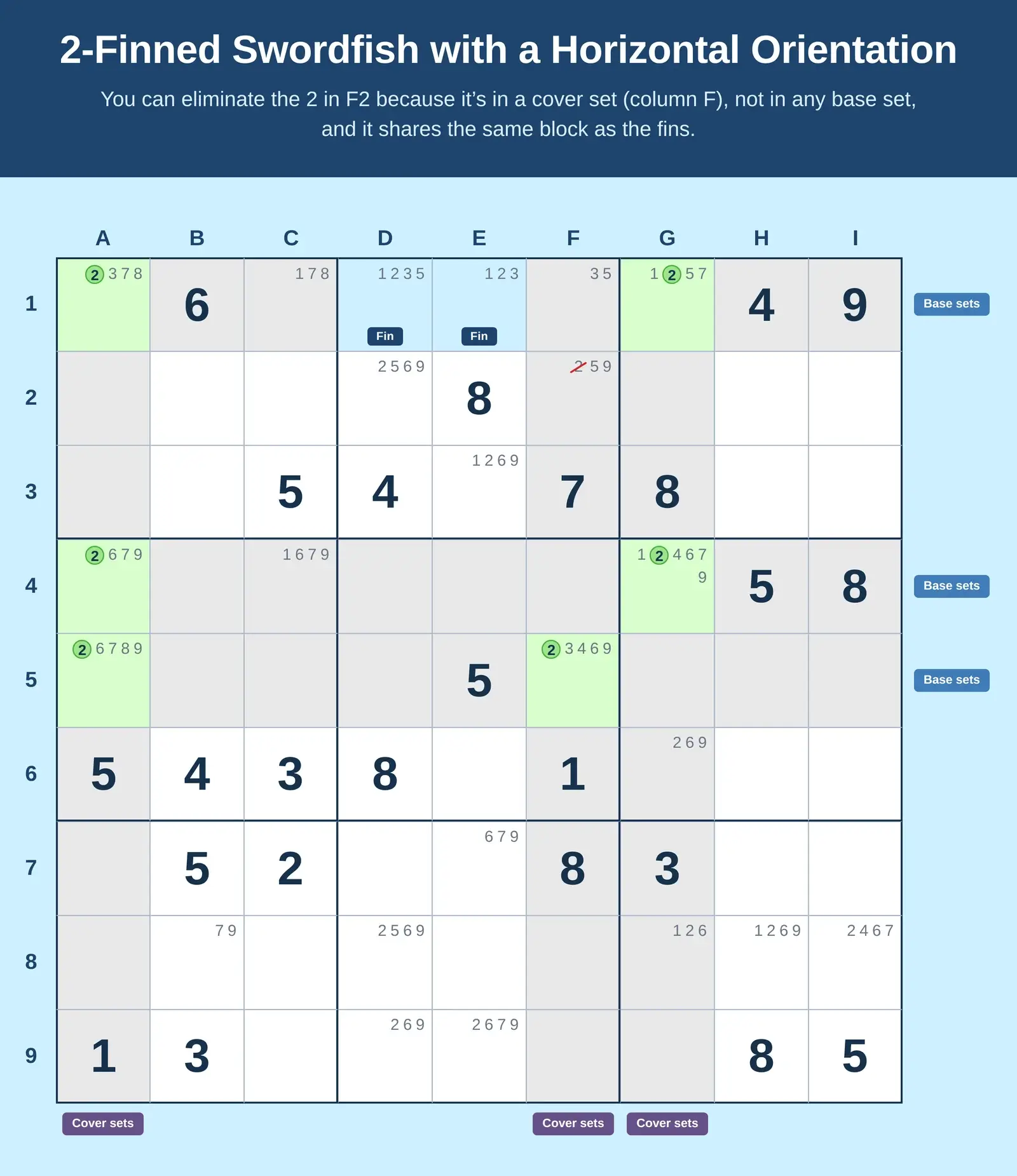
To find a finned swordfish (this one has a horizontal orientation), follow these steps:
- Find the base sets. The 2 appears in rows 1, 4, and 5 to create the base sets with cells A1, A4, A5, F5, G1, and G4.
- Confirm that the cells align in three cover sets. The 2s line up in columns A, F, and G.
- Locate the fins. The fins (D1 and E1) lie within the base set of row 1, but they don't align within any of the cover sets. However, even if the fins were removed, you'd still have a valid swordfish, making this a finned swordfish and not a sashimi.
- Eliminate any candidate that lies in a cover set but outside of a base set and that sees the fin. You can eliminate the 2 in F2 because it's in a cover set (column F), not in any base set, and it shares the same block as the fins.
Sashimi Swordfish Example
A finned swordfish is sashimi when the swordfish can't stand without the fin. Here the fin is C6. Remove it and you'd have a hidden single (6) in C1 instead of a swordfish pattern.You can still eliminate any 6 that sits in a cover set outside the base sets and sees the fin: the 6s in A5 and B5 both share the fin's block, so they can be removed.
The finned swordfish Sudoku technique is a useful strategy when you feel like you've hit a roadblock playing Sudoku online. Practice this and other strategies to unlock your grid, create opportunities for elimination, and solve extreme and hard Sudoku puzzles!