Killer Sudoku combines the logic of classic Sudoku with arithmetic, giving you more ways to narrow down candidates and place numbers. Just like regular Sudoku, the goal of Killer Sudoku is to fill in every row, column, and 3x3 block with the numbers 1 through 9 without repeats in each unit, but the cage sums add a mathematical constraint that actually gives you an advantage. In addition to using standard Sudoku techniques, you can use cage sums, number combinations, and the Rule of 45 to find answers that aren't immediately obvious from the grid.
The key to solving a Killer Sudoku puzzle is knowing which clues to use and when. Some cages provide immediate answers, while others require you to combine information from several rows, columns, or blocks. These nine Killer Sudoku strategies will help you recognize opportunities, eliminate possibilities, and solve puzzles more efficiently when playing Sudoku online.
Beginner Killer Sudoku Strategies
The first thing that intimidates beginners is dealing with the cage sums. Killer Sudoku divides the grid into cages outlined by dashed lines. The numbers in each cage must add up to the small total shown in its corner, and digits can't repeat within a cage. While the cages make the grid look busier, the sums offer more clues for placements. So these beginner strategies focus on finding easy placements and narrowing down candidates before tackling more complicated relationships.
1. Start with the Most Restrictive Cages
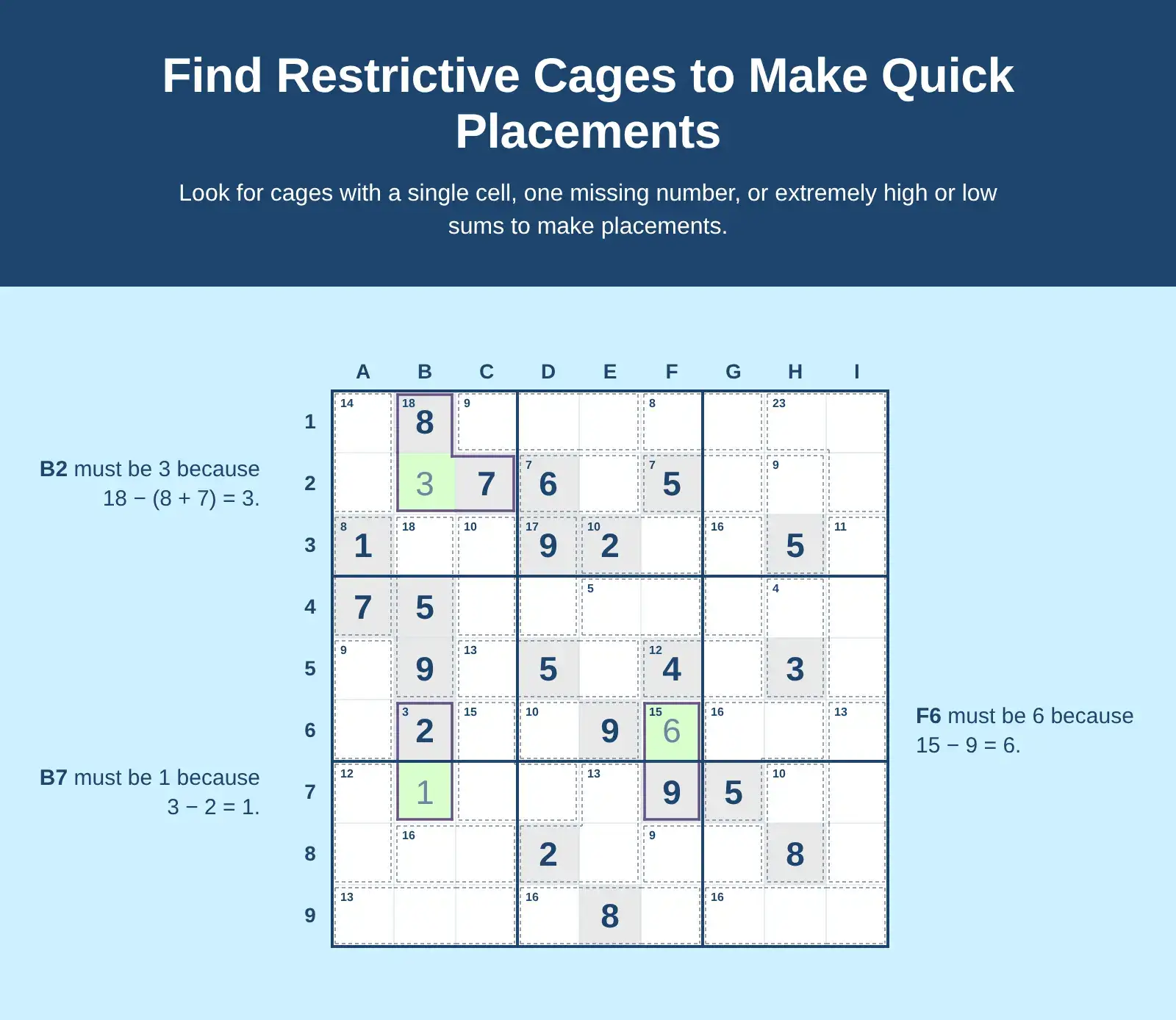
Some cages are easier to solve than others because they have fewer possible answers. These are called restrictive cages. The more a cage limits which numbers can go in its cells, the easier it is to make an immediate placement.
With this strategy, you don’t need to fill in candidates yet. Instead you’re looking for three types of cages:
- Single-cell cages: These give you an immediate answer because the number in the cell must equal the cage total. For example, if a single-cell cage has a sum of 7, you can place 7 in that cell.
- Cages with one missing number: Subtract the numbers already placed from the cage total to find the missing digit. For example, if a three-cell cage totals 18 and already contains 4 and 9, the empty cell must be 5 because 18 − 4 − 9 = 5.
- Cages with totals near the minimum or maximum for their size: These have fewer possible combinations, making it easier to place numbers when you consider surrounding cells. For example, a two-cell cage totaling 3 must contain 1 and 2. If one cell shares a row with an existing 1, that cell must be 2, leaving 1 for the other cell.
The goal is to find cages where you can place a number right away, rather than working through every possible combination. After each placement, check the surrounding row, column, and 3×3 block to see whether you've created another easy answer.
2. Use Cage Combinations to Eliminate Candidates
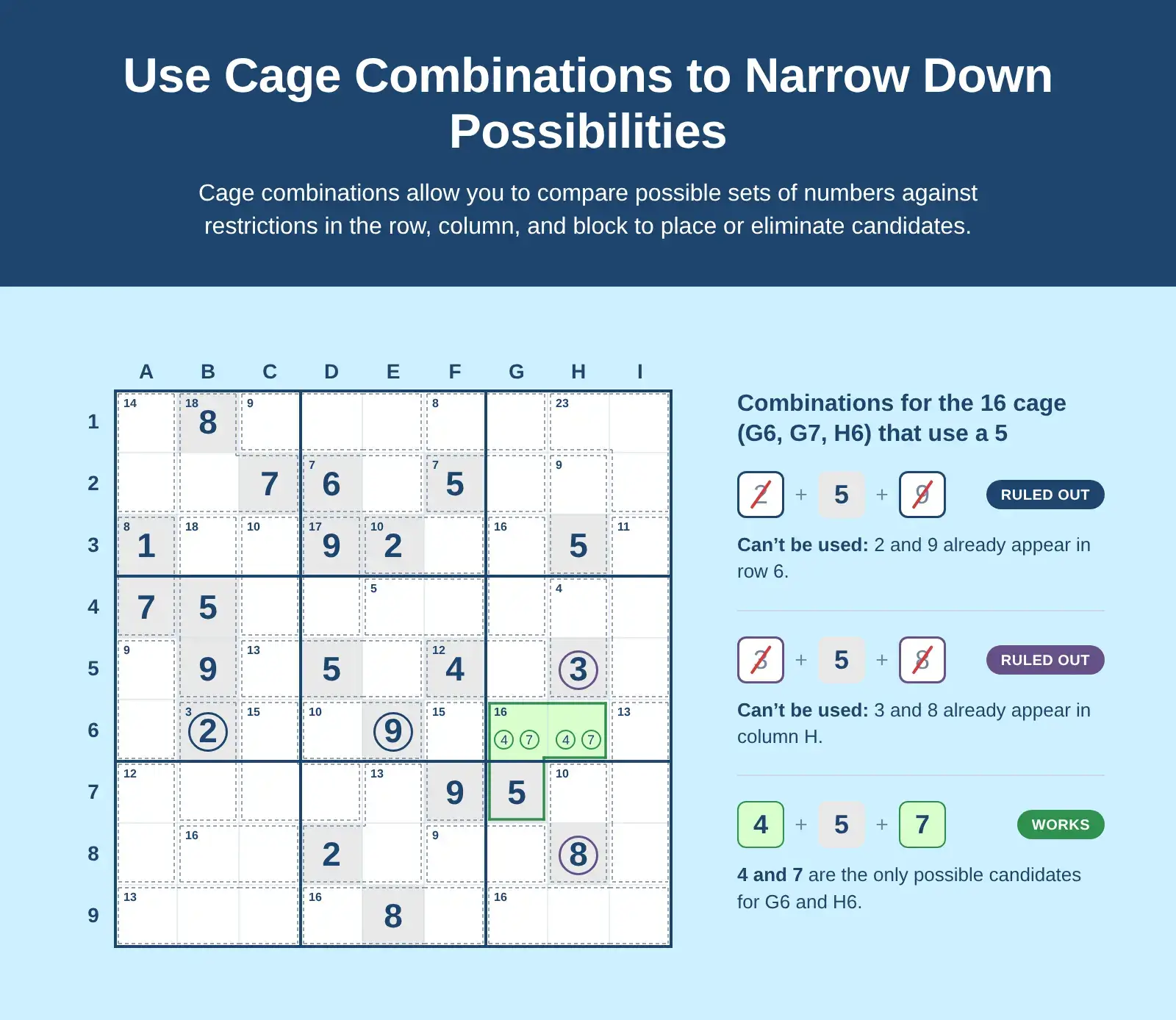
Killer Sudoku cage combinations are sets of non-repeating digits that add up to a cage's total. Some cages have only one possible combination, while others have several.
For example, a two-cell cage totaling 7 has three possible combinations:
- 1 + 6
- 2 + 5
- 3 + 4
You can't determine which combination is correct from the sum alone, but you can check the row, column, and block restrictions for each cell. For example, if one cell cannot contain 2, 3, or 4 and the other cannot contain 2, 3, or 5, that eliminates 2 + 5 and 3 + 4 as possible combinations. You now know that 1 + 6 is the only possible combination. Although you still need to determine which cell contains 1 and which contains 6, you've eliminated every other possibility.
3. Use Candidate Mode to Track Possible Numbers
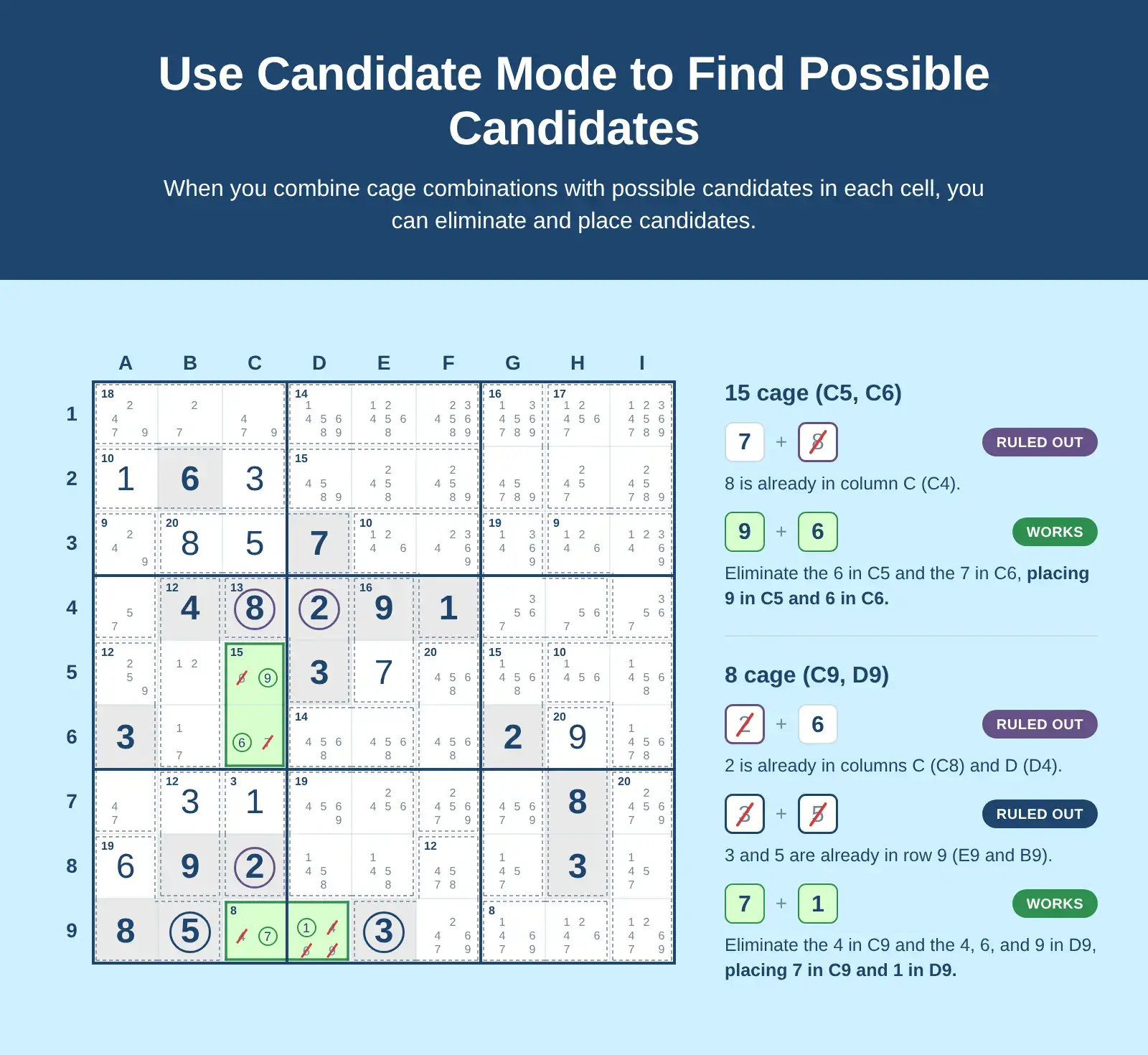
Candidate mode, sometimes called pencil marks, helps you track candidates when you can't place a number immediately. After you’ve buzzed through the first couple of strategies, filling quick placements, candidate mode can help you keep track of all the possible candidates in each cell.
In Killer Sudoku, you must account for both standard Sudoku restrictions and the cage total. A digit may be allowed in a cell based on its row, column, and block but still be impossible because it would prevent the cage from reaching its required sum.
For example, if a two-cell cage totals 12 and one cell can only contain 4 or 5, the other must contain 7 or 8. You can use candidate mode to mark those two candidates and revisit the cell as you place numbers and eliminate combinations. Accurate candidates make it easier to recognize patterns and apply more advanced Sudoku techniques.
4. Apply Classic Sudoku Techniques
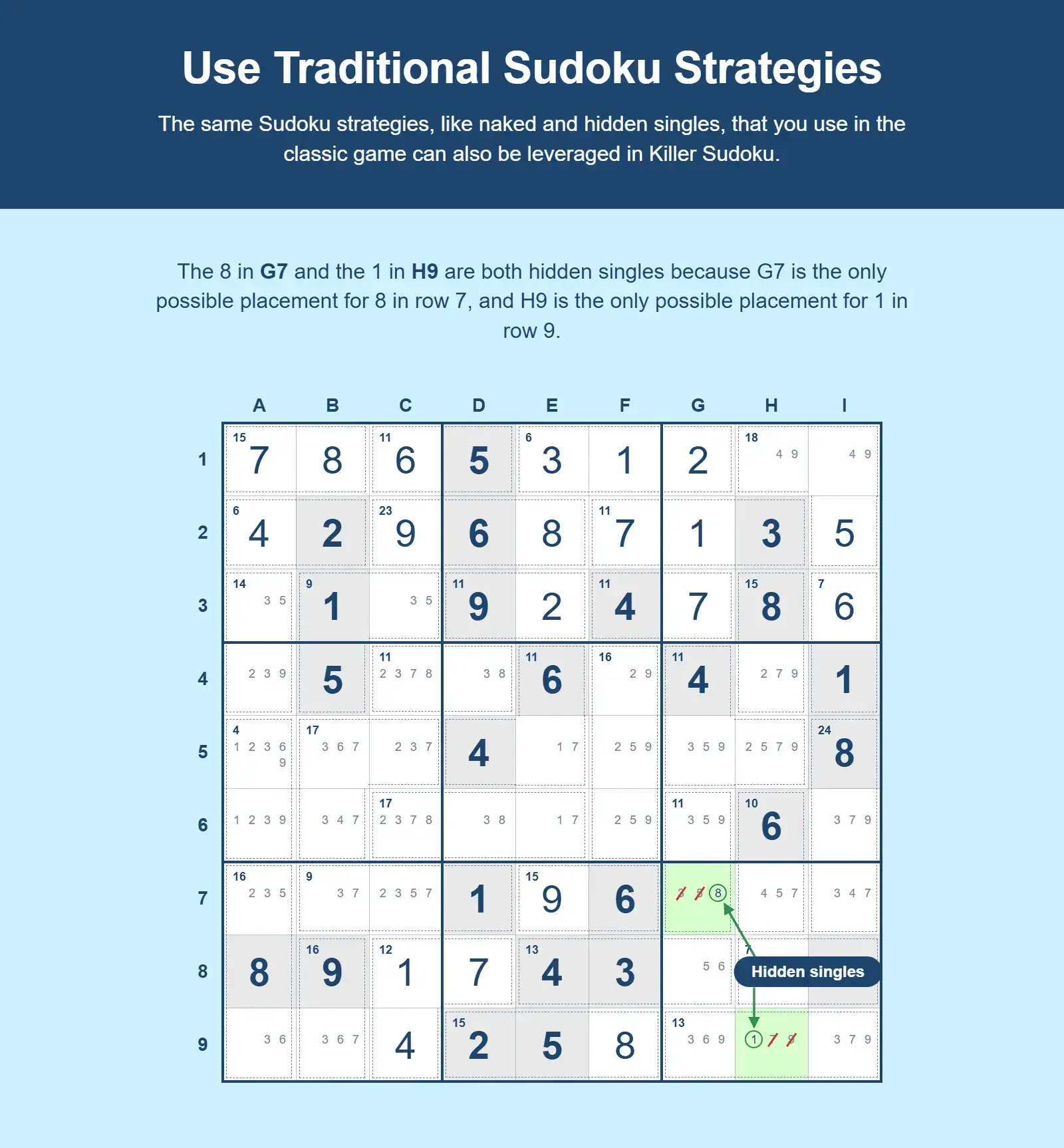
Rather than treating cage calculations and regular Sudoku strategies separately, look for ways they can work together. Although cage sums provide additional clues, Killer Sudoku still follows the same placement rules as classic Sudoku. That means that if you feel stuck, you can rely on familiar techniques alongside the Killer arithmetic to narrow down candidates.
Some of the most useful Sudoku strategies to apply to Killer grids include:
- Naked singles: A cell has only one possible candidate remaining.
- Hidden singles: A digit can only appear in one cell within a row, column, or block.
- Naked pairs: Two cells in the same unit contain only the same two candidates, allowing you to eliminate those digits from other cells in that unit.
For example, identifying a cage's possible digits because of its cage sum combination may help you eliminate candidates from nearby cells. Those eliminations could reveal a naked single or hidden single that you wouldn't have noticed using cage sums alone.
Intermediate Killer Sudoku Strategies
After you've used the easier cages and candidate eliminations, you can start examining how cage sums relate to entire rows, columns, and blocks.
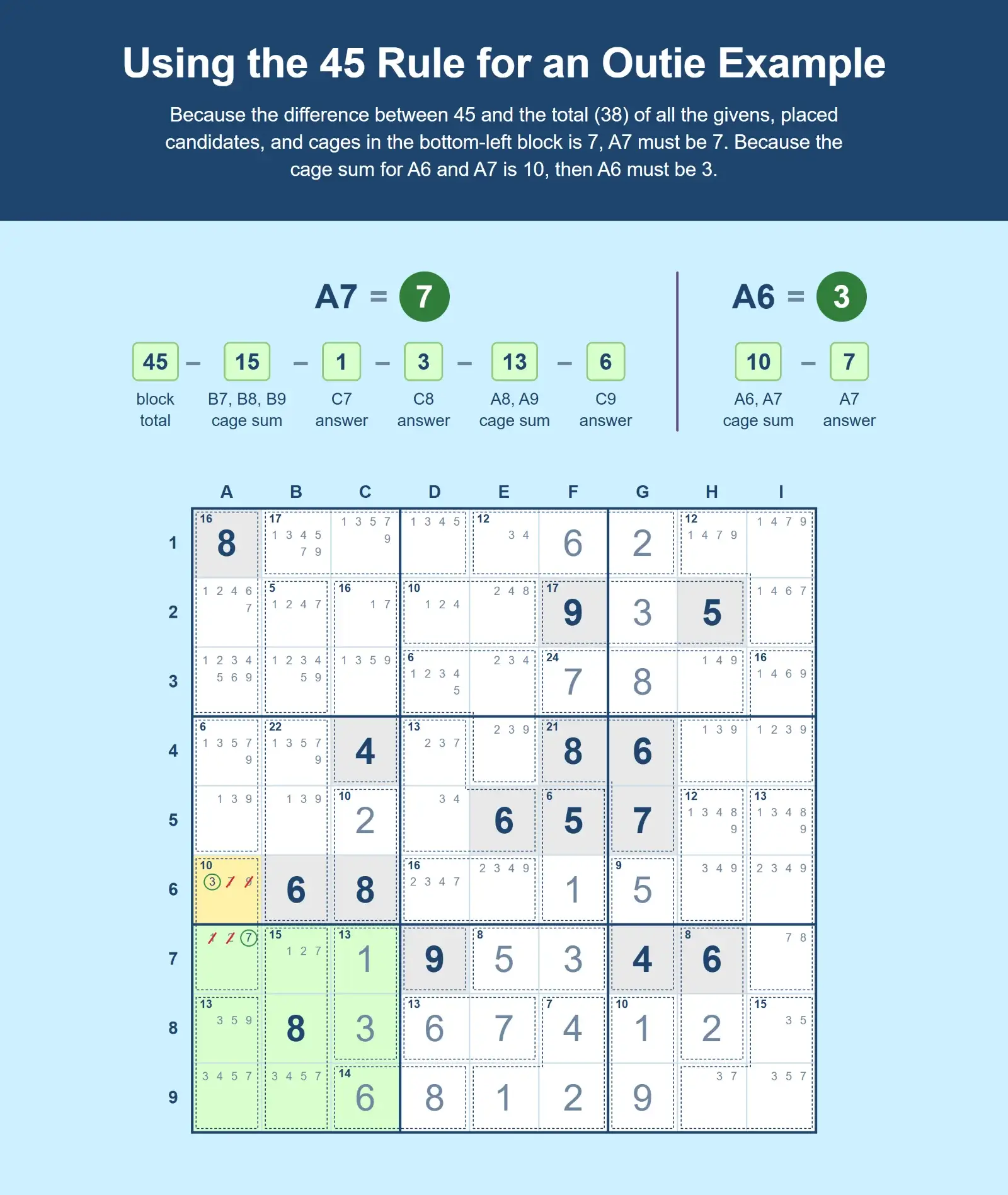
5. Use the Rule of 45 to Find Innies and Outies
The Rule of 45, also called the 45 Rule, is one of the most useful Killer Sudoku techniques. Every row, column, and 3×3 block contains the digits 1 through 9 exactly once. Because those digits add up to 45, you can subtract known cage totals within a unit (row, column, or block) from 45 to find missing values.
Cages that cross a boundary by just one cell offer the easiest innies and outies to solve.
- An innie is a cell inside a unit that isn't included in the cage totals you're adding.
- An outie is a cell outside a unit that belongs to one of the cages included in your calculation.
These single cells can offer a quick placement or narrow down candidates, for example:
- Innie: If complete cages within a block total 39 but one cell inside the block has a cage extending outside the unit, that cell is an innie. Because their total is 39, the innie must be 6 because 45 − 39 = 6.
- Outie: For example, if several cages cover an entire 3×3 block but one cell extends beyond the block’s boundary, that cell is an outie. If their combined totals equal 50, the outie cell must be a 5 because 50 − 45 = 5.
6. Use the Rule of 45 to Find Missing Numbers
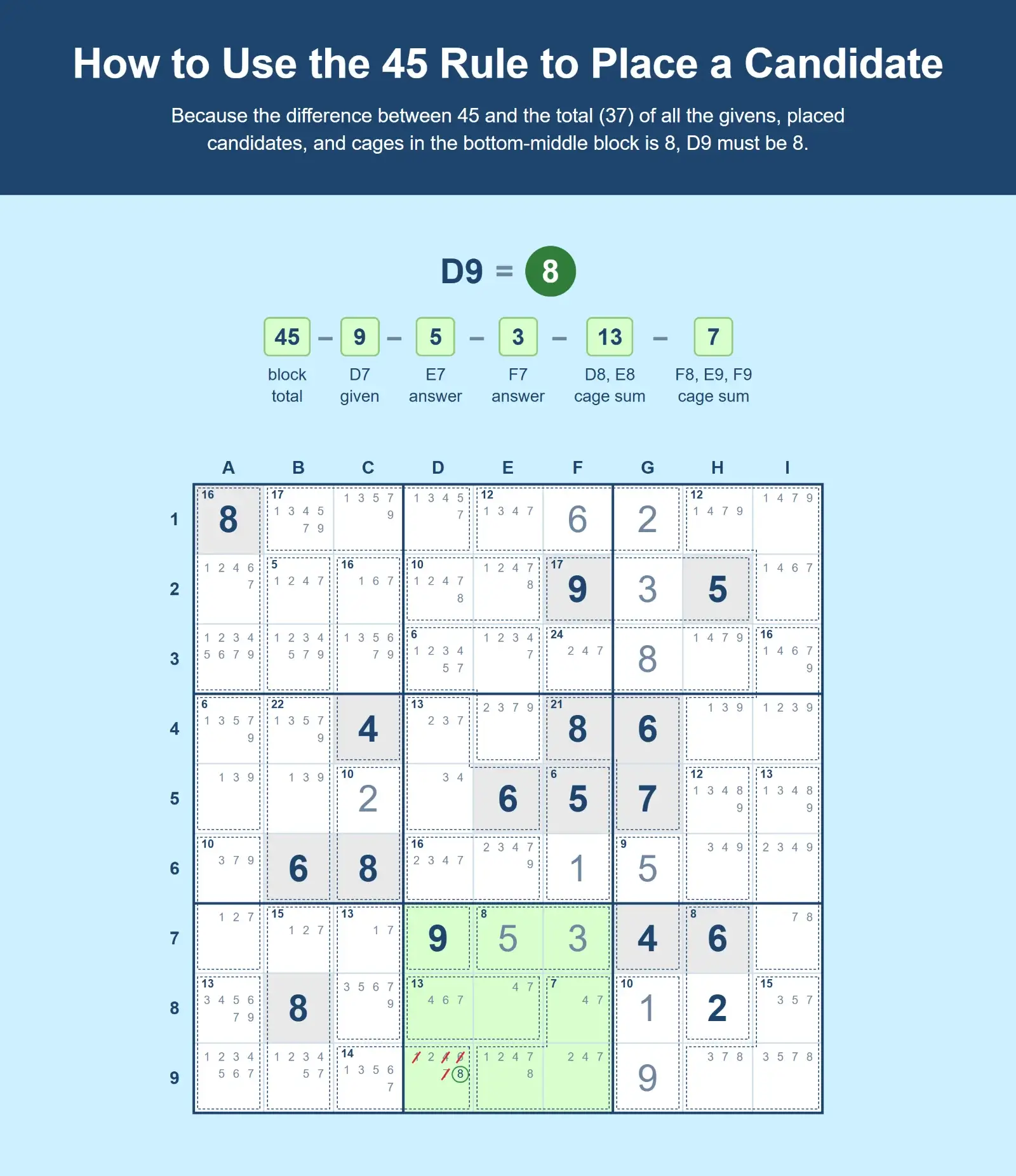
As puzzles increase in difficulty, cages won’t cleanly fit into single units, and you may find more than one cell extending in or out of the unit you’re considering. But you can still utilize the Rule of 45 to eliminate and narrow down candidates.
For example, suppose a row contains three complete cages totaling 12, 15, and 10 but two cells in the row belong to cages that extend outside the row. You can total those cages contained completely in the row, subtract from 45, and narrow down the possibilities for the other two cells. The math looks like this:
- The complete cages total 37 (12 + 15 + 10 = 37).
- Because the row must total 45, the remaining cells must total 8 (45 − 37 = 8).
- Now you can use the possible combinations for 8 (1 + 7, 2 + 6, and 3 + 5) and compare them against other constraints on those cells.
- See if those digits appear in another unit that overlaps those cells.
- See if any cage combinations eliminate or include those digits.
The Rule of 45 works with columns and blocks, too. Look for areas where complete cages account for most of the cells and only one or two cells remain outside those totals.
7. Lock Candidates Within Rows, Columns, and Blocks
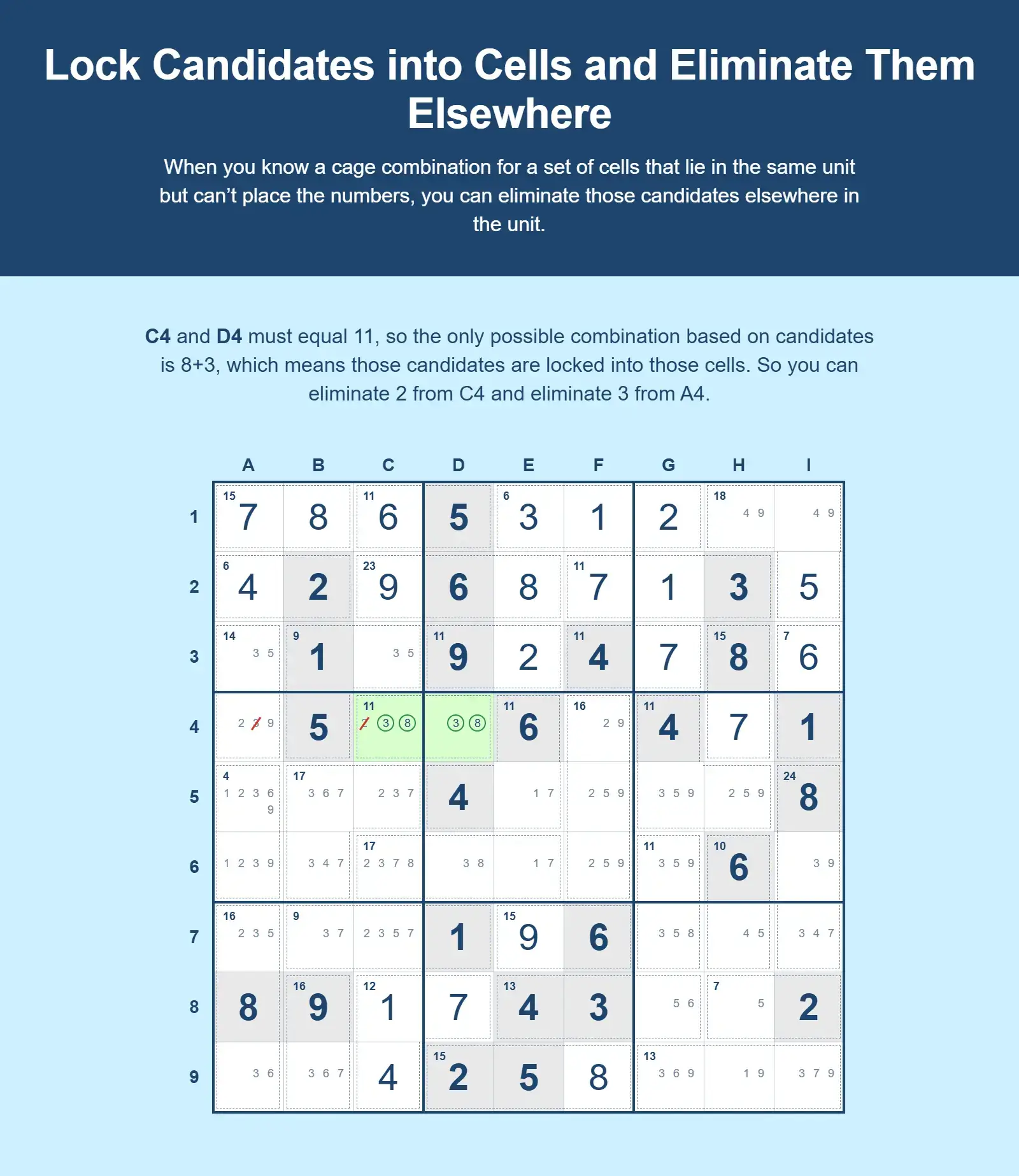
Sometimes you know which digits belong in a cage without knowing their exact positions. If those digits are confined to a single row, column, or block, you can eliminate them from other cells in that unit.
For example, a two-cell cage totaling 17 must contain 8 and 9. If both cells are in the same 3×3 block, neither digit can appear anywhere else in that block. You don't need to determine which cell contains 8 and which contains 9 to make those eliminations.
The same technique works with 3-cell cages and larger groups. A three-cell cage totaling 6 must contain 1, 2, and 3. If all three cells share a row, you can eliminate those numbers from the other cells in that row.
This strategy may not solve the cells in that cage, but it could rule out other candidates and expose a naked or hidden single in another cell in that unit.
Advanced Killer Sudoku Strategies
Harder Killer Sudoku puzzles may require you to connect information across multiple cages and units or use more advanced Sudoku solving strategies.
8. Apply the Rule of 45 to Multiple Units
The Rule of 45 isn't limited to a single row, column, or block. You can combine multiple units to find totals for larger areas of the puzzle. In more difficult grids, cages will more often extend into other units, which means you may have to use a multiple of 45 while following the same strategy concept.
For example, two complete rows must total 90 because each row contains the digits 1 through 9. If the cages you’re considering are fully contained within two rows except one cell has a cage that extends outside of those rows, you can still use the Rule of 45.
- Suppose complete cages account for all but one cell in two rows. Those cages total 82, and the remaining cell belongs to a cage that extends beyond the two rows.
- You know that the two rows must equal 90 (45 x 2).
- The one remaining cell must contain 8 because 90 − 82 = 8.
Look for larger areas where the cage boundaries leave only a few cells unaccounted for, especially when individual rows or blocks don't provide enough information. Then be sure you multiply 45 by however many units you’re considering in your calculations.
9. Use Advanced Sudoku Patterns When Cage Logic Isn't Enough
On difficult Killer Sudoku puzzles, cage sums may not provide enough information to place another number immediately. When that happens, you can look for patterns used in advanced Sudoku techniques.
Some techniques that can help include:
- X-Wing: When a candidate appears in exactly two cells in each of two rows, and those cells align in the same two columns, you can eliminate that candidate from other cells in those columns. The pattern also works with rows and columns reversed.
- Swordfish: An extension of X-Wing that uses three rows and three columns to eliminate candidates.
- Skyscraper: A pattern where a candidate appears in exactly two cells in each of two rows or columns, with one pair aligned. This lets you eliminate that candidate from cells that can see both unaligned cells (endpoints).
These advanced Sudoku techniques don't depend on cage sums, but cage restrictions can help create the candidate patterns that make them useful. For example, eliminating several cage combinations might leave a candidate in only two cells within a row. If another row has the same restriction in the same columns, you may be able to apply an X-Wing.
You don't need to master every advanced technique before solving Killer Sudoku. Focus on the cage-based strategies first, then use these patterns when simpler deductions stop producing progress.
Practice Your Killer Sudoku Strategies
The best way to improve at Killer Sudoku is to practice recognizing which strategies work in different situations. Start with easier puzzles to get comfortable finding those quick placements, and then progress to more difficult puzzles that require you to connect information across multiple cages. As you practice, you'll become quicker at identifying restrictive cages, spotting opportunities for candidate eliminations, and combining arithmetic with Sudoku logic. Play Killer Sudoku online at Sudoku Bliss and put these strategies to work.